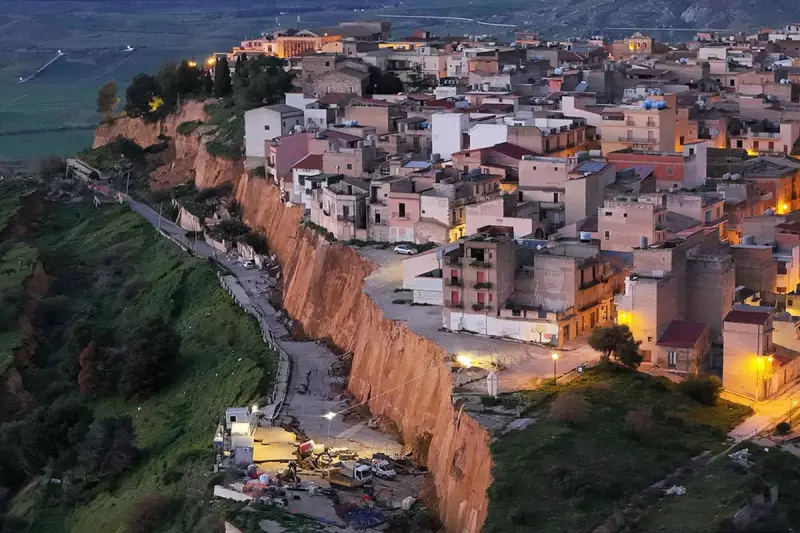
A catastrophic landslide has torn through the edge of a Sicilian town, forcing the evacuation of more than 1,500 residents and prompting Italian Premier Giorgia Meloni to tour the devastated area. The disaster, triggered by days of torrential rainfall from Cyclone Harry, has left homes teetering on the brink of collapse and raised urgent questions about construction on unstable ground.
Emergency Response and Evacuations
Italian authorities have declared a state of emergency for several southern regions, including Niscemi, and allocated an initial 100 million euros for relief efforts. However, regional officials estimate the total damage could reach a staggering 2 billion euros, highlighting the scale of the destruction.
Civil protection crews have established a 150-meter-wide "no go zone" around the landslide area, which spans an alarming 4 kilometers. At the edge of Niscemi, some cars and structures have already plunged 20 meters off the newly formed cliff, while other homes remain precariously balanced on shifting ground.

Geological Instability and Long-Term Displacement
Authorities have warned that residents with homes in the affected area, which faces the coastal city of Gela, will need to find permanent alternative housing. The water-saturated ground is deemed too unstable for safe return.
"The entire hill is collapsing onto the plain of Gela," stated civil protection chief Fabio Ciciliano. "To be honest, there are houses located on the edge of the landslide that obviously can no longer be inhabited, so we need to work with the mayor to find a permanent relocation for these families."
Geologists explain that Niscemi, built on layers of sand and clay, is particularly vulnerable to landslides during heavy rain. The town experienced a major landslide in 1997 that forced 400 evacuations, but experts warn the current event is even more severe.
"Today, the situation is repeating itself with even more significant characteristics: the landslide front extends for about 4 kilometers and directly affects the houses facing the slope," cautioned Giovanna Pappalardo, professor of applied geology at the University of Catania.
Political Fallout and Infrastructure Debates
The disaster has ignited political controversy about why construction was permitted on land with known high landslide risk. Premier Giorgia Meloni took a helicopter tour of the area and met with local officials but did not immediately comment on the situation.
Sicily's center-right regional president, Renato Schifani, acknowledged the legitimacy of such questions while noting his recent tenure in office. He emphasized the priority of providing immediate institutional support to affected residents.
Meanwhile, opposition leader Elly Schlein of the center-left Democratic Party proposed redirecting 1 billion euros from the controversial Sicily-to-mainland bridge project—currently stalled in legal challenges—toward storm-damaged regions instead.
The landslide began on Sunday as Cyclone Harry battered southern Italy, compounding the region's weather-related challenges. As rescue and assessment operations continue, the focus remains on supporting displaced families and addressing the underlying geological risks that made this disaster possible.