Major Winter Storm Set to Unleash Historic Freeze Across Florida and Southeast
A significant and dangerous winter weather system is barrelling towards the Southeastern United States this weekend, placing an estimated 35 million people under extreme weather warnings. This event threatens to bring a second consecutive weekend of snow and ice to millions of Americans, with unusually frigid conditions predicted for states like Florida that are largely unaccustomed to such severe cold snaps.
Bomb Cyclone Formation and Arctic Air Invasion
Forecasters indicate the storm's pressure is expected to intensify rapidly, creating what is informally termed an 'Arctic hurricane' – formally known as a bomb cyclone. This intense low-pressure system is projected to form off the Southeast coast near Georgia and South Carolina early on Saturday. It will then track northwards along the coastline, strengthening quickly into Sunday.
The driving force behind the extreme conditions is a massive plunge of frigid air originating from the Canadian Arctic, which will sweep down into the Southeast. The National Weather Service has illustrated this Arctic air invasion, showing how it will envelop the region.

Unprecedented Cold and Snow Potential for Florida
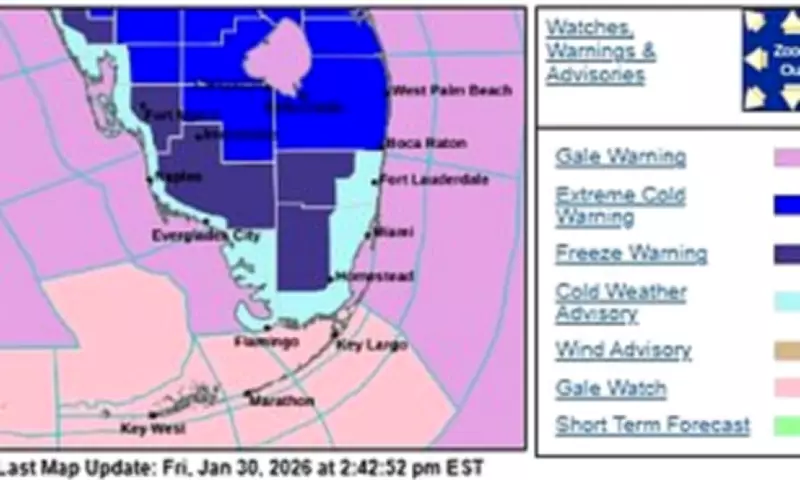
The Sunshine State is bracing for a historic chill. Forecasts suggest the freezing temperatures will reach Florida by Saturday, intensifying through the day and into Sunday morning. Statewide, numerous daily record low temperatures and cold daytime highs are predicted.
In a remarkable turn of events, the cold air raises the possibility of snow along Florida's Gulf Coast or Atlantic beaches. The National Weather Service has set the chance of snow flurries around the Tampa Bay area from late Saturday night into Sunday morning at 10 to 20 percent.
Temperature forecasts are startling for the region:
- Orlando could plummet to 25 degrees Fahrenheit or below.
- Miami may see temperatures in the mid-30s from Sunday into Monday.
- Wind chills in northern and central parts of the state could fall into the single digits.
This level of cold has not been witnessed in Florida since 2010, posing significant challenges for residents who are less likely to possess heavy winter clothing due to the typically warm climate.
Widespread Impacts: From Theme Parks to Citrus Groves
The impending freeze has already triggered major disruptions. In Orlando, both Disney World and Universal Studios have announced temporary closures of their theme parks due to the dangerous conditions. Specifically, Disney's Typhoon Lagoon water park will be closed from today through Monday, and Universal Studios' Volcano Bay water park will also not operate.
Authorities have issued a wind advisory, urging locals to secure loose objects as blustery conditions will make driving high-profile vehicles difficult and create perilous situations for small boats on the water.
The unique freezing conditions extend beyond human infrastructure. Florida's wildlife and agriculture are also at risk. Meteorologist Brandon Buckingham told AccuWeather that 'green iguanas are sensitive to the cold and can become stunned when temperatures fall into the 40s and 30s. When that happens, they may lose their grip and fall from the trees.'
Furthermore, the state's vital citrus industry faces a serious threat. Citrus groves are expected to be impacted, as fruit begins to sustain damage at 28 degrees Fahrenheit, meaning oranges and grapefruit could be frozen on the trees.
Region Still Recovering from Previous Storm
This new system, arriving on the heels of Winter Storm Fern, compounds recovery efforts. As of Saturday, data from PowerOutage.us indicated that more than 150,000 Americans in Louisiana, Mississippi, and Tennessee remained without power following Fern's devastation, which claimed more than 100 lives.
Tennessee Governor Bill Lee emphasised the need for 'a clear timeline for power restoration, transparency on the number of linemen deployed, and a better understanding of when work will be completed' for affected neighbourhoods.

With overnight lows potentially dropping into the teens and 20s across the Southeast, the risk to public health is severe. Authorities warn that prolonged exposure to such extreme cold can cause hypothermia and frostbite within minutes, urging residents to take all necessary precautions as Winter Storm Gianna approaches.