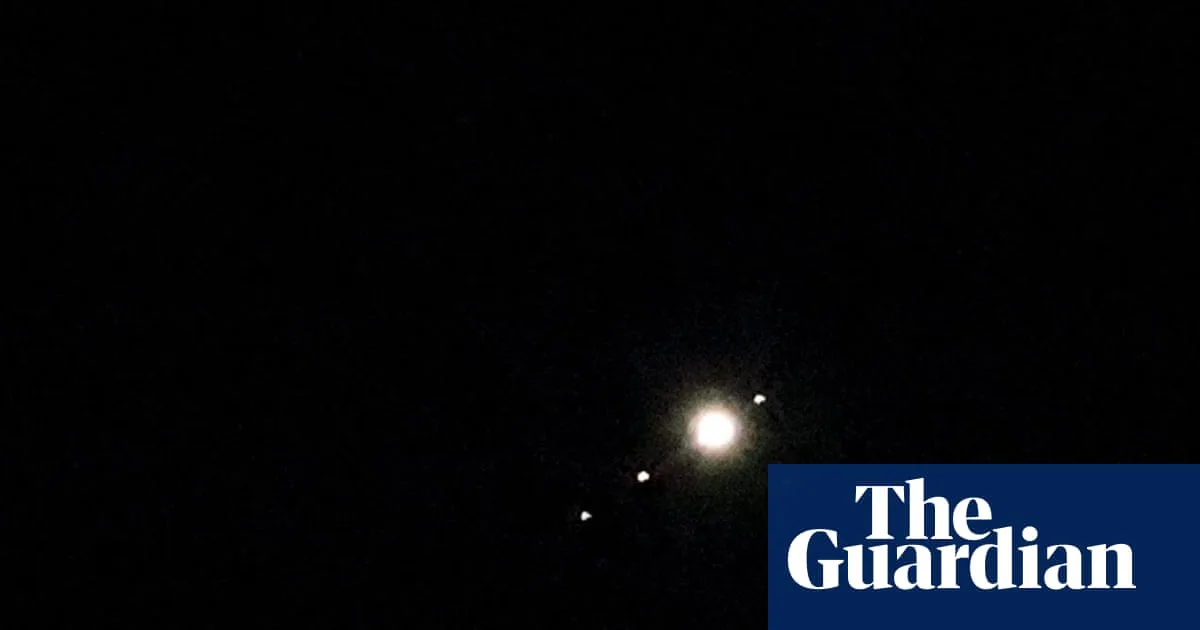
As the wolf moon wanes, skywatchers are in for a treat: Jupiter reaches opposition tonight, making it the biggest and brightest it will be all year. The planet rises in the east each evening, outshone only by Sirius, but tonight Earth sits directly between Jupiter and the sun, offering prime viewing.
Jupiter is a true giant, with a volume equivalent to 1,300 Earths. Its atmosphere is 1,000km thick, beneath which lies a sea of liquid hydrogen 20,000km deep. The planet rotates in under 10 hours, generating immense turbulence and wind speeds of almost 1,450km/h, creating distinct colour bands and storms like the Great Red Spot, which is three times Earth's diameter and visible through binoculars.
Binoculars also reveal Jupiter's four largest moons: Callisto, Ganymede, Europa and Io, first observed by Galileo in 1610. Io, roughly the size of Earth's moon, is the most volcanically active body in the solar system, constantly spewing lava from countless volcanoes.

In the same region of sky, the stars Castor and Pollux, chief stars of Gemini, form a close configuration from our perspective, though they are light years apart. The wolf moon, meanwhile, continues its gravitational dance with Earth, generating spring tides around the world.
For those who have never tried stargazing, tonight offers an ideal opportunity to witness Jupiter at its finest, a reminder of the unseen forces that govern the universe.