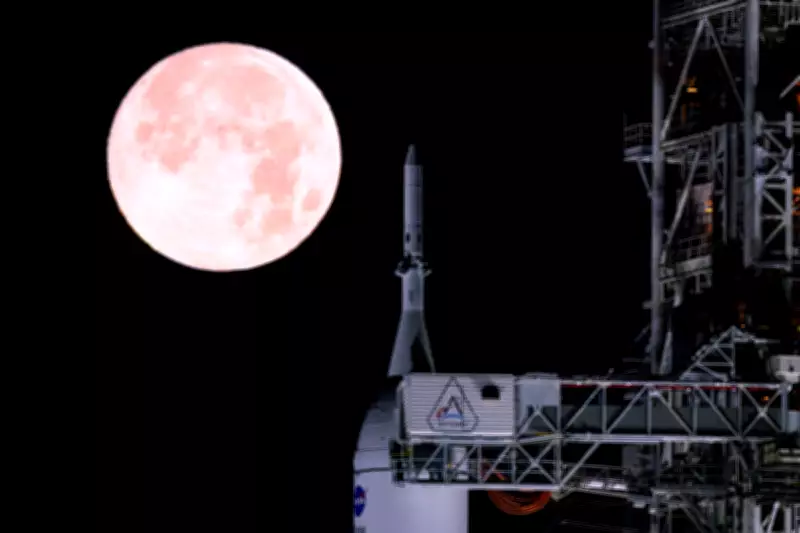
The celestial calendar aligns with a historic space endeavour this week as the full Pink Moon is set to peak within a narrow window of NASA's Artemis II mission launch. This rare astronomical and technological convergence marks a significant moment in human space exploration.
A Synchronised Celestial Event
April's full moon, traditionally known as the Pink Moon due to the seasonal blooming of pink flowers, will reach its peak illumination at 3:12am BST on Thursday. Remarkably, this occurs less than four hours after the scheduled launch of NASA's Artemis II mission from the Kennedy Space Center in Florida at 6:24pm EDT on Wednesday.
The timing means that as the Pink Moon shines brightest, the four-person crew aboard the Orion spacecraft will already be en route to the Moon, embarking on a groundbreaking 10-day journey. This mission represents the first time astronauts will travel to the Moon in over five decades, reviving lunar exploration ambitions.

Historic Trajectory and Visibility
Artemis II will follow a unique trajectory that takes the crew further from Earth than any humans have previously travelled. This is made possible by the Moon's orbital position in early April 2026, which places it slightly farther from Earth compared to the Apollo 13 mission in 1970.
While the Orion spacecraft itself will not be visible to the naked eye during flight—requiring a high-powered telescope for direct observation—NASA will provide a live feed of its position on their official website for public viewing. Meanwhile, the Pink Moon will be visible across much of the United Kingdom, though Met Office forecasts indicate cloud cover may obscure views in southeastern and northeastern England.
The Pink Moon Phenomenon
Despite its evocative name, the Pink Moon will not actually appear pink in the sky. The designation originates from Native American traditions linking the April full moon to the emergence of pink wildflowers. However, atmospheric conditions may occasionally lend a pinkish hue to the Moon when it is low on the horizon.
On Wednesday evening, the Moon will rise in the southeastern sky shortly after sunset, offering an early viewing opportunity before the main event. For those who miss the peak, the Moon will continue to appear full throughout Thursday night, providing another chance to witness this celestial spectacle.
Looking ahead, the next full moon—known as the Flower Moon—is scheduled for 6:23pm BST on Friday, 1 May, continuing the cycle of seasonal lunar names that have guided agricultural and cultural practices for centuries.