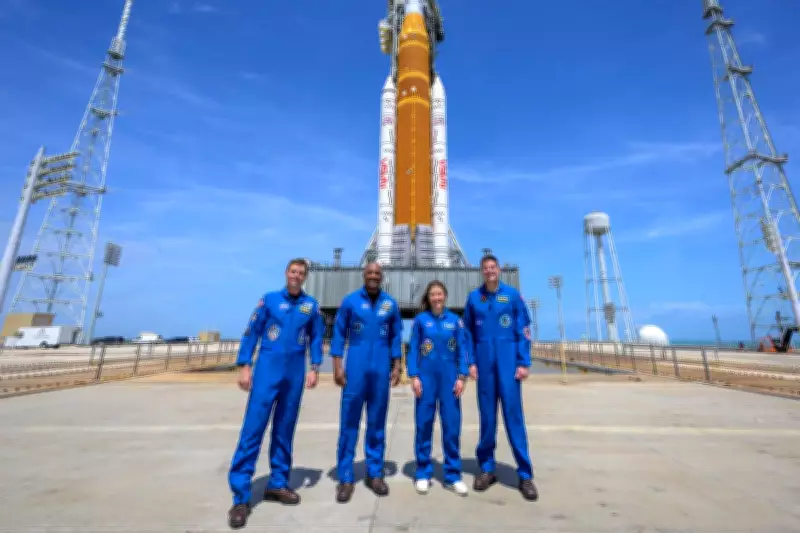
NASA has declared its first crewed mission to the Moon in more than five decades "ready to go," with a historic launch scheduled for Wednesday from Cape Canaveral, Florida. The Artemis II mission marks a monumental return to lunar exploration, aiming to send astronauts deeper into space than any human has ventured before.
A Journey into the Unknown
Four astronauts—three from the United States and one from Canada—are set to blast off aboard a towering 322-foot rocket, provided weather conditions remain favourable and no last-minute technical issues arise. This 10-day test flight will see the crew fly around the Moon and back, covering an immense 685,000-mile journey through the cosmos.
Record-Breaking Lunar Flyby
During the mission, the Orion spacecraft will perform a lunar flyby, traveling approximately 4,700 miles beyond the far side of Earth's natural satellite. This manoeuvre will set a new record for the farthest distance humans have ever traveled from our planet, surpassing all previous spaceflight achievements.

While the astronauts will not land on the lunar surface, Artemis II serves as a critical precursor to future Moon landings planned within the next few years. The mission is part of NASA's broader Artemis programme, which aims to achieve a two-person lunar landing by 2028, reigniting humanity's presence on the Moon after a long hiatus.
International Collaboration and Readiness
The United Kingdom is contributing to this epic celestial voyage, with the Goonhilly Earth Station in Cornwall assisting in tracking the capsule throughout its journey. This international effort underscores the global significance of the mission.
At a recent news conference at Florida's Kennedy Space Centre, NASA associate administrator Amit Kshatriya expressed unwavering confidence in the mission's preparedness. "As we enter the pre-launch phase, the teams are in a strong posture, and the mission remains on track," he stated. Kshatriya emphasised, "The vehicle is ready. The system is ready. The crew is ready."
He reflected on the historical context, noting, "For everybody else, 53 years ago humanity left the Moon and did not return. Now we go back." This sentiment highlights the profound importance of Artemis II in bridging a gap that has lasted since Apollo 17 in 1972, the last time NASA sent astronauts to the Moon.
Countdown and Challenges
Artemis launch director Charlie Blackwell-Thompson confirmed that the countdown to launch commenced at 4:44 PM local time on Monday. She described the moment as "an exciting time for this team and our crew and really our nation and the world," adding that all indications point to excellent conditions as preparations intensify.
NASA chief flight director Emily Nelson detailed the extensive preparations, stating, "Our teams in mission control and our crew members have spent the last two years dedicated to training for this particular mission, developing all of the products associated with this flight, and they are ready to go." Nelson highlighted the immense opportunity, saying, "to finally get the chance to send our crew farther than anyone's gone before."
The mission has faced its share of obstacles, including a two-month postponement due to technical issues such as hydrogen fuel leaks and clogged helium lines. However, these challenges have been addressed, paving the way for a successful launch.
Looking Ahead
Artemis II represents a bold step forward in space exploration, testing critical systems and procedures for future lunar missions. As the world watches, this mission not only honours past achievements but also sets the stage for a new era of discovery, with the ultimate goal of establishing a sustainable human presence on the Moon and beyond.