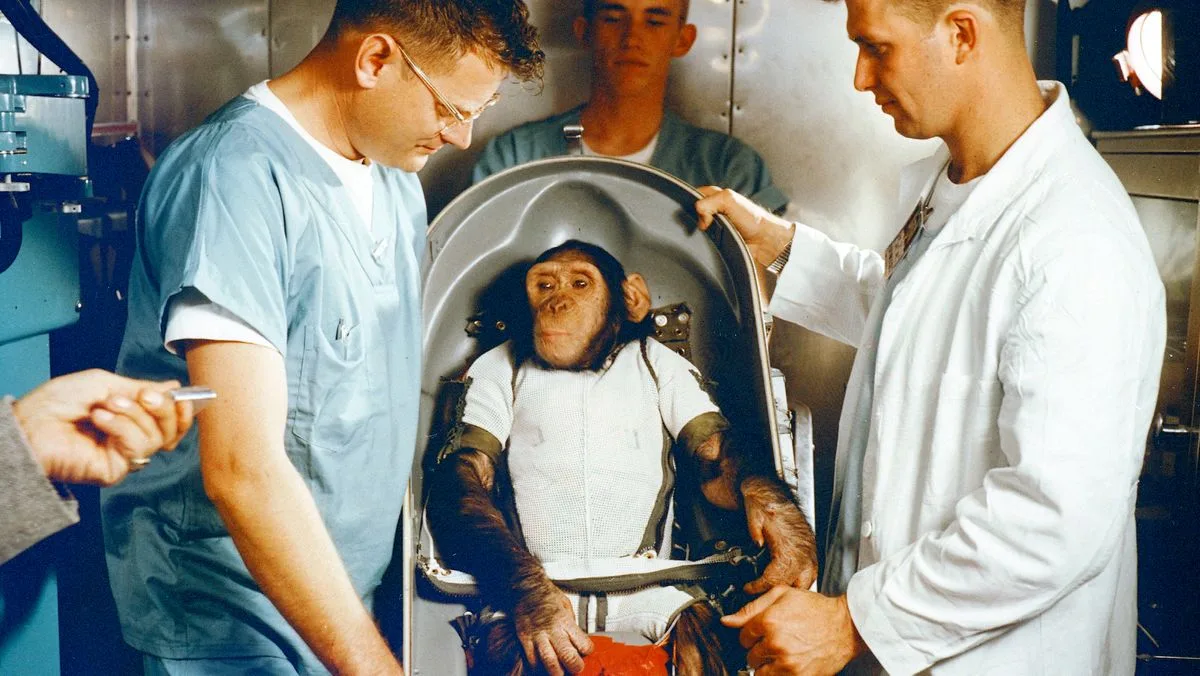
Before humans ventured into the cosmos, a chimpanzee named Ham paved the way for space exploration. On 31 January 1961, Ham became the first great ape launched into space aboard the Mercury-Redstone 2 mission, part of NASA's Project Mercury.
Initially referred to as 'No 65', Ham was renamed after his safe return, with 'Ham' serving as an acronym for the Holloman Aerospace Medical Center where he was trained. Officials reportedly avoided naming him beforehand to mitigate potential public outcry in case the mission failed.
Ham underwent 15 months of intensive training, learning to push a lever within five seconds of a flashing blue light to receive a banana pellet, or face a mild electric shock. His suborbital flight lasted 16 minutes and 39 seconds, reaching a peak altitude of 254 kilometres and travelling over 640 kilometres downrange.

However, a valve malfunction caused higher thrust than planned, subjecting Ham to excessive g-forces—17 g during ascent and 14.7 g during re-entry. This led to equipment errors and two shocks during the flight. Despite the ordeal, Ham was in good physical condition post-mission, with only a minor cut, dehydration, and a 5.37% body weight loss. He was traumatised, panicking when placed back in a capsule or approached by press.
Ham's flight provided critical data that enabled Alan Shepard's suborbital mission on 5 May 1961. His legacy endures as a pioneer, though his story often stirs debate about animal testing in space.