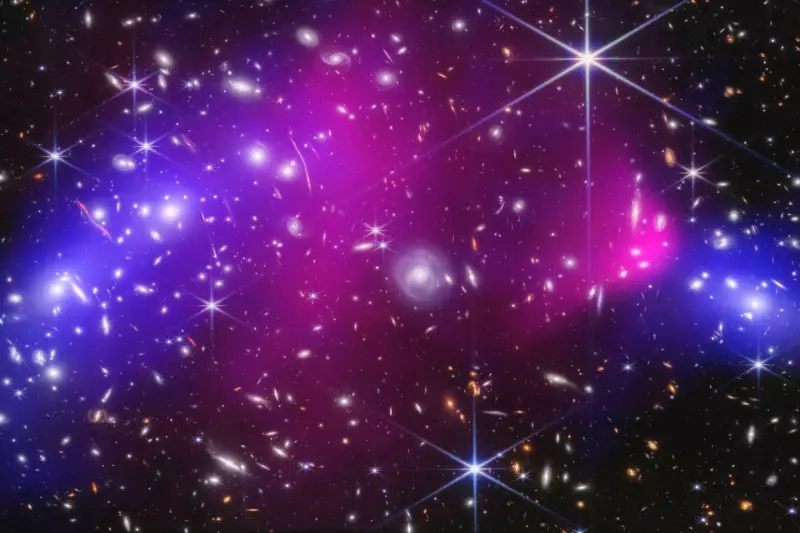
A groundbreaking new map of far-off galaxies, created using data from NASA's James Webb Space Telescope, is providing scientists with their clearest view yet of the mysterious dark matter that permeates our universe. This high-resolution chart represents a significant leap forward in the decades-long quest to understand this invisible substance that constitutes over a quarter of the cosmos.
Mapping the Invisible Universe
Dark matter presents a unique challenge to researchers because it neither absorbs nor emits light, making direct observation impossible. However, scientists can study its profound gravitational effects on the visible universe around it. The new map captures these subtle distortions across vast cosmic distances, revealing how dark matter warps and bends the light from hundreds of thousands of galaxies stretching back 10 billion years.
"Now, we can see everything more clearly," explained study author Diana Scognamiglio from NASA's Jet Propulsion Laboratory. "This map has twice the resolution of previous attempts using the Hubble Space Telescope, allowing us to observe structures across an unprecedented expanse of sky."

The Cosmic Framework Revealed
Published in the journal Nature Astronomy, this detailed chart includes information about newly discovered galaxy clusters and the intricate filaments of dark matter that connect them. These structures collectively form what scientists describe as the fundamental skeleton of the universe. By examining how dark matter has accumulated and distributed itself over billions of years, researchers can trace the cosmic evolution that has led to our current universe.
While ordinary matter—the stars, planets, and people that surround us—comprises just 5% of the universe, dark matter accounts for approximately 27%. The remaining portion consists of the equally enigmatic dark energy. Together, these invisible forces dominate the cosmic landscape, shaping everything from the largest galactic superclusters to the fundamental structure of reality itself.
Humanity's Cosmic Curiosity
Astrophysicist Rutuparna Das from the Harvard-Smithsonian Center for Astrophysics, who was not involved in the new study, emphasized the profound human significance of this research. "Dark matter may not affect your daily lunch choices or bedtime routine, but it constantly passes through your body and has fundamentally shaped the universe we inhabit," she noted.
"Our home is the universe, and we naturally seek to understand its true nature," Das continued. "The story of our cosmic origins cannot be fully told without accounting for dark matter's crucial role in cosmic evolution."
This new galactic map represents more than just technical achievement—it offers humanity a clearer window into the hidden architecture of existence. As scientists piece together these cosmic clues, they move closer to answering fundamental questions about the composition, history, and ultimate fate of our universe.