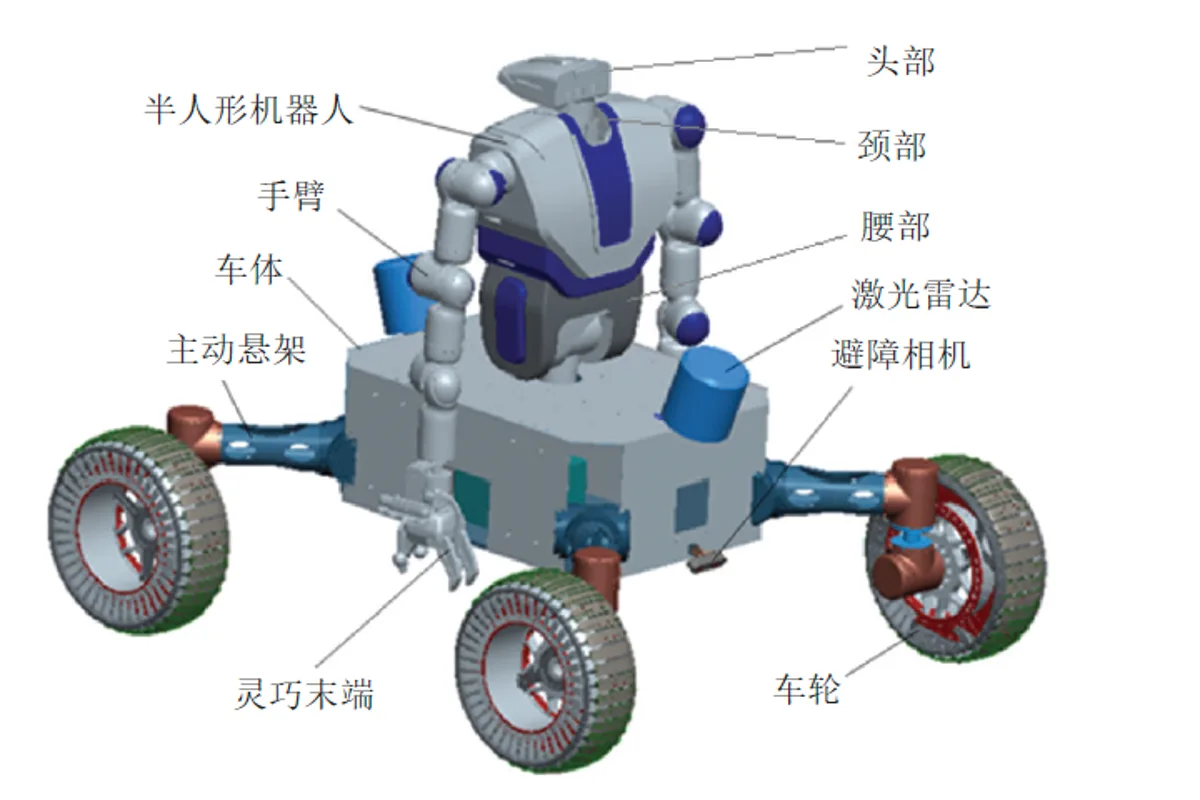
China has unveiled a humanoid robot on wheels that it envisions as key to building a research station on the Moon by 2035. Since the lunar environment is dangerous for humans, initial missions will rely on autonomous machines to ferry equipment and construction robots that can use lunar materials to build structures.
In a new study published in the Journal of Deep Space Exploration, scientists from the Beijing Institute of Spacecraft System Engineering describe a wheeled robot with a humanoid upper body designed for manipulating tools, assembling structures, and carrying out scientific experiments. The robot's waist can rotate 180 degrees in either direction and bend forward up to 90 degrees, while its hand has four degrees of freedom for precise manipulation.
The researchers opted for a wheeled design instead of a fully walking humanoid because walking robots are mechanically complex, risk falling over, and consume more energy. Wheeled rovers have been successfully used in China's Yutu lunar rover and Zhurong Mars rover, making them more practical for long-term lunar work.

The robot features stereo cameras similar to human eyes for calculating depth, distance, and shape of objects, and a neck that moves up, down, left, and right for a wide viewing angle. Its arms can rotate in seven different ways, including at the shoulder, elbow, and wrist, enabling precise mechanical tasks. An advanced suspension system allows it to maintain balance on uneven terrain with craters and loose lunar soil.
Researchers hope the prototype will serve as a reference for developing equipment needed to build lunar bases, assembling infrastructure, transporting materials, collecting samples, and maintaining equipment before astronauts arrive.