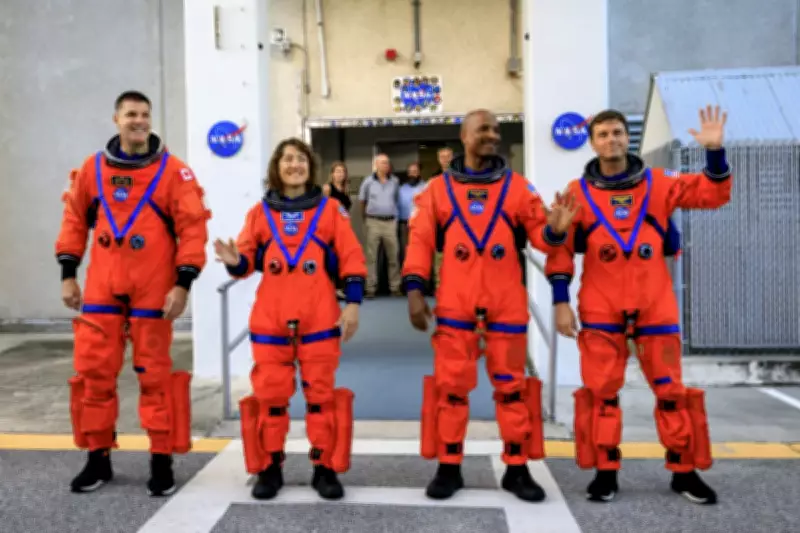
Nasa has confirmed the final preparations for the Artemis II mission, a groundbreaking crewed journey to the Moon, with launch scheduled for Wednesday, 1 April 2026, from the Kennedy Space Centre in Florida. This historic endeavour marks the first human mission to the Moon since the Apollo era, aiming to pave the way for future lunar landings.
Crew Composition and Historic Firsts
The mission will be piloted by a diverse four-person crew, comprising Nasa astronauts Reid Wiseman, Victor Glover, and Christina Koch, alongside Canadian Space Agency astronaut Jeremy Hansen. This selection represents several historic milestones, including the inclusion of the first woman and the first person of colour on a lunar mission, as well as the first Canadian to venture beyond Earth's orbit.
Mission Details and Objectives
Artemis II involves a 10-day journey around the Moon, during which the Orion spacecraft will perform a high-altitude flyby, reaching approximately 400,000 kilometres from Earth. This distance surpasses any previous human travel, setting a new record for the furthest humans have ever ventured from our planet.

The mission is designed to test critical systems and establish foundational protocols for sustained lunar exploration. Key objectives include evaluating the spacecraft's performance, crew safety measures, and communication capabilities in deep space environments.
Technological Advancements and Records
Upon re-entry into Earth's atmosphere, the Orion spacecraft is anticipated to achieve a record-breaking speed, demonstrating advanced engineering and heat shield technologies. This aspect of the mission will provide valuable data for future missions, including the planned crewed lunar landing in 2028 as part of the Artemis IV mission.
The success of Artemis II is crucial for Nasa's broader Artemis program, which aims to return humans to the Moon and eventually facilitate missions to Mars. By conducting this flyby, scientists and engineers will gather essential insights into long-duration space travel and lunar orbital dynamics.
Global Collaboration and Future Prospects
The inclusion of a Canadian astronaut underscores the international collaboration involved in the Artemis program, with partnerships extending to other space agencies worldwide. This mission not only advances scientific knowledge but also fosters global cooperation in space exploration.
Looking ahead, the data collected from Artemis II will inform subsequent missions, including Artemis III, which is slated to land astronauts on the lunar surface. The ongoing efforts highlight a renewed commitment to exploring the cosmos and expanding human presence beyond Earth.