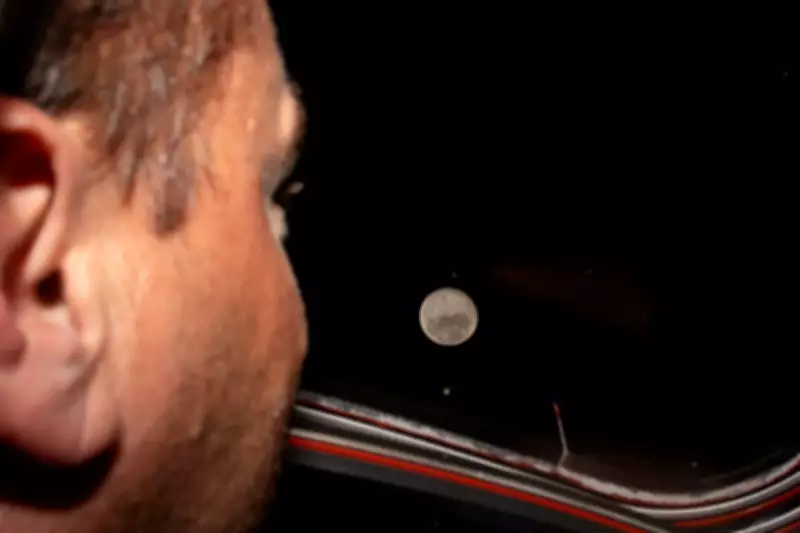
Artemis II Astronauts Commence Return Voyage Following Historic Lunar Pass
The crew of NASA's Artemis II mission have embarked on their journey back to Earth after achieving a monumental milestone during their lunar flyby. This marks the first manned mission to the Moon in more than five decades, rekindling humanity's deep-space exploration ambitions.
Record-Breaking Distance and Lunar Encounter
The four astronauts aboard the Orion spacecraft reached an unprecedented distance of 252,756 miles (406,771 kilometres) from Earth. This surpasses the previous record set by Apollo 13 in April 1970, which stood at 248,655 miles (400,171 kilometres). The record was established during a meticulously planned seven-hour lunar flyby.
During this critical phase, the crew experienced a 40-minute communication blackout as they traversed the far side of the Moon, completely out of contact with mission control. It was at this closest approach that they came within 4,067 miles (6,545 kilometres) of the lunar surface.

Crew Experiences and Emotional Moments
Canadian astronaut Jeremy Hansen expressed awe at the vistas, stating, "It is blowing my mind what you can see with the naked eye from the Moon right now. It is just unbelievable." The astronauts also witnessed a total solar eclipse from their unique vantage point behind the Moon early on Tuesday.
In a poignant tribute, the crew requested NASA to name two newly observed lunar craters. One, named Integrity, honours their Orion spacecraft capsule, while the other, Carroll, commemorates the late wife of Commander Reid Wiseman, who passed away from cancer in 2020.
Historical Echoes and Future Aspirations
Artemis II is utilising the same gravitational slingshot manoeuvre famously employed by Apollo 13 after its oxygen tank explosion crisis. This "free return" trajectory, leveraging the Moon's gravity, will bring the crew home over four days, culminating in a Pacific Ocean splashdown on Friday.
NASA Administrator Jared Isaacman reflected on X, emphasising the mission's symbolic importance: "This mission will be remembered as the moment people started to believe that America can once again do the near-impossible and change the world." He added that the mission isn't complete until the crew is safely under parachutes in the Pacific.
Political Recognition and International Collaboration
US President Donald Trump hailed the astronauts as "modern-day pioneers" during a post-flyby call, linking further lunar exploration to eventual Mars missions. The mission has also seen international cooperation, with the Goonhilly Earth Station in Cornwall, UK, assisting in tracking the spacecraft's flight.
Legacy and Technical Challenges
While Artemis II will not land on the lunar surface, it critically paves the way for future crewed landings and establishes foundational protocols for eventual Mars expeditions. The mission overcame significant hurdles, including a two-month launch delay due to hydrogen fuel leaks and clogged helium lines.
The last NASA crewed Moon mission was Apollo 17 in 1972. The agency now aims to return astronauts to the lunar surface by 2028, ahead of China's projected timeline around 2030. During the flyby, the crew captured detailed photographs of the Moon's seldom-seen far side, providing valuable scientific data.
As the Orion spacecraft continues its homeward journey, the Artemis II mission stands as a testament to human ingenuity and a bold step toward renewed interplanetary exploration.