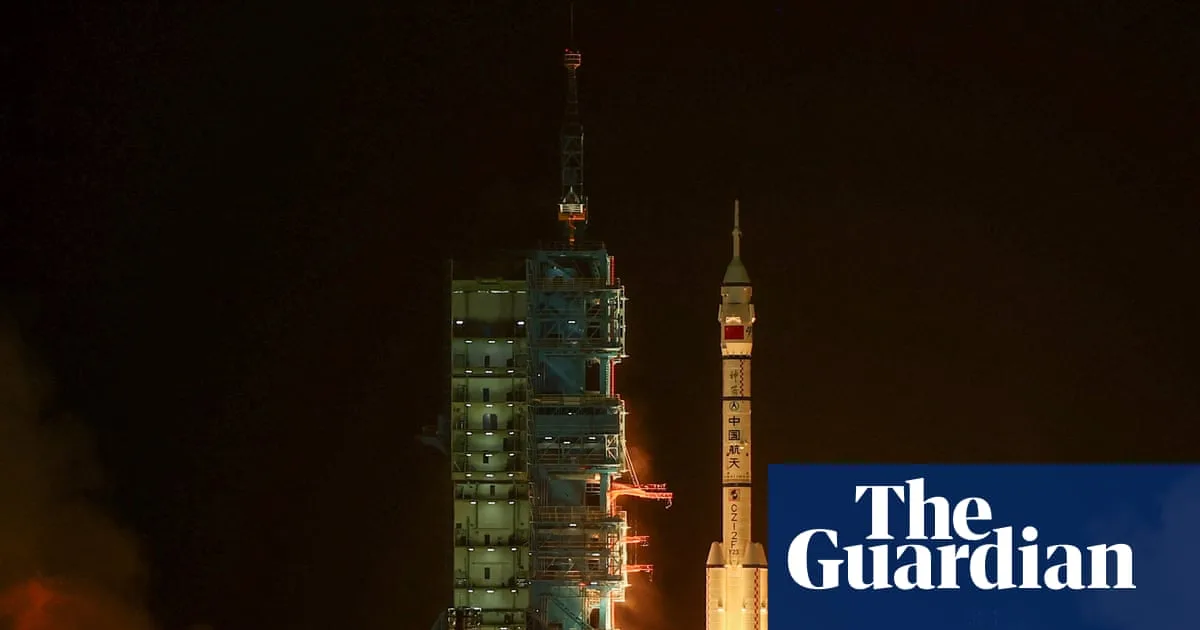
China has launched its Shenzhou-23 mission, sending three astronauts to the Tiangong space station. The Long March 2-F rocket lifted off from the Jiuquan launch centre in north-western China on Sunday, marking a crucial step in Beijing's ambition to land humans on the moon by 2030.
The mission includes the first astronaut from Hong Kong, Lai Ka-ying, 43, a former police officer. The other crew members are space engineer Zhu Yangzhu, 39, and former air force pilot Zhang Zhiyuan, also 39, both making their first spaceflight.
A key objective of the mission is to have one astronaut spend a full year in orbit for the first time, studying the effects of long-term microgravity on the human body. This experiment is vital for China's preparations for future lunar and Martian missions. The astronaut selected for the year-long stay will be named later.

The crew will conduct scientific projects in life sciences, materials science, fluid physics, and medicine. Richard de Grijs, an astrophysicist at Macquarie University, noted challenges such as bone density loss, muscle wasting, radiation exposure, and psychological fatigue, as well as the need for reliable life-support systems.
Shenzhou-23 is part of China's broader space ambitions, including a planned orbital test of the Mengzhou spacecraft in 2026, which will replace the Shenzhou line and carry astronauts to the moon. China also aims to build the International Lunar Research Station by 2035 and welcome its first foreign astronaut from Pakistan to Tiangong by the end of this year.