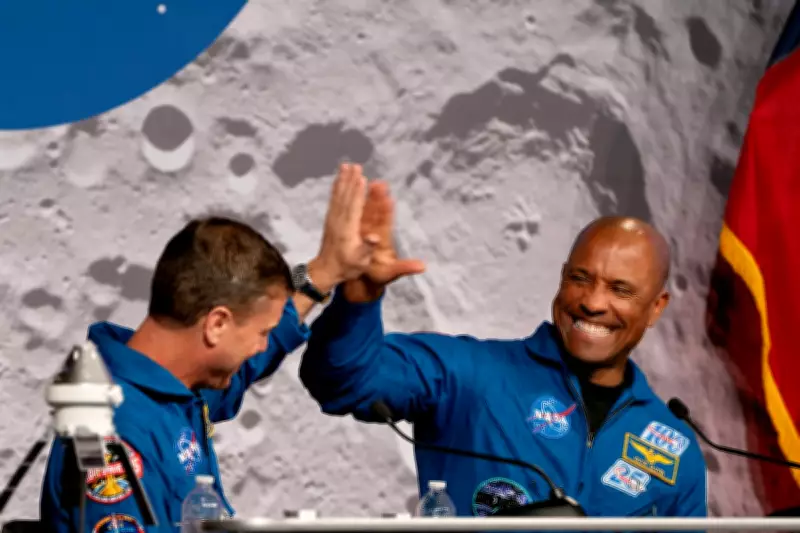
Artemis II Astronauts Hail 'Glorious' Return, Bolster NASA's Moon Landing Ambitions
The Artemis II astronauts, who recently completed a historic lunar flyby, have offered high praise for their spacecraft's performance during reentry, particularly highlighting its heat shield. In their first news conference since returning to Earth, the three American and one Canadian crew members affirmed that their mission significantly bolsters NASA's ambitions for a crewed moon landing within two years and the eventual establishment of a sustainable lunar base.
Historic Mission Details and Records
Speaking from NASA's Johnson Space Center in Houston, Commander Reid Wiseman, pilot Victor Glover, mission specialist Christina Koch, and Canada's Jeremy Hansen launched from Florida on April 1. This mission marked NASA's first lunar crew in over half a century and its most diverse to date. The quartet became the most distant human travelers ever, surpassing Apollo 13's record, as they circumnavigated the lunar far side.
From this unique vantage point, they observed lunar features never before seen by the human eye, with the added spectacle of a total lunar eclipse enhancing their celestial journey. Their Orion capsule, which they named Integrity, parachuted into the Pacific last Friday to conclude the nearly 10-day voyage. Artemis II's Houston homecoming the next day coincidentally aligned with the 56th anniversary of the Apollo 13 launch.

Heat Shield Performance and Analysis
Wiseman reported that he and Glover observed only minimal char loss on the heat shield as Integrity plunged through the fastest, hottest part of reentry. Once aboard the recovery ship, they carefully examined the capsule's underside, leaning over to inspect for any signs of damage. They noted a slight loss of charred material on the shoulder where the heat shield meets the capsule structure.
"For four humans just looking at the heat shield, it looked wonderful to us. It looked great, and that ride in was really amazing," Wiseman declared during the press conference. He cautioned that detailed analyses still need to be conducted, stating, "We are going to fine-tooth comb every single, not even every molecule, probably every atom on this heat shield."
The heat shield on the first Artemis test flight in 2022 returned so pockmarked and gouged that it delayed Artemis II by months if not years. Rather than redesigning it completely, NASA opted to modify the capsule's entry path to minimize heating effects. Future capsules will feature an entirely new design to address these thermal challenges more effectively.
Reentry Experience and Medical Evaluations
As the parachutes deployed just before splashdown, Glover described feeling like he was in freefall, comparing the sensation to diving backward off a skyscraper. "That's what it felt like for five seconds," he explained, adding that when the ride smoothed out: "It was glorious."
Since their return, the four astronauts have undergone extensive medical testing to assess their balance, vision, muscle strength, coordination, and overall health. They even donned spacewalking suits for exercises under conditions simulating the moon's one-sixth gravity of Earth. These tests aim to determine how much endurance and dexterity future moonwalkers might possess upon lunar touchdown.
Future Artemis Missions and Lunar Ambitions
NASA is already progressing with Artemis III, the next critical step in its grand moon base-building plans. The launch platform has returned to Kennedy Space Center's Vehicle Assembly Building, where preparations will commence for next year's Artemis launch. Artemis III will remain in Earth orbit as astronauts practice docking their Orion capsule with one or two lunar landers currently under development by Elon Musk's SpaceX and Jeff Bezos' Blue Origin.
Artemis IV will follow in 2028 under NASA's latest schedule, with two astronauts scheduled to land near the moon's south pole. NASA emphasizes that this time, the agency aims for sustainable lunar presence rather than brief visits. During the Apollo era, twelve astronauts explored the lunar surface between 1969 and 1972, but their stays were intentionally limited in duration.

Crew Reflections and Future Challenges
Koch expressed that since returning, she and her crewmates are "feeling even more excited and just ready to take that on as an agency." She added emphatically, "We made it happen."
Hansen noted that everyone involved will need to accept additional risk to achieve these ambitious goals and trust that any future problems can be resolved in real time. "We're not going to be able to pound everything flat before we go. We're going to have to trust each other," he stated. While everything proceeded smoothly for Artemis II, "it was also very clear to us that it can get pretty bumpy," he acknowledged, warning that future crews must "understand it can get real bumpy real fast."