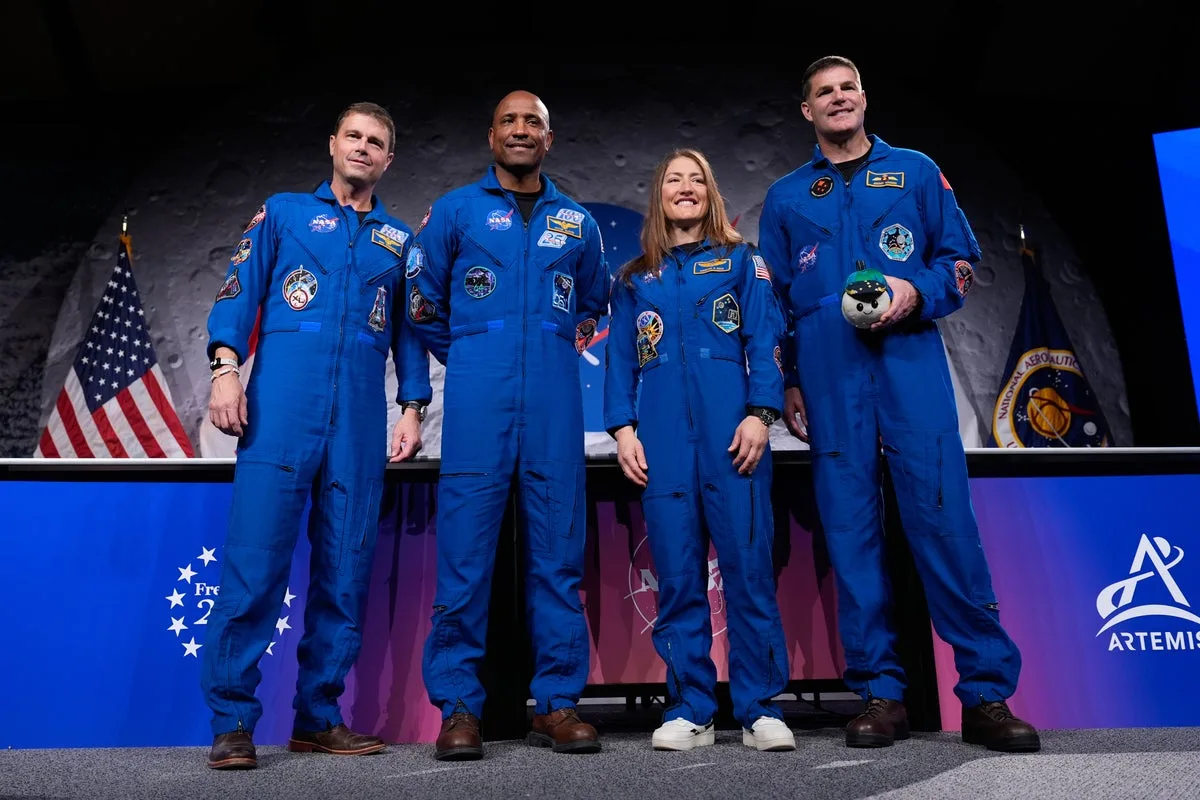
Artemis II Astronauts Applaud Moonship's Performance, Spotlight Heat Shield Success
The Artemis II astronauts, hailed for igniting a lunar renaissance, have awarded top marks to their moonship for its stellar performance during reentry, with particular praise directed at the heat shield's effectiveness.
In their inaugural news conference since returning to Earth, the three American and one Canadian crew members emphasised that their lunar flyby has significantly bolstered NASA's position for a crewed moon landing slated within two years and the eventual establishment of a moon base. The briefing took place at NASA's Johnson Space Center in Houston, which serves as their operational home base.
Historic Mission and Record-Breaking Journey
Commander Reid Wiseman, pilot Victor Glover, Christina Koch, and Canada's Jeremy Hansen embarked on their lunar voyage from Florida on April 1, marking NASA's first crewed lunar mission in over half a century and notably the most diverse crew to date.
During their expedition, they shattered the distance record previously held by Apollo 13, venturing further than any humans before as they navigated around the lunar far side. This trajectory provided unprecedented views of lunar features never before observed by human eyes, enhanced by the awe-inspiring spectacle of a total lunar eclipse.
The Orion capsule, christened Integrity by the crew, concluded its nearly ten-day journey with a parachute-assisted splashdown in the Pacific last Friday. This homecoming coincided poignantly with the 56th anniversary of the Apollo 13 launch, underscoring the historical continuity of lunar exploration.
Heat Shield Assessment and Reentry Experience
Wiseman reported that during the intense reentry phase, he and Glover observed only minimal char loss on the heat shield. Upon recovery, they inspected the capsule's underside, noting slight material degradation at the shoulder where the shield interfaces with the capsule.
"For four humans just looking at the heat shield, it looked wonderful to us. It looked great, and that ride in was really amazing," Wiseman remarked, while cautioning that comprehensive analyses are still pending. He added, "We are going to fine-tooth comb every single, not even every molecule, probably every atom on this heat shield."
This scrutiny follows issues with the heat shield from the uncrewed Artemis I test flight in 2022, which exhibited significant pockmarking and gouging, leading to delays. In response, NASA adjusted the capsule's entry trajectory to reduce heating, with future designs incorporating enhancements.
Glover described the parachute release before splashdown as akin to a freefall sensation, comparing it to diving backward off a skyscraper for five seconds, before the ride smoothed into what he called "glorious."
Post-Mission Evaluations and Future Lunar Plans
Since their return, the astronauts have undergone extensive medical testing to assess balance, vision, muscle strength, coordination, and overall health. They even conducted exercises in spacewalking suits under simulated lunar gravity conditions to evaluate endurance and dexterity for future moonwalkers.
NASA is actively advancing Artemis III, the next phase in its moon base initiative. The launch platform has returned to Kennedy Space Center's Vehicle Assembly Building for preparations ahead of next year's mission.
Artemis III, which awaits crew assignment, will involve orbital docking practices with lunar landers developed by SpaceX and Blue Origin. Artemis IV is scheduled for 2028, targeting a landing near the moon's south pole, as NASA shifts focus toward sustainable lunar presence, contrasting with the brief Apollo visits of the past.
Crew Reflections and Risk Management
Koch expressed heightened excitement and readiness for upcoming challenges, stating, "We made it happen." Hansen highlighted the necessity of accepting extra risks and fostering trust to overcome future obstacles in real time, noting, "We're not going to be able to pound everything flat before we go. We're going to have to trust each other."
He also cautioned that while their mission proceeded smoothly, future crews must be prepared for potential turbulence, emphasising, "it can get pretty bumpy" and "real bumpy real fast."
The Associated Press Health and Science Department acknowledges support from the Howard Hughes Medical Institute's Department of Science Education and the Robert Wood Johnson Foundation, with the AP maintaining full responsibility for all content.