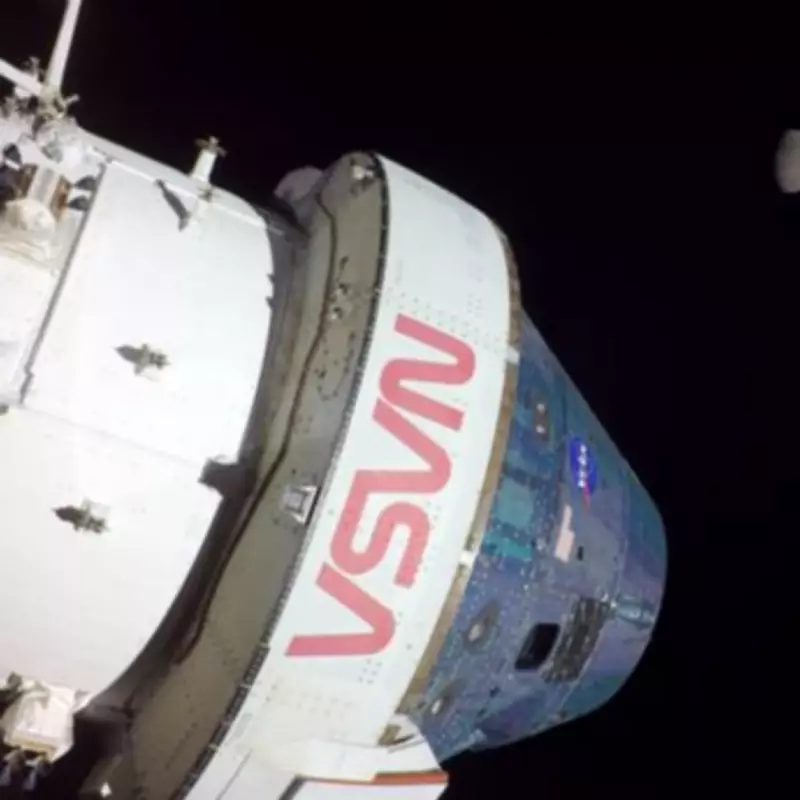
Artemis 2 Launch Confronts Critical Heat Shield Safety Issues
NASA's highly anticipated Artemis 2 mission, scheduled to launch as early as April 1, is facing renewed safety concerns as scientists highlight potential risks with the Orion capsule's heat shield. The mission, which aims to send four astronauts on a 10-day journey around the Moon, could encounter dangerous re-entry problems due to unexpected damage observed during previous tests.
Orion Capsule's Heat Shield Under Scrutiny
The crew, consisting of Reid Wiseman, Victor Glover, Christina Koch, and Jeremy Hansen, will travel in a compact Orion capsule measuring 11 feet by 16.5 feet, launched atop NASA's Space Launch System rocket. However, experts have raised alarms about the heat shield's integrity, which protects astronauts from searing temperatures during re-entry through Earth's atmosphere. Ed Macaulay, a lecturer in Physics and Data Science at Queen Mary University of London, emphasized that during the final phase, there is no backup or escape option, leaving the astronauts reliant on a thin layer of resin-coated silica to shield against heat approaching half the Sun's surface temperature.
During the unmanned Artemis I test in 2022, the heat shield suffered significant and unexpected damage, with large chunks of material, known as Avcoat, breaking off unevenly. This uneven ablation complicates thermal load predictions and increases the risk of exposing the capsule to dangerously high heating levels. Dr. Macaulay explained that instead of burning away uniformly, gases built up in pockets due to insufficient permeability, causing entire sections to detach.

NASA's Response and Mission Adjustments
Despite these concerns, NASA has opted to proceed with the same heat shield for Artemis II, implementing key mission changes to mitigate risks. The agency plans to use a more direct re-entry model, avoiding the 'skipping' technique that involves bouncing on water, which should reduce exposure time to extreme temperatures and prevent gas buildup. However, this adjustment will subject the crew to increased deceleration forces during re-entry.
Dr. Danny Olivas, a former NASA astronaut who investigated the Artemis I incident, stated that this heat shield is not what NASA would ideally provide for astronauts, underscoring the calculated risks involved. Human spaceflight, while perilous, offers unique perspectives on our cosmic place, and the Artemis II mission aims to make its crew the first in over 50 years to view Earth entirely from space.
The success of this mission hinges on the meticulous work of thousands of scientists and engineers, with the astronauts carrying the hopes of a new generation of explorers. As launch approaches, the focus remains on ensuring a safe return, balancing innovation with safety in the quest to expand human presence beyond Earth.