Artemis 2 Launch: Crew's Life Inside 'Shed-Sized' Capsule from Tortillas to Toilet Rule
The Artemis 2 launch will see four astronauts embark on a ten-day mission that will take them further into space than ever before, as part of NASA's broader plan to send humans to Mars. Tonight, these astronauts will blast off on a journey that promises to redefine human space travel, but life onboard will be far from glamorous.
As NASA prepares to launch its first crewed lunar mission in over 50 years, the reality inside the spacecraft is closer to survival than science fiction. The Artemis II mission will loop around the far side of the Moon before returning to Earth, but while the distance is record-breaking, the conditions inside the capsule are cramped, basic, and often uncomfortable.
'Garden Shed' Living Conditions
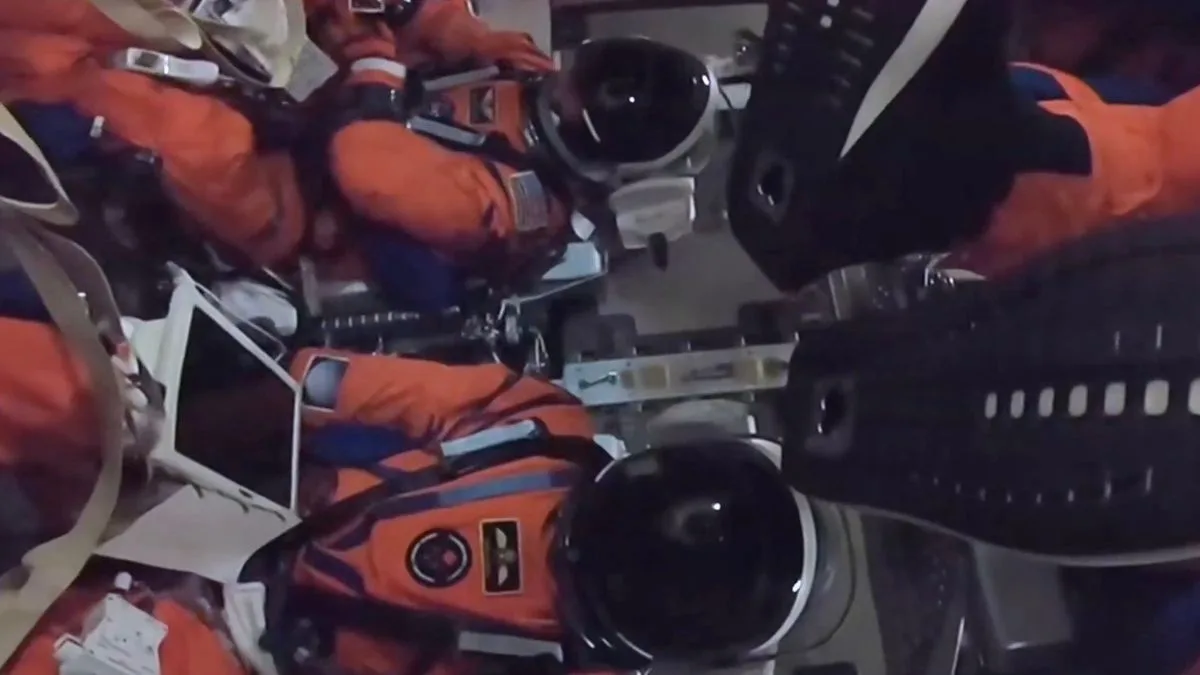
NASA's massive Artemis 2 rocket stands 98 meters tall and weighs approximately 2.6 million kilograms when fuelled. Perched atop the Space Launch System rocket is the Orion capsule, roughly the size of a garden shed, which will be home to all four crew members for the duration of the mission. Orion is loosely based on the Apollo modules but features an increased diameter, updated thermal protection, and modern upgrades.
The module is just big enough to fit four seats, which the astronauts will use during launch. Once in orbit, they will pack these away to create more room. There is no privacy, no luxury sleeping quarters, and certainly no fancy meals. Instead, astronauts will strap themselves into tight spaces, sleep in shifts, and float in microgravity.
Every inch of space is designed for efficiency, not comfort. To prevent waking up oxygen-deprived, astronauts need good airflow around them as they sleep, as poor ventilation can lead to a buildup of carbon dioxide from their breath. In weightlessness, the crew can utilize control panels on the "ceiling" and equipment in lockers under the floor. A built-in flywheel exercise machine provides daily cardiovascular workouts.
Food and Nutrition in Space
There is a water dispenser for drinking and rehydrating food, with each astronaut selecting their favourite meals for the trip. The menu includes five types of hot sauces and over 10 beverages, such as lemonade, apple cider, and vanilla, chocolate, and strawberry breakfast drinks. Enough coffee is onboard for approximately 43 cups, or just over one cup per crew member daily.
NASA stated, "With no resupply, refrigeration, or late-load capability, all meals must be carefully selected to remain safe, shelf-stable, and easy to prepare and consume in NASA's Orion spacecraft." Food selections balance calorie needs, hydration, and nutrient intake while accommodating individual preferences.
Although the ship lacks refrigeration, some non-perishable vegetables like butternut squash and blueberries are included, along with a mango salad. The crew will also enjoy barbecued beef brisket, dehydrated for storage, 58 tortillas, spicy mustard, strawberry jam, and almond butter.
Toilet Systems and Hygiene
Perhaps the least discussed aspect of space life is how astronauts manage bodily functions in zero gravity. Unlike the Apollo crew 50 years ago, there is a toilet tucked under the floor, a new luxury designed for use in weightlessness, though it offers little privacy.
For shorter missions like this, astronauts rely on specially designed waste systems, including absorbent garments—essentially high-tech adult nappies—particularly during launch and re-entry when movement is restricted. These garments are a practical solution for managing functions during unpredictable situations or delays, as astronauts cannot simply unbuckle to use the toilet at all times.
Meet the Historic Crew
Leading the mission is Reid Wiseman, aged 50, joined by Victor Glover, Christina Koch, and Jeremy Hansen. The mission marks several milestones, including the first woman and first Black astronaut on a lunar mission, as well as the oldest person to make the journey.
Before launch, the crew underwent two weeks of isolation to prevent illnesses in the tightly sealed spacecraft. During the mission, they will travel up to 250,000 miles from Earth, surpassing the record set by Apollo 13 in 1970. At that distance, the Moon will appear no larger than a basketball held at arm's length. Using a gravity-assisted "slingshot" manoeuvre, the spacecraft will loop around the Moon to conserve fuel.
On re-entry, the Orion capsule will hit speeds of over 25,000 mph, making the crew the fastest-travelling humans in history.
Mission Plan and Future Goals
While Artemis II will not land on the Moon, it is a critical step in NASA's larger plan to establish a permanent lunar base by the end of the decade, with the ultimate aim of sending humans to Mars. Future missions, such as Artemis III and Artemis IV, will build on this groundwork, aiming to return astronauts to the Moon for the first time since Apollo 17 in 1972.
The focus this time is not just exploration but long-term survival, particularly at the Moon's south pole, where scientists believe ice deposits could provide water, oxygen, and fuel.
The crew is scheduled to lift off at about 10:24 PM UK time on Wednesday night, weather permitting. NASA's massive Artemis 2 rocket stands 98 meters tall and weighs approximately 2.6 million kilograms when fuelled.