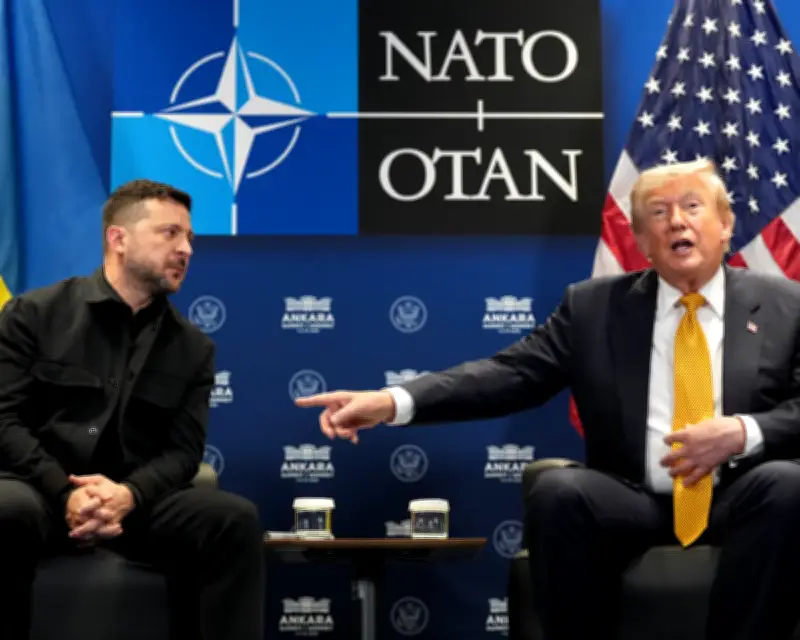
Donald Trump offered Volodymyr Zelenskyy a vague commitment to explore licensing the manufacture of Patriot missiles in Ukraine, but no concrete agreement was reached during their meeting in Washington on Wednesday, according to sources familiar with the discussion.
Meeting Details and Context
The meeting, which lasted approximately 45 minutes in the Oval Office, was the first face-to-face encounter between the two leaders since Trump returned to the White House. Zelenskyy has been pressing for permission to produce the advanced air defence systems domestically as Ukraine seeks to bolster its military-industrial capacity amid the ongoing war with Russia.
According to a senior Ukrainian official, Trump said he would "look into" the request but made no firm promises. The official described the president's response as "non-committal," adding that no timeline or specific terms were discussed. The US has previously resisted transferring sensitive missile technology, citing concerns about proliferation and intellectual property.

Strategic Importance of Patriot Systems
Patriot systems, manufactured by Raytheon, are among the most sophisticated air defence weapons in the US arsenal. Ukraine currently operates several Patriot batteries supplied by the US, Germany, and the Netherlands, but has sought to establish its own production line to reduce dependency on foreign supplies and accelerate delivery timelines.
Zelenskyy has argued that domestic manufacturing would allow Ukraine to produce missiles at a fraction of the cost and time required for foreign procurement. A Ukrainian defence ministry official noted that the country already has the technical expertise to assemble complex weaponry, citing its successful production of Soviet-era systems and recent co-production deals with Turkish drone manufacturers.
US Concerns and Conditions
However, US officials have expressed reservations about transferring the technology. A State Department spokesperson said that any decision would require rigorous safeguards to prevent the technology from falling into the wrong hands. "We take our non-proliferation obligations seriously," the spokesperson said. "Any discussion of co-production would need to address these concerns comprehensively."
Trump's offer, while vague, represents a shift in tone from the Biden administration, which had been more cautious on technology transfers. The Trump administration has signalled a willingness to expand defence industrial cooperation with allies, but has also insisted on strict conditions, including licensing fees and oversight mechanisms.
Impact on Ukraine's Defence Strategy
For Ukraine, the ability to manufacture Patriot missiles would be a game-changer, allowing it to sustain air defence operations without relying solely on foreign donations. Currently, Ukraine faces a critical shortage of interceptor missiles, with some reports suggesting it has only enough for a few more months of intense fighting.
"This is about survival," said Oleksiy Melnyk, a defence analyst at the Kyiv-based Razumkov Centre. "If we can produce our own interceptors, we can defend our cities and infrastructure more effectively. But we need a clear commitment, not just a vague promise."
Zelenskyy, in a brief statement after the meeting, said he was "grateful for the president's willingness to consider our request" but acknowledged that "much work remains to be done." He stressed that Ukraine would continue to push for concrete outcomes, including a formal agreement on technology transfer.
Next Steps and Broader Implications
Both sides agreed to task their respective defence teams with studying the feasibility of a licensing arrangement. A joint working group is expected to meet in the coming weeks to discuss technical and legal aspects. However, no deadline has been set for a decision.
The outcome of these talks could have significant implications for the global defence industry, potentially setting a precedent for other countries seeking to produce advanced US weapons locally. It also underscores the evolving nature of US-Ukraine defence cooperation, which has deepened since Russia's full-scale invasion in 2022.

As of 2023, the US had provided Ukraine with over $40 billion in military aid, including Patriot systems, but has remained cautious about transferring sensitive production capabilities. Trump's vague promise marks a potential opening, but the path to a concrete deal remains uncertain.