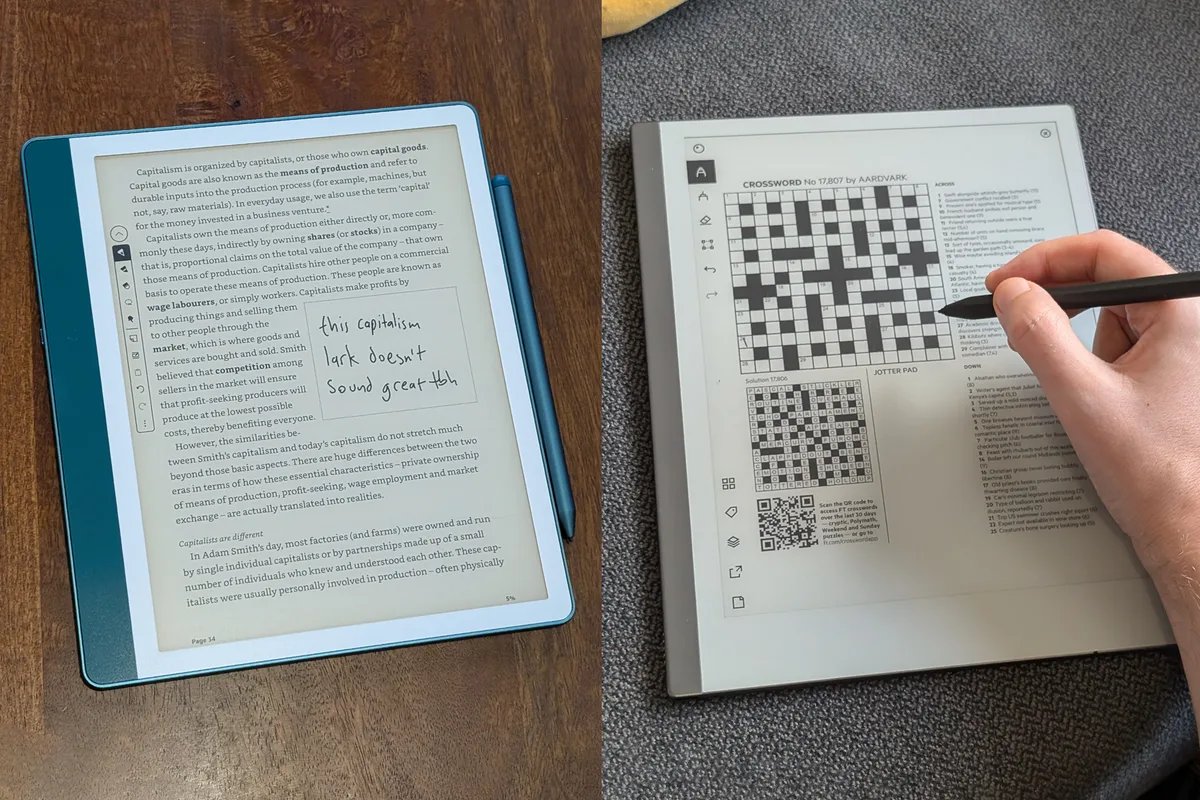
For those seeking to replace traditional paper with a modern, digital alternative, two devices currently dominate the conversation: the reMarkable 2 and the Amazon Kindle Scribe. Both utilise innovative e-ink displays to mimic the feel of pen on paper, but they cater to distinctly different users. Tech expert Steve Hogarty put both gadgets through rigorous testing to determine which digital notepad truly delivers.
The Core Technology and Design Philosophy
At first glance, these tablets share a fundamental similarity: their matte, textured e-ink screens. Unlike the glossy, backlit displays of conventional tablets, this technology offers a glare-free writing experience with a tactile surface that closely resembles real paper. This is the key feature that separates digital notepads from standard slates, providing a focused environment for handwriting, sketching, and annotating documents.
However, their purposes diverge significantly. The reMarkable 2 is a dedicated digital notebook, engineered first and foremost as a distraction-free tool for prolific note-takers and doodlers. It aims to be a direct, albeit premium, replacement for a traditional notepad. Conversely, the Kindle Scribe is fundamentally an advanced Amazon e-reader that has been thoughtfully expanded with comprehensive note-taking capabilities, making it a hybrid device for readers who also need to jot down thoughts.
Putting the reMarkable 2 Under the Microscope
Steve Hogarty's testing, which involved using the device for notes in meetings, at home, and while travelling, revealed a gadget of singular focus. The reMarkable 2 is razor-thin, incredibly lightweight at 403.5g, and boasts a minimalist interface that encourages writing. Its Marker Plus stylus glides with precise friction, registering 4,096 levels of pressure for natural-looking strokes.
Organisation is a strong suit. Users can create separate notebooks, sort them into folders, and choose from templates like ruled paper or to-do lists. The ability to export notes as PDFs or convert handwriting to editable text adds versatility. A particularly clever feature is signing and annotating PDFs directly on the device, a boon for professionals handling contracts.
Yet, it has notable limitations. The device is poor as an e-book reader; transferring EPUB files or web pages is fiddly. You cannot search through handwritten notes, which can lead to lost information. The handwriting-to-text conversion can be inaccurate, and the magnetic stylus, while convenient, isn't secured and could be lost. Priced from £389 with the standard marker to £429 with the Marker Plus, it's a premium investment for a dedicated tool.
Examining the Amazon Kindle Scribe's Dual Role
The Kindle Scribe, priced at £379.99 for the 16GB model, enters the market as Amazon's first writable e-reader. Its asymmetric design aids grip, making the large 10.2-inch screen feel less bulky. The included stylus enables annotation directly in e-books via virtual sticky notes and allows for freehand note-taking or sketching in a dedicated notebook.
For students and professionals, its strength lies in importing and marking up personal documents, such as PDFs or Word files. The process of emailing a PDF, signing it, and sending it back is seamless. The battery life is exceptional, lasting around four weeks on a single charge.
Compromises exist to achieve this hybrid functionality. The screen resolution is 300 PPI, lower than on other Kindles, making text slightly less crisp. The stylus has a fractionally slower latency than the reMarkable 2's, slightly breaking the paper-like illusion. This is partly due to the Scribe's front light, a feature the reMarkable lacks, allowing for use in the dark.
The Final Verdict: Which Digital Notepad Wins?
Choosing between these two devices ultimately depends on your primary need. If you want an e-reader first and a sketchbook second, the Kindle Scribe is the more sensible and versatile choice. Its seamless integration with the vast Kindle ecosystem and strong document annotation features make it ideal for students and professionals who read heavily.
For truly distraction-free, purist note-taking, the reMarkable 2 is the superior device. It is slimmer, lighter, and offers a marginally better writing experience. By stripping away features like a web browser and a built-in book store, it forces focus onto the task of writing. It is an executive toy and a statement gadget for those who value the analogue feel above all else.
Both devices validate their place in the market, proving that for prolific note-takers who regularly share work or are prone to losing paper notes, digital notepads offer a compelling and organised upgrade from the traditional 99p biro.