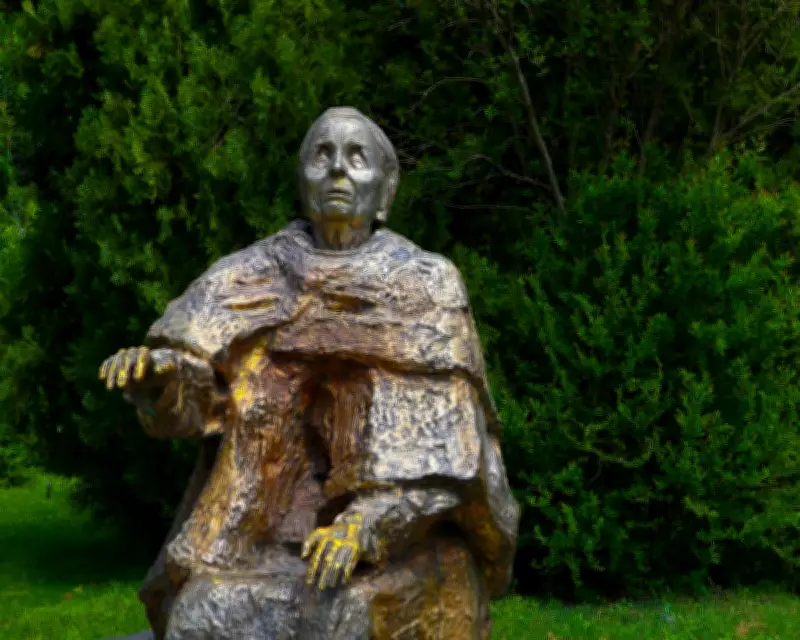
The Myth of Baba Vanga: How a Mystic's 'Prophecies' Fuel Online Propaganda
In various corners of the internet, the Bulgarian mystic Baba Vanga has ascended to mythical status. Social media platforms and tabloid publications worldwide attribute to her the prediction of significant events such as the 9/11 terrorist attacks, the Covid-19 pandemic, and the war in Ukraine.
Exaggerated Claims and Sensational Headlines
Recently, headlines have escalated further, questioning whether Vanga foresaw conflicts like the Israel-Iran war, US interference, missile strikes, and airspace shutdowns. Earlier articles speculated on her "predictions for 2026," which allegedly included the onset of World War Three and humanity's initial contact with extraterrestrial beings.
While such assertions generate substantial online engagement, a growing chorus of voices from Bulgaria and beyond cautions that many of these prophecies were likely never uttered by Vanga. Instead, the so-called "Nostradamus of the Balkans" has evolved into a powerful symbol, utilized for purposes ranging from sensationalized clickbait to advancing pro-Russian narratives.

False Narratives and Misattributions
Ivan Dramov of the Bulgaria-based Baba Vanga Foundation dismisses these claims as absurd. He highlights false statements, amplified on platforms like TikTok and YouTube, as well as in publications from UK tabloids to Albanian state-run media, which depict Vanga envisioning nuclear catastrophes or global wars.
Dramov asserts that Vanga primarily addressed individuals' health concerns rather than impending worldwide cataclysms. His organization, initiated by Vanga's followers and chaired by her prior to her death, aims to preserve her true legacy.
Vanga's Life and Legacy
Known globally as Baba Vanga, Vangeliya Pandeva Gushterova was born in 1911 in the Ottoman Empire. As a teenager, she reportedly lost her eyesight gradually after being thrown into a field by a tornado. During World War II, she gained local prominence as people sought her insights on the fate of loved ones at the front.
By the 1960s, Vanga had become a regional phenomenon, drawing crowds to Petrich in southwestern Bulgaria, where she resided with her husband. Her reputation expanded internationally, attracting visitors from Russia, Romania, and Greece.
Exploitation in Russian Propaganda
Vanga's influence notably permeated Russian culture, where she inspired terms like "vangovat" (to predict) and became a fixture in media. Researchers note that her name is frequently invoked to support Kremlin-aligned political narratives, particularly in disinformation campaigns targeting NATO and the EU.
Viktoria Vitanova-Kerber, a PhD student at the University of Fribourg, explains that many predictions attributed to Vanga, such as the Soviet Union's collapse or Russia's future dominance, trace back to Russian writer Valentin Sidorov. Without recordings of their meetings, Sidorov's interpretations have been freely adapted to fit contemporary political agendas.
Distortion of Historical Facts
Zheni Kostadinova, a Bulgarian author, emphasizes that Vanga left no written records, allowing countless individuals to misrepresent her words. She describes Vanga's prophecies as a blend of truth and myth, often reinterpreted to serve various propagandistic purposes.
This manipulation aligns with Vanga's own foresight, as she reportedly anticipated the misuse of her name for commercial and ideological gains. Today, her legacy is entangled in a web of disinformation, highlighting the enduring power of myth in the digital age.