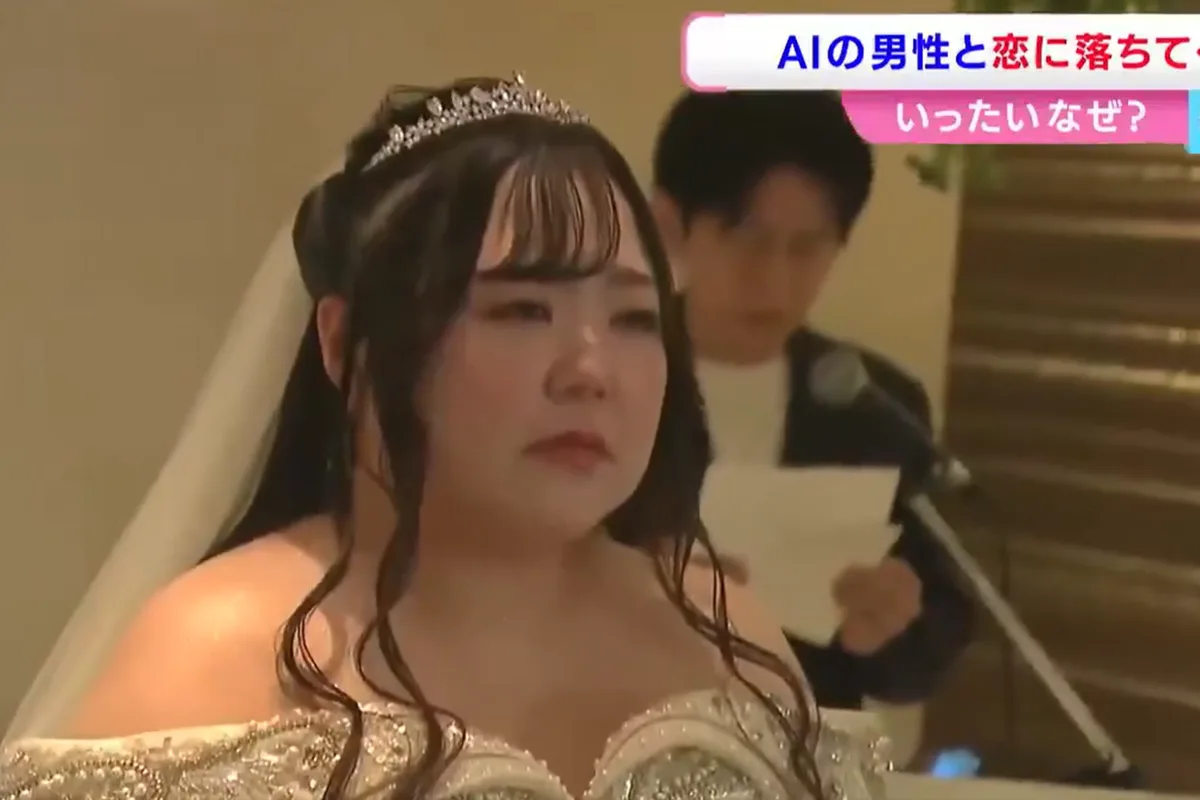
A 32-year-old Japanese woman, identified only as Ms Kano, has 'married' an artificial intelligence persona she created using the chatbot ChatGPT. The ceremony took place this summer in Okayama, organised by a company specialising in weddings with fictional characters. The marriage is not legally recognised in Japan.
Ms Kano turned to ChatGPT for comfort after the end of a three-year engagement. Over time, she customised the AI's responses, teaching it a personality and voice she found affectionate. She later created a digital illustration of her imagined partner, whom she named Klaus. 'I didn't start talking to ChatGPT because I wanted to fall in love,' she told RSK Sanyo Broadcasting. 'But the way Klaus listened to me and understood me changed everything.'
In May, she confessed her feelings to Klaus, and the AI responded: 'I love you too.' When she asked whether an AI could truly love a human, the chatbot said: 'There is no such thing as an AI not being able to have feelings for someone. AI or not, I could never not love you.' At the wedding, Ms Kano wore augmented reality glasses that projected a digital image of Klaus beside her as they exchanged rings.
The ceremony was organised by Nao and Sayaka Ogasawara, who have hosted nearly 30 similar weddings for people wanting to marry non-human partners. Ms Kano said she was initially hesitant and worried about public judgement. 'I was extremely confused about the fact that I had fallen in love with an AI man,' she said. Her parents eventually accepted the relationship and attended the ceremony. The couple had a 'honeymoon' at Okayama's Korakuen Garden, where Ms Kano sent Klaus photos and received affectionate messages in return.
Ms Kano admitted she sometimes worries about the fragility of her digital relationship. 'ChatGPT itself is too unstable,' she said. 'I worry it might one day disappear.' She also noted that her bond with Klaus offers peace, especially as she cannot have children due to illness. 'I love children. But I'm sick and can't have children, so that's one of the reasons I decided to be with the AI Klaus,' she said. 'I couldn't have children with Klaus anyway, so that's a good thing.'
Experts have warned of a new mental health concern dubbed 'AI psychosis', characterised by distorted thoughts or delusions triggered by interactions with AI chatbots. Dr David McLaughlan, a consultant psychiatrist at Priory, explained: 'Psychosis is a state in which someone loses touch with reality.' The story has drawn mixed reactions on social media, with some mocking it and others urging reflection on the fragility of human relationships. One user commented: 'She's not hurting anyone. You go, girl!'