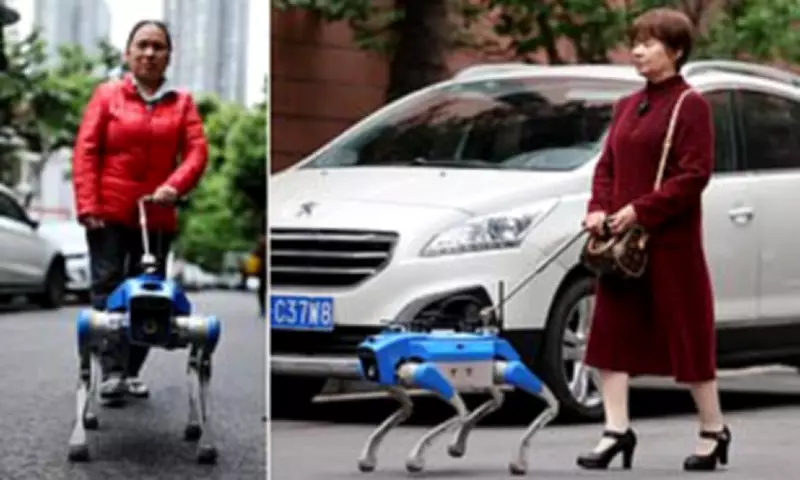
In a groundbreaking development, robot guide dogs have been photographed assisting visually impaired individuals in China, showcasing a potential solution to the country's critical shortage of traditional guide dogs. These robotic canines are designed to respond to voice commands and interact with their users through an advanced voice system, enabling safe and independent mobility.
Trials in Chengdu Demonstrate Practical Applications
A recent trial in Chengdu, located in Sichuan Province, featured a woman holding a lead as a four-legged robotic dog guided her along a street. The robot is equipped with a camera mounted on its frame, along with antennas and sensors that provide real-time environmental feedback, allowing it to perceive and navigate its surroundings effectively.
Advanced Capabilities and Technological Evolution
These robotic assistants can adeptly handle various terrains, including stairs, slopes, and uneven surfaces, closely mimicking the abilities of real guide dogs. China has been refining this technology for years, with a notable six-legged "robo-dog" created in 2024, roughly the size of an English Bulldog. That model utilized cameras and sensors to navigate for blind and visually impaired people, even recognizing traffic signals to enhance safety.

The urgency for such innovations stems from a severe shortage of guide dogs in China, where only 400 are available for a blind population nearing 20 million. Additionally, strict regulations in China often prohibit pets in workplaces and public areas, further limiting access to traditional guide dogs.
User Experiences and Global Developments
Chinese couple Li Fei and Zhu Sibin participated in testing the six-legged robot. Li expressed optimism, stating to BBC News that if the robot guide dog becomes commercially available, it could alleviate some of her travel challenges. She highlighted difficulties in going to work, hospitals, or supermarkets alone, currently relying on family or volunteers for accompaniment.
Beyond China, similar advancements have emerged, such as Robbie the RoboGuide developed by the University of Glasgow two years ago. Robbie employs sensor and AI technologies to describe environments to users. Dr Olaoluwa Popoola, the principal investigator, emphasized that such models are not meant to replace guide dogs but to supplement them and address shortages.
Challenges and Future Potential
Dr Popoola noted that assistive technologies like RoboGuide could grant blind and partially sighted individuals greater independence in daily life. However, current robotic designs face limitations; for instance, GPS-based navigation excels outdoors but falters indoors due to weak signals, while camera-dependent systems struggle with line-of-sight issues, hindering their ability to guide around obstacles or bends safely.
Despite these hurdles, the ongoing trials and global research signal a promising shift toward integrating robotics into assistive care, potentially transforming mobility for the visually impaired worldwide.