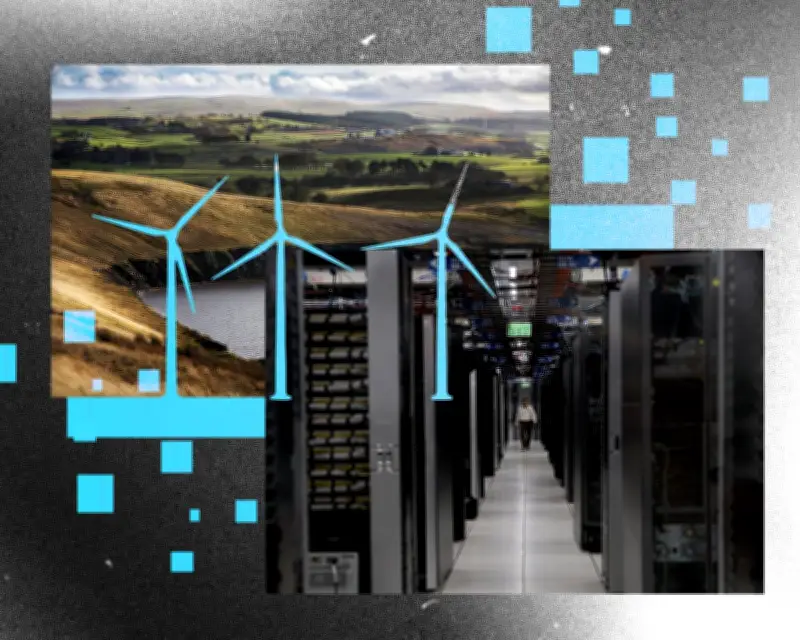
The Guardian's global tech reporting team is increasingly shifting its focus from the digital realm to the physical world, investigating the vast datacentres that power the AI revolution. Their work reveals that many datacentre projects worldwide are being challenged or cancelled, highlighting significant physical constraints.
Datacentre Projects Face Reality Checks
An investigation published this week exposed that an £8.2bn AI complex in rural Scotland misrepresented its plans to be powered entirely by on-site renewables. Aisha Down, who covers AI for the Guardian, visited Lanarkshire to examine sites where datacentres and energy infrastructure might be built. She spoke with local residents, examined public records, and obtained internal documents. 'Our reporting is showing that you can't simply wave a magic wand and have a datacentre appear,' she says. 'There are a lot of huge physical constraints and reality checks. These physical, tangible things are what makes or sinks the AI boom.'
Dan Milmo, the Guardian's global technology editor, published an article on the number of large datacentre projects around the world facing challenges or cancellations. He recalls visiting a site in Wales that 'was about as well-organised and well-funded as you can get, and I still got a sense of how difficult it is for tech companies to pull off these big infrastructure projects.'

Physical Constraints Include Grid Capacity and Sustainability
The physical reality checks on AI include the capacity of local electricity grids, the availability of chips and other components, and the impact on tech companies' carbon footprints and sustainability goals. Blake Montgomery, the Guardian's US tech editor, notes: 'The AI boom has radically changed the physical presence of all of these tech companies in the physical world. These AI datacentres are some of the most massive and complex structures that humanity has created.'
Environmental and Sensory Impacts
Last month, Aisha visited Slough, home of the largest datacentre park in Europe, to experience the heat-island effect. Some research suggests temperatures near datacentres can increase by an average of 2C, and as much as 9C. 'It was baking hot and there was this audible whine. If you were sleeping or working nearby everyday, I think it'd wear you down,' she says. Robert Booth, the UK technology editor, experienced even louder volumes at datacentres in Santa Clara, Silicon Valley. 'They call those datacentres screamers because they're louder than an aircraft taking off. I had to pack my ears with protection and, even with that, I was still left with ringing ears.'
Local Tensions and Protests
Local tensions and backlashes against datacentres are a growing part of the tech story. Dan Milmo notes: 'Protests against datacentres are becoming a kind of manifestation of voter and public concern about tech and AI in general. It's very difficult for people to protest against technology or to make tangible their feelings about things that are transmitted over the internet. But while it's hard to protest against ChatGPT and what it means for your undergraduate kids' employment prospects, it's easier to protest against the infrastructure that facilitates its existence and how that infrastructure functions.'
The Guardian has also published an interview with Erin Brockovich about her work helping communities affected by datacentres' impact on energy and water resources.
Shift from Digital to Physical Reporting
This shift in focus marks a departure from the early days of social media, when tech reporters often scrolled through screens and downloaded apps to spot trends. 'Perhaps because unreality has become so pervasive, reality has become a lot more interesting to people,' Aisha suggests. 'Did a child harm themselves because of their social media feed? How hot is it next to a datacentre? People are now more interested in those kinds of stories.'
The team's work includes attending courtroom hearings about social media harms and interviewing children about the UK's under-16 social media ban. Dan Milmo went to west London to speak with children and teenagers about the ban. 'I was struck by how I hadn't heard enough of those voices, and I personally hadn't written enough about what these children think and how important their perspective was,' he says.