Google is struggling with the latest version of its flagship AI model, Gemini 3.5, which is months behind schedule. According to Bloomberg, Google is trying to improve Gemini's coding abilities to catch up to Anthropic's Claude, widely considered the best AI coding tool. OpenAI released a new model in early July; Google had been expected to do the same in May. News of the delay sent Google's shares sliding as investors questioned whether it could maintain its top position in the AI race.
China's Moonshot Debuts Unexpectedly Strong Model
As Google's internal struggles became public, Chinese startup Moonshot debuted an unexpectedly strong model, sending shivers through Silicon Valley and Washington DC. Moonshot's Kimi K3 model featured surprisingly capable coding, particularly in front-end coding. "This may be the single biggest release of the year," said Anastasios Angelopoulos, CEO of AI testing company Arena. By Sunday night, Moonshot couldn't keep up with demand. "Kimi K3 has received far more love than we expected, and our GPUs are feeling it. Over the past 48 hours, demand has pushed close to the limits of our current capacity," the company posted on X.
Unlike ChatGPT, Claude, and Gemini, Kimi K3 is free to use and open-weight, meaning anyone can download and run it locally. This follows the general strategy of Chinese AI companies: open-source and open-weight models, beating US AI companies on price, mirroring the broader US-China trade war. DeepSeek inspired a major US market panic last year. Alibaba previewed its latest model, Qwen3.8 Max, on Sunday, showing a similar number of parameters as Kimi K3. The company plans to publish the model's weights soon, per Bloomberg.

Beijing Subsidizes AI Startups
The strategy is made possible by Beijing, which subsidizes computing resources and power consumption for domestic AI startups, allowing them to release AI models free of charge. The logic is that if these startups can't compete on capability with US models, they can compete on cost and undercut US parent companies that need to earn a profit. This is causing major headaches in Silicon Valley. There are no longtime incumbents in the AI business; if buyers, especially businesses needing lots of generated code, can turn to cheap or free alternatives, there may be little need to spend on brand-name bots. The South China Morning Post reported: "As US AI costs soar, global businesses pivot to China's low-cost, open-weight models."
In the US, nerves are rattling. Hawkish Trump administration officials are rekindling efforts to block US access to Chinese AI models via de facto bans, commerce department rules, or an executive order, Axios reported on Monday. OpenAI's policy head for advanced AI, former Trump adviser Dean Ball, wrote that Beijing's open-weight approach would lead to "full AI communism" with government-run datacenters powering AI as a public good. He denounced that future. OpenAI has been sounding the alarm about Chinese models for years, which reads as part political disagreement and part business strategy, since Chinese open-weight models threaten OpenAI's projected profits.
US Response Scattered
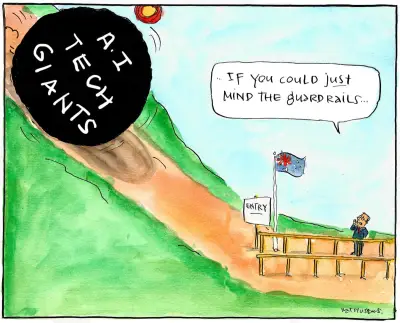
There is no alignment between US AI companies and government players. Emil Michael, the US Pentagon's chief technology officer, responded to Ball: "Every industry/ecosystem has its supreme village idiot. Dean Ball is that for AI." As Beijing presents a unified front, the White House's response is growing more scattered. Trump had talked until recently of complete deregulation and never restraining AI investment. By contrast, the White House is restricting access—even allies' access—to Anthropic and OpenAI's advanced cybersecurity models. Chris Fall, director of the Trump administration's Center for AI Standards and Innovation, is resigning just three months into his tenure, Axios reported on Monday.
Not all of the AI crowd is against these models' incursion. Bill Gurley, a longtime venture capitalist known for early backing of Uber, wrote in the Washington Post: "They aren't a security threat – they're what competition looks like."

Workers Take Action
Silicon Valley workers are worried about AI's impact on their jobs. Last week, Meta workers filed a lawsuit against their former employer, alleging that it automated their firing via algorithmic decision-making. Meanwhile, thousands of Google workers petitioned their CEO for layoff protections as the company shifts spending from employees to AI infrastructure. "Make no mistake: this is a company that is enjoying massive, unprecedented success," said Parul Koul, a Google software engineer and president of the Alphabet Workers Union, outside the company's California headquarters. "These layoffs and cuts are not difficult decisions, but simply profit being put over the people that make this company run."
A Meta employee who was part of a recent union drive in the UK said: "It's about us having a voice in all of the operations of the company, from products to employee experience." Meta countered the lawsuit with an unusually direct statement: "These claims lack merit and are not based on facts. Workforce management and organizational decisions were and are made by people, not AI." Google did not issue a statement in response to the petition.