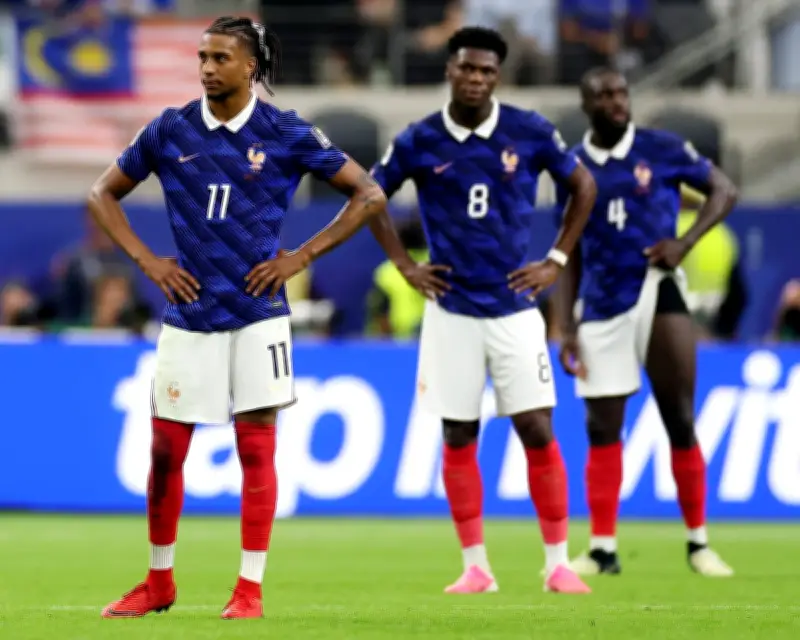
France’s World Cup campaign ended in disappointment as they fell 2-0 to Spain in the semi-finals, failing to reach a third consecutive final. Trailing for the first time in the tournament after Mikel Oyarzabal’s 22nd-minute penalty, Didier Deschamps’ side never recovered. Kylian Mbappé and the vaunted attack were stifled by Spain’s tactical coherence, leaving France to reflect on where it went wrong and what lies ahead under incoming manager Zinedine Zidane.
France’s Front Four Flounder
France’s all-star attack, which had scored 13 goals in the first four matches, failed to fire against Spain. The forwards did not combine meaningfully, and their lack of clinical edge was exposed. France were 2-0 down before registering a shot on target. Mbappé, the second top scorer in men’s World Cup history, did not have a shot on target; his attacking impact was blunted by the need to drop deep, and his first shot came midway through the second half. Michael Olise, compared to Michel Platini in the group stage, lost the ball 20 times. Ousmane Dembélé troubled goalkeeper Unai Simón only in the final minutes. Bradley Barcola’s most significant impact was defensive, while Lucas Digne struggled against Lamine Yamal. The forwards, once fluid in swapping positions, became isolated as Spain locked down the middle third, keeping them distant from each other and the rest of the team.
Deschamps Had No Answers
Adrien Rabiot was the only France player who repeatedly broke through Spanish lines, but a 10th-minute yellow card hampered him. Deschamps substituted him at half-time, drastically reducing France’s chances in midfield. Aurélien Tchouaméni, recently injured, played too deep to influence the match, and Manu Koné could not replicate his standout performance against Morocco. Deschamps made like-for-like switches, but Désiré Doué and Rayan Cherki were confined to isolated pockets, and Théo Hernandez fared no better than Digne against Spanish attacks down the right.
Spain’s Midfield Supremacy Continues
Deschamps repeatedly called Spain tournament favourites, a view backed by recent results. Counting the Olympic final, France have lost four consecutive matches to Spain, all in semi-finals or finals. Spain’s midfield of Rodri, Fabián Ruiz, and Dani Olmo overran France for the second time in three years. Spain’s superiority extends beyond senior sides; their clearly defined style is replicated across age groups, contrasting with France’s case-by-case approach. Against a deeply ingrained tactical system, individual talents have been thwarted.
What Next? The Zidane Era
Deschamps will end his 14-year tenure after Saturday’s third-place playoff in Miami. Finishing on the podium at three World Cups would mark him as France’s best-ever head coach, but the lasting verdict may be that he underachieved given the talent available. The freedom he afforded forwards could be seen as a transition to Zinedine Zidane, who was famously non-interventionist at Real Madrid. Zidane’s appointment brings continuity and respect; like Deschamps, he is a pragmatist. He inherits a relatively young squad with goodwill from fans, players, and decision-makers. The 2018 and 2022 campaigns culminated Deschamps’ tactics of control and pragmatism, but that approach had run its course by Euro 2024. The radical switch to a more open style was perhaps overly ambitious to click immediately. France breezed through early rounds but failed against Spain. This new-look team may realize its full potential in four years under Zidane, with Deschamps’ legacy including a World Cup win and foundations for a new era.