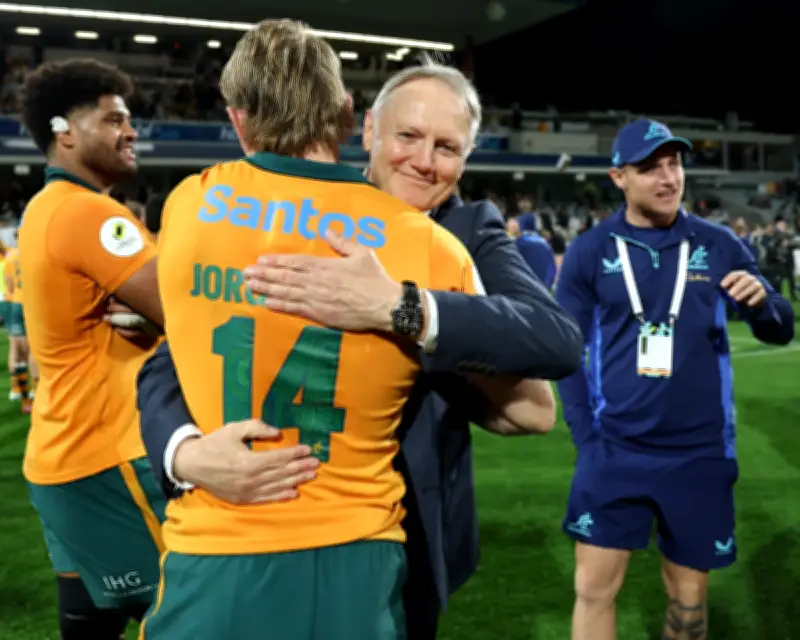
Australia ended the Joe Schmidt era with a dominant 57-10 victory over Italy in Perth on Saturday, a performance that showcased the best of his tenure while highlighting the inconsistencies that defined it. The Wallabies scored nine tries, with lock Josh Canham completing a hat-trick, as the home side produced precise, powerful rugby that offered a tribute to their departing coach and a reminder of why his spell has been so difficult to judge.
Schmidt's Record Under Scrutiny
This was Schmidt's 12th win in 31 Tests, giving him a winning percentage of just under 39%. Among Wallabies coaches of the professional era, only Dave Rennie and Eddie Jones – in his disastrous second stint – have fared worse. Schmidt inherited the rubble left by Jones after the 2023 World Cup, but the rebuilding operation never gathered much pace. Australia arrived at his farewell on a six-Test losing streak, having won one of their previous 10. Even this emphatic sendoff could not transform the record into anything resembling a revival.
What Schmidt Leaves Behind
Schmidt handed out 27 debuts in 31 Tests, leaving the Wallabies with a broader group of players exposed to international rugby than he found. Not all are finished products, and there remains a shortage of heavyweight forwards, but Les Kiss takes charge of a deeper and more experienced group. Josh Canham, 25, was Australia's best player in this home leg of the Nations Championship, an athletic lock who carried dynamically, worked accurately at the lineout and seemed to materialise whenever a try needed scoring. His three on Saturday provided a gaudy flourish, though each owed something to a pack that dominated the maul, recycled relentlessly near the line and finally looked capable of imposing itself.
Clear Method with the Ball
Schmidt also gave Australia a clear method with the ball. At their most fluent they were startlingly quick around the fringes, with forwards handling before contact, cleaners arriving at pace and the next wave launching before the defence could set. Ryan Lonergan was an understated expression of that philosophy, keeping the ball moving at such speed that Italy rarely had time to organise themselves. Ireland and France also struggled for stretches before finding ways to slow the supply or overwhelm Australia physically. Schmidt taught the Wallabies to play quickly without becoming frantic, and when the timing was right their continuity was accurate, intelligent and exceptionally difficult to stop.
Improved Breakdown Work
There was greater tenacity at the breakdown, too. Fraser McReight has been the obvious standard-bearer, but Harry Wilson, Carlo Tizzano and several others have contributed to a team that became far more threatening over the ball. Australia came within one successful intervention at the final breakdown in Melbourne of forcing the British & Irish Lions into a series decider. The Wallabies entered Schmidt's tenure looking incapable of remaining in the ring with the strongest teams. Under him, they beat England at Twickenham, defeated the Lions in Sydney and came back from 22-0 down to beat South Africa at Ellis Park. The ceiling unquestionably rose.
Persistent Problems: Depth and Fly-Half
The floor, however, barely moved. Australia's lack of bench strength remains the most obvious problem. Their starting side can trade blows with almost anyone, but once the leading forwards depart the rhythm and physical authority often go with them. This cannot be left entirely at Schmidt's door. No coach can conjure a second international-quality tight five from empty cupboards. But he leaves without closing the gap. Nor did he establish continuity in the positions responsible for controlling the game. Declan Meredith became the eighth player used at fly-half during Schmidt's reign when he debuted against France last week. Injuries played a major role: the No 10 jersey sometimes appeared cursed. Noah Lolesio, Ben Donaldson, Tom Lynagh, Carter Gordon and others moved in and out, while Jake Gordon's absences also disrupted the scrum-half position. Schmidt built a sophisticated attacking machine, but never found a permanent pair to operate it.
What Lies Ahead for Kiss
So Kiss takes charge of something more useful than the wreckage Schmidt received, but substantially less than a finished team. Rob Valetini remains among the world's premier loose forwards, while Len Ikitau and Joseph-Aukuso Sua'ali'i form a midfield with rare power and imagination. Max Jorgensen, Dylan Pietsch and Tom Wright are electric, and the returning Mark Nawaqanitawase will add still more dynamism to an already dangerous backfield. None of which supplies the extra bulk Australia still require up front. The World Cup lands on home soil next year. Kiss does not need to begin again, but he must achieve what Schmidt could not: turn the Wallabies' best rugby from the occasional special into something the kitchen can serve every week. A sixth consecutive sellout suggests Australian rugby has not yet exhausted the public's patience, though that goodwill may not survive another era built on glimpses and excuses.