The International Olympic Committee's official online store has sold out of controversial t-shirts featuring artwork from Adolf Hitler's 1936 Berlin Games, drawing sharp criticism from Jewish advocacy groups and German politicians alike. The items were part of the IOC's 'Heritage Collection,' which reproduces official Olympic posters on apparel.
Nazi Propaganda on Olympic Merchandise
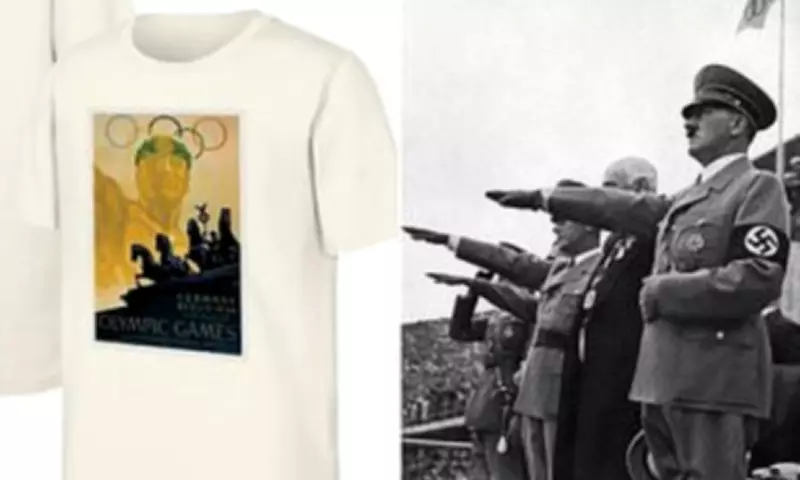
Among the sold-out items was a t-shirt featuring the poster designed by German artist Franz Würbel for the 1936 Summer Olympics in Berlin. This poster, depicting a laurel-crowned male figure before the Brandenburg Gate with Olympic rings, became one of the earliest and most notorious examples of 'sports-washing' as Hitler's regime used it to spread Nazi propaganda globally.
The design was extensively circulated under the Nazi regime to promote Aryan supremacy ideals. Despite considerable backlash, the IOC also produced and sold a t-shirt featuring the poster from the 1936 Winter Olympics, held in the Alpine ski resort of Garmisch-Partenkirchen under Nazi Germany's organization.

Controversial Winter Games Design
This second sold-out shirt displays artwork by Nazi propagandist Ludwig Hohlwein, showing a black-and-red clad man holding skis in his left hand while making what appears to be a fascist salute with his right. Both shirts have now completely sold out on the Olympic store website, according to the IOC's confirmation to media outlets.
Political and Advocacy Condemnation
Klara Schedlich, sports policy spokesperson for Berlin's Green Party state parliament, strongly criticized the IOC's decision. 'The 1936 Olympic Games were a central propaganda tool of the Nazi regime,' Schedlich stated, accusing the Olympic body of 'clearly not reflecting sufficiently on its own history.' She added that 'the choice of image is problematic and unsuitable for a T-shirt' without proper historical context.
Liora Rez, founder of StopAntisemitism, called the merchandise 'a shame,' connecting it to broader concerns about antisemitism in Olympic history. 'The Olympics have been a staging ground for antisemitism for decades,' Rez told Fox News Digital, referencing the 1972 Munich Games attack on Israeli athletes and what she described as inadequate commemoration by the IOC.
IOC's Defense and Historical Context
In response to criticism, an IOC spokesperson acknowledged the 'historical issues of Nazi propaganda related to the Berlin 1936 Olympic Games' but emphasized the athletic achievements of those Games. 'We must also remember that the Games in Berlin saw 4,483 athletes from 49 countries compete in 149 medal events,' the spokesperson explained, highlighting American sprinter Jesse Owens' world-stunning performances that challenged Hitler's racial theories.
The spokesperson noted that 'the historical context of these Games is further explained at the Olympic Museum in Lausanne' and that limited production quantities contributed to the sell-out status. However, this defense has done little to quell the controversy surrounding merchandise featuring imagery created specifically to advance Nazi ideology.
Historical Ironies and Consequences
While Jesse Owens' four gold medals famously contradicted Hitler's Aryan superiority beliefs, Nazi Germany actually topped the 1936 Summer Olympics medal table with 33 golds and 89 total medals. The Winter Games told a different story, with Norway claiming the most gold medals (7) just four years before Nazi Germany would invade and occupy the country until 1945.
The Nazi regime's actions had direct consequences for the Olympic movement beyond propaganda. Hitler's initiation of World War II led to the cancellation of both the 1940 and 1944 Summer Olympics (originally scheduled for Tokyo/Helsinki and London respectively) and the 1940 and 1944 Winter Games (planned for Sapporo and Cortina d'Ampezzo).
The current controversy highlights ongoing tensions between commemorating Olympic history and avoiding glorification of regimes that exploited the Games for political purposes. As these t-shirts sell out despite condemnation, questions remain about how sporting institutions should handle problematic aspects of their heritage in commercial contexts.