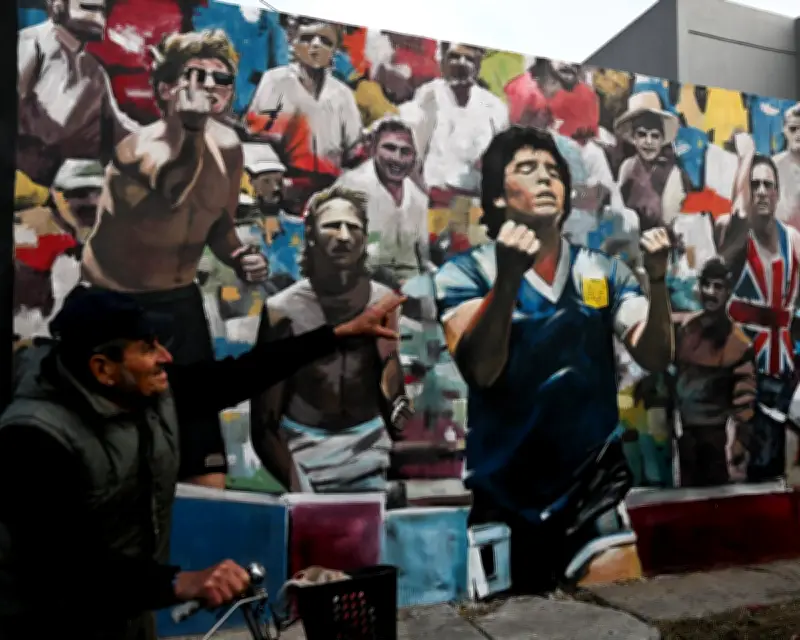
On Sunday afternoon, Godoy Cruz played Defensores de Belgrano in Nacional B, Argentina's second division. Among the blue home banners were two St George's crosses, apparently taken from England fans at the 2014 World Cup. One read: "Boys & Girls From Oakwell Barnsley." The other: "Big Al – Y-Bird – South Croydon – CPFC." This act of territorial banter, preserved for 12 years, epitomises the depth of the rivalry between Argentina and England.
A Rivalry Steeped in History
Argentina v England is often described as a "grudge match," but it is far more complex. It involves war, culture, empire, nationalism, collective memory, and a mutual fascination deepened over time. The relationship is defined not only by distance and difference but by a weird, long-repressed kinship.
British influence on Argentina is profound. From place names to the culture of "merienda" derived from English afternoon tea, Argentina was once considered the "sixth dominion" of the empire. The only overseas branch of Harrods was in Buenos Aires from 1912 to 1998. English rock bands like the Smiths and the Cure are wildly popular in Argentina.
Football as a Cultural Bridge
In football, English influence is evident in club names such as Newell's Old Boys, River Plate, and Arsenal. Terms like "crack" (star player) and "orsai" (offside) are used. For years, amateur matches began with a cry of "aurieli?" (are you ready?). Similarities between the footballing cultures include the depth of the pyramid, neighbourhood clubs as expressions of local tradition, and the role of song and mass overseas travel.
For many Argentinian fans, the Falklands war occupies the same spiritual space as World War II does in England. This is visible in banners, murals, and even tattoos. After Argentina's quarter-final win over Switzerland, the squad sang: "For the Malvinas, for Diego, for Leo's last one." Rodrigo De Paul sent his framed shirt from the 2022 World Cup to the Malvinas veterans centre in Lomas de Zamora.
Antagonistic Footballing Styles
Jorge Valdano, a veteran of the 1986 World Cup quarter-final against England, said: "Very early, an Argentinian way of playing football was born that clearly distanced itself from the English influence. We tried to be antagonistic to the English. If they liked long passes, we favoured shorter ones. If the English favoured passing, we’d focus on dribbling. Against England, there was something else at stake, and at the time it was worth more than the championship."
Over time, the feeling became mutual. An ill-tempered friendly at Wembley in 1974 saw chants of "animals" every time Argentina touched the ball, echoing Alf Ramsey's accusation eight years earlier. By 1986, Jimmy Greaves cracked Falklands jokes on ITV's World Cup coverage and waved a German flag before the final. Sol Campbell called the 1998 Argentina team "just a bunch of idiots."
Scarcity Keeps the Rivalry Pure
Unlike most sporting rivalries, Argentina v England has remained pure through scarcity. The two countries have not played competitively since 2002. Argentinian influence on English football remains modest: Ossie Ardiles and Sergio Agüero, but never Gabriel Batistuta or Juan Román Riquelme; Mauricio Pochettino, but never Diego Simeone; and never the two greatest, Lionel Messi and Diego Maradona, who still feel remote and mysterious to English fans.
Too different to be friends, too entwined to be purely enemies, Argentina v England is less a blood feud and more a messy, century-long break-up. The teeth-baring may be a mark of respect, a shared admiration, perhaps even a love that dare not speak its name.