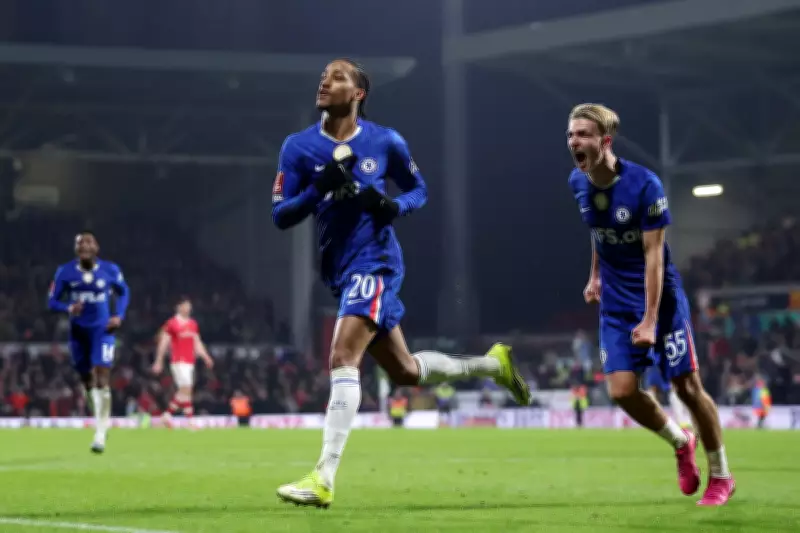
Why Liam Rosenior's Champions League Debut Against PSG Captivates Football
Chelsea manager Liam Rosenior prepares for his first ever Champions League knockout match in what has emerged as this season's most compelling and unpredictable last-16 encounter. The young coach, with no prior experience at this elite European level, faces the formidable challenge of Paris Saint-Germain, the reigning champions managed by the vastly experienced Luis Enrique.
A Tactical Prodigy Meets European Royalty
While Chelsea's recent 2-1 defeat to Arsenal was dismissed by many as uneventful, PSG's coaching staff perceived something entirely different. They observed an intensely sophisticated contest filled with strategic rotations, unexpected player movements, and what they described as "5D chess" in positioning. Like Arsenal before them, PSG recognized Rosenior's capacity to present opponents with unconventional tactical problems that demand constant adaptation.
Rosenior's tactical evolution has been particularly noteworthy. PSG analysts noted how the young manager has significantly upscaled his approach since his time at Strasbourg, adding greater layers of sophistication now that he commands superior players at Chelsea. This progression suggests Rosenior is not merely repeating past strategies but evolving his methodology to match his new environment.

Historical Context: Rosenior's Previous Encounters with PSG
The Chelsea manager brings relevant experience from his tenure at Strasbourg, where he faced PSG three times across the 2024-25 and 2025-26 seasons. His record reveals a promising pattern:
- An early 4-2 away defeat to PSG
- A notable 2-1 victory against Luis Enrique's team at their absolute peak
- A 1-1 draw earlier this current season
Beyond the respectable results, Rosenior's performances were particularly impressive. He consistently implemented an intense attacking approach that created genuinely end-to-end contests—a strategy many managers avoid against PSG's formidable attacking talent. This bold methodology generally proved effective and may become even more potent with Chelsea's superior squad, provided PSG fails to adapt to the nuanced details Rosenior incorporates.
Mutual Respect and Tactical Study
Rosenior has been diligently studying his upcoming opponent, acknowledging PSG's excellence under Luis Enrique. "PSG were so good last year," he admitted on the eve of the match. "The football I saw... I was admiring it. I don't have too big an ego to say I don't look at other coaches and learn from them. I showed the Strasbourg players clips of PSG last year."
Through this analysis, Rosenior identified something remarkable about Luis Enrique's approach. While many top teams have focused on intricate positional play, PSG under the Spanish manager has revitalized dribbling as an intrinsic part of their ideology. This represents a significant evolution from the base Guardiola-style positional game that has dominated elite football, with Luis Enrique creating a more dynamic, livewire model that emphasizes individual brilliance within a structured framework.
Contrasting Careers at Critical Junctures
The personal narratives surrounding both managers heighten this tie's intrigue. Rosenior stands at the beginning of his managerial journey, overseeing his first Champions League knockout match against the competition's defending champions. As one fellow Champions League coach observed, "He has an ego, and he's just taken a step that hasn't been normal in most careers, but he also has quality."
Conversely, Luis Enrique represents established excellence—a manager with two trebles to his name, sought after by clubs like Manchester United and previously considered by Chelsea themselves. This experience gap reflects a broader trend in this season's Champions League last 16, where a small group of highly experienced managers (including Pep Guardiola and Diego Simeone with 30 combined seasons between them) contrasts sharply with a larger contingent of relative newcomers.

Wider Context: Inexperience Versus Tradition
This season's knockout stage features five managers, including Rosenior, experiencing their first Champions League campaign, plus three others in only their second season. This distribution highlights evolving trends in football management, with clubs increasingly favoring head coaches over traditional managers. Historical precedent suggests inexperience isn't necessarily prohibitive—Guardiola, Di Matteo, Zidane, Flick, and Luis Enrique himself all won the Champions League in their debut seasons.
While not predicting Rosenior will replicate this achievement, the even nature of this particular tie is striking. Many consider it the most balanced of all eight last-16 matchups, with genuine uncertainty about which tactical approach will prevail. Individual matchups add further intrigue, with Chelsea's Joao Pedro currently in form that could challenge PSG's Kvicha Kvaratshkelia.
Complicating Factors and External Pressures
Several additional elements contribute to this tie's unpredictability. PSG has experienced something of a natural drop-off following their Champions League triumph—a phenomenon that explains why no club outside Real Madrid has retained the trophy since 1990. Questions persist about the sustainability of Luis Enrique's intense approach, particularly given he faced similar challenges after his previous treble with Barcelona.
Both clubs also contend with long-term fatigue from the recent Club World Cup, which disrupted pre-season preparations and continues to affect squad fitness. While Chelsea enjoys relatively few direct injury concerns, with hope surrounding Reece James's availability, the cumulative impact of a compressed schedule cannot be discounted.
These varied factors create a fascinating tactical puzzle that Rosenior must solve against a manager with extensive experience managing such complexities. The resulting first leg promises to be perfectly balanced and exceptionally difficult to predict—a fitting representation of two teams and managers approaching this crucial encounter from dramatically different perspectives.