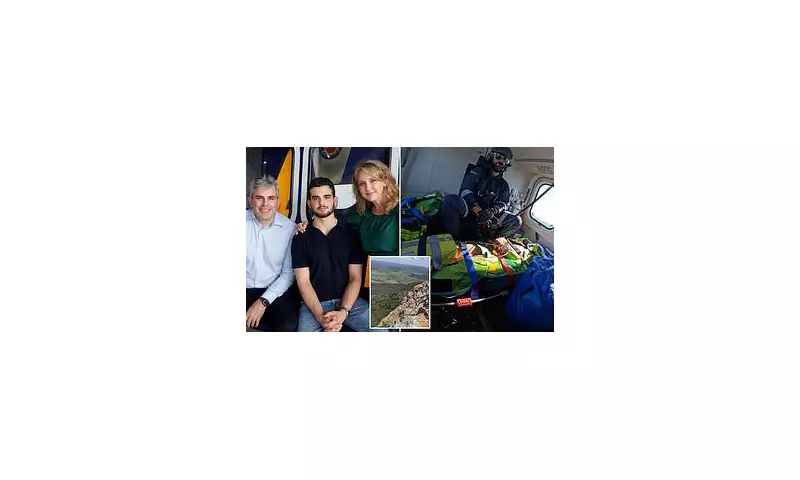
An 18-year-old bushwalker has recounted his miraculous survival after plummeting 80 metres down a mountain in a Queensland national park, crediting a combination of modern technology and sheer luck for his rescue.
A Solo Hike Turns to Disaster
Jake McCollum's first solo bushwalk ended abruptly and catastrophically in November 2025. While on Mount Walsh, located north of Brisbane, the teenager suffered a devastating fall. Landing on his back with a heavy thud after the 80-metre drop, he immediately feared the worst for his survival. "I remember thinking it was probably all over for me," McCollum recalled.
The fall left him severely injured. He sustained a fractured spine, multiple broken ribs, significant internal bleeding, and a deep laceration to his head. His mobile phone, which he had used just moments before to capture the summit view, was shattered in the accident.

The Fight for Survival and a Faint Connection
Despite his injuries, McCollum managed to crawl to his backpack. His crucial action was to activate his personal locator beacon (PLB), a portable device that sends a distress signal and GPS coordinates directly to emergency services. With the beacon activated, he could only wait and hope.
Approximately thirty minutes after the fall, he heard a call coming through his 'hand-me-down' Apple AirPods. By the time he painfully crawled to retrieve them, he had missed ten calls. Thankfully, they rang again. With a tap, he answered to hear his mother's voice on the other end.
"I heard really, really faintly 'mum, I'm hurt really bad'," said Rachel McCollum, describing the harrowing call. "It's probably the worst news you can ever hear. I don't know how many times he said during that phone call 'I think I'm going to die'."
A Complex Rescue Against the Odds
His parents, Tim and Rachel, began a frantic 90-minute drive from their home in Bundaberg to the mountain, with Rachel staying on the phone to relay information to authorities. The rescue was fraught with difficulty. McCollum had not used the main trail, and his beacon signal was bouncing off boulders, confusing the coordinates provided to rescuers.
Then, the AirPods' battery died. In a desperate move, McCollum pressed his ear against his damaged phone and could just make out his parents' faint voices as a rescue helicopter from LifeFlight circled the area. "When the helicopter did arrive, I remember thinking 'oh, this is great' but then it went right past me," he said.
It took five hours from the time of the fall for aircrew officer Shayne White to finally spot the teenager's legs through the thick canopy. The rescue team then spent an hour stabilising his critical injuries before winching him to safety and transporting him to hospital.
Barely two months later, the McCollum family shared an emotional reunion with the rescue team. Reflecting on the incident, Officer White stated, "He's a very lucky boy with a good outcome. If his AirPods and phone weren't working, we might not have found him." The story underscores the vital importance of carrying reliable communication and distress devices when venturing into remote areas.