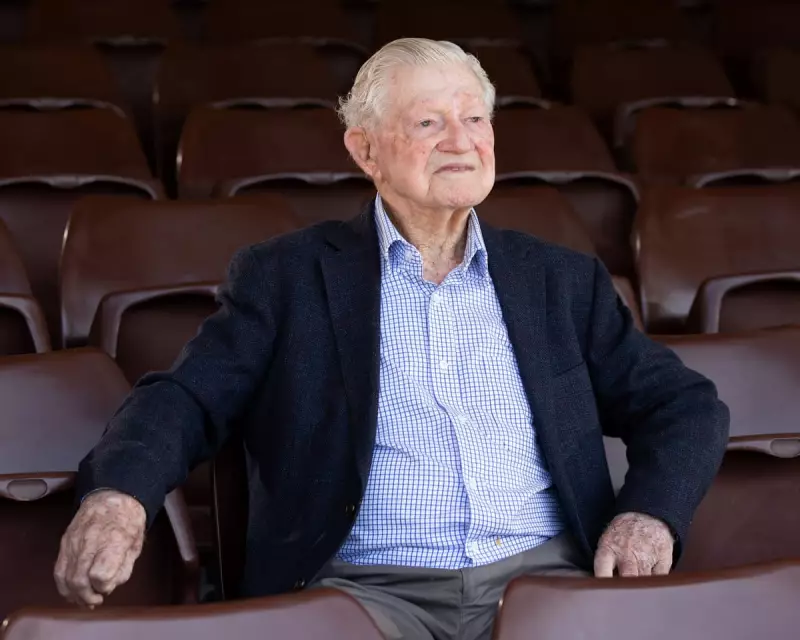
From the comfort of his armchair, the world's oldest living Test cricketer offers a sharp critique of the modern game. Neil Harvey, the last surviving member of Sir Donald Bradman's legendary 1948 'Invincibles', has watched the evolution of cricket for nearly eight decades. Now 97, his perspective is a unique blend of cherished history and blunt assessment of contemporary trends like England's 'Bazball' approach.
A Life in Cricket: From Invincible to Elder Statesman
Harvey's connection to the sport is profound. A dashing left-handed batsman, he made over 6,000 Test runs at an average of 48 during a 15-year career for Australia. He famously scored 153 in just his second Test. His Sydney home is a museum of a life well-lived, filled with memorabilia including napkin rings from Bradman himself, his MBE and OAM awards, and portraits from his prime.
He recalls his first Ashes tour in 1948 with vivid clarity, arriving in a war-ravaged London. "England was very damaged," he remembers. "I can still see St Paul's cathedral, all the buildings around it were flattened." He forged his career against greats like Alec Bedser and Freddie Trueman, learning from the best of his era.

The Bazball Experiment: "I'd Like to See Them Pull Their Hooves In"
While Harvey was known for his attacking style, he views England's current aggressive philosophy with scepticism. "I've been disappointed in England," he states plainly. "The way they approach the batting side of things, they get too reckless. Nobody seems to want to build an innings, like a [Colin] Cowdrey or a [Geoffrey] Boycott."
He believes the high-risk strategy is flawed against top-tier opposition. "It might work against ordinary teams, but when you get a class side like Australia it's a different ballgame. I used to score runs relatively quickly... but when you try to play this Bazball thing it takes the odds away from winning an important Test."
Concerns for Test Cricket's Future and Modern Equipment
Harvey's worries extend beyond one team's tactics. He is concerned about the overall standard and the tools of the trade. "There are so many poor cricket teams playing international cricket, I only wish I'd have played against them," he remarks.
He saves particular criticism for modern batting equipment. "I think these bats they use today are unfair. You don't have to hit it any more, all you have to do is flex your wrist and hold your bat there, the ball flies off and goes for four." He argues this skews the contest, ensuring "the stronger batting side will win" in any evenly matched fixture.
Despite his critiques, his love for the game's artistry remains. He highlights New Zealand's Kane Williamson and England's Joe Root as the best contemporary batsmen, and praises Australian paceman Mitchell Starc as a "marvel" who is "up there with one of the greats."
One lingering regret from his own career was missing out on the Australian captaincy, which went to the younger Ian Craig. He did captain his country once, leading Australia to victory at Lord's in 1961 – his favourite ground in world cricket.
Now, his Test watching is done from his La-Z-Boy, 25 kilometres north of the Sydney Cricket Ground he frequented for decades. He switches between cricket and horse racing, enjoys a glass of Barossa Shiraz, and stays keenly aware of world affairs. As he chuckles during the interview, his message is clear: "I'm not quite dead yet." And neither is his passion for the timeless Test match contest, even if he believes its modern incarnation has lost some of its rigour.