Unite Union to Pay £265k Fine with Funds Previously Allocated to Labour Party
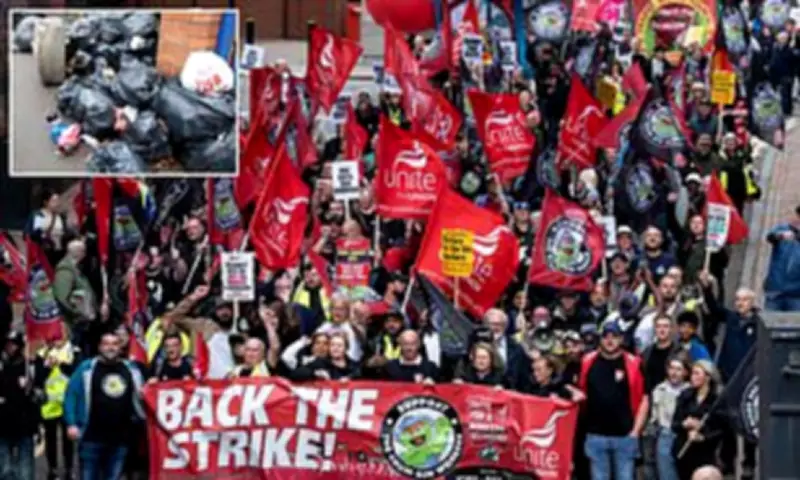
The Unite trade union has been fined £265,000 for breaching a High Court injunction during the prolonged Birmingham bin strike, with the union announcing it will cover the penalty using money that was originally intended for the Labour Party. This decision follows a year-long industrial dispute that has resulted in significant rubbish accumulation across England's second-largest city.
Court Ruling and Union Response
In a detailed 21-page judgment delivered on Tuesday, Mrs Justice Jefford imposed the substantial fine on Unite for multiple breaches of court orders related to the Birmingham bin dispute. The union had previously admitted to violations including blockading rubbish collection vehicles at depot entrances and engaging in slow-walking protests alongside moving vehicles.
Unite general secretary Sharon Graham responded to the financial penalty with notable composure, stating she was 'very relaxed' about the situation. 'Every single penny will come out of Labour's affiliation fee,' Graham declared, referencing the union's recent decision to reduce its funding to Keir Starmer's party by 40 percent, amounting to a £580,000 cut.

The judge acknowledged that Unite's apology appeared genuine but noted it was not offered until September 2025, approximately two months after the initial breaches occurred. Additionally, the court ordered Unite to pay £170,000 in costs as an interim payment within fourteen days.
Background of the Birmingham Bin Dispute
Members of the Unite union have been engaged in industrial action for over a year in Birmingham, leading to substantial rubbish buildup throughout the city. Labour-run Birmingham City Council initiated legal proceedings in May of last year after Unite violated a High Court injunction that specifically prohibited the obstruction of rubbish collection vehicles.
In her ruling, Mrs Justice Jefford expressed skepticism about Unite's compliance with court assurances, stating: 'I cannot accept that when Unite offered an assurance that protesting would be limited to the assembly areas, anyone giving instructions for that assurance to be offered would have intended that the protests could just be moved a few hundred metres away from the depots so that the vehicles that had left the depots could then be obstructed and delayed at a different point in their route.'
The judge further emphasized that 'It would make a nonsense of the order if, once the wagons had exited the depots, a few yards down the road their progress could be obstructed by protests outside the designated assembly areas.'
Union's Defiant Stance and Council's Position
Sharon Graham maintained a defiant position regarding the fine and the ongoing dispute, characterizing the legal action as 'yet another pathetic attempt to intimidate workers' that would prove ineffective. She asserted that Unite would not allow workers to bear financial consequences for what she described as council failures.
'Instead of using Thatcher's anti-union laws to injunct the picket line and stop lawful protest, the council should honour the deal scoped out at Acas,' Graham argued. 'They walked out of the room, said they would be back with the deal in writing, and never returned.'
The union leader highlighted that Birmingham City Council had reportedly spent £33 million of residents' money attempting to break the strike rather than resolving the dispute. 'It won't be broken – these workers are fighting for council workers everywhere,' she declared.
Majid Mahmood, Birmingham City Council's cabinet member for environment and transport, expressed satisfaction with the court's decision, stating: 'We are pleased the judge has accepted the evidence that members of Unite the Union repeatedly breached the injunction ordered by the court last year.'
Mahmood emphasized the council's commitment to maintaining essential services, noting: 'We are working to keep the city safe and clean. This judgment confirms that Unite has tried to prevent us from collecting our residents' bins and to fill the city up with rubbish.'

The council representative added that the substantial fine, along with the interim costs payment, would 'send a clear message about what is acceptable behaviour and what is not.' He reiterated that while everyone has the right to protest, 'What is not acceptable is for pickets to obstruct vehicles and prevent people from doing so.'
Broader Implications for Labour Funding
This development represents a significant escalation in tensions between Unite and the Labour Party, coming shortly after the union's announcement of reduced financial support. The decision to redirect funds originally intended for Labour affiliation fees to cover legal penalties underscores the deepening rift between the union and the political party it has traditionally supported.
Graham made the union's position unequivocally clear: 'So, Labour will be paying for this one and any others that come our way.' This statement suggests potential future conflicts that could further strain the relationship between the trade union and the political party.
The Birmingham bin strike continues to highlight broader issues surrounding industrial relations, local government management, and the complex dynamics between trade unions and political parties in contemporary British politics.