Trump's State of the Union Address Reveals Fading Charisma and Persistent Offence
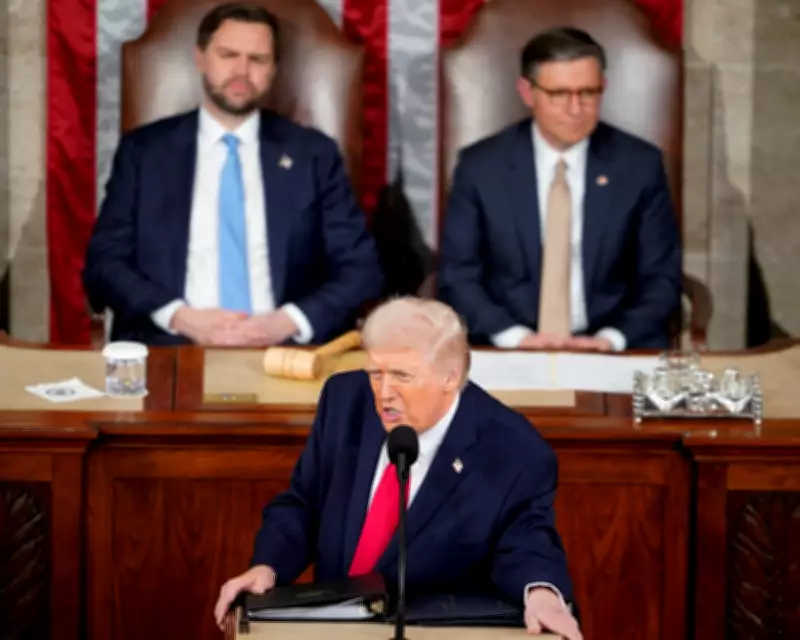
Donald Trump's recent State of the Union address has starkly illustrated a significant shift in his public persona. While the former president has long been known for his ability to captivate and provoke, this speech demonstrated that he may have lost the capacity to entertain, yet he retains, undeniably, the power to offend. The nearly two-hour address was characterised by fatigue, falsehoods, and a notable absence of substantive policy proposals, leaving many to question the relevance of such traditions in modern politics.
A Rambling and Tired Performance
Throughout the speech, Trump appeared visibly weary. He struggled with the teleprompter, gripping the podium with an intensity that bordered on desperation. As the broadcast progressed, his voice grew audibly raspy, betraying his age and perhaps the exhaustion of his speechwriters. The address meandered through familiar themes, including attacks on immigrants, assertions of his opponents' dishonesty, and personal grievances, but offered few new ideas. Contradictions and misrepresentations of facts were frequent, with little attention paid to the nation's most pressing concerns as identified by polls.
Trump frequently paused to address veterans in the audience, awarding them medals in what seemed like stunts for television. He digressed into a lengthy and peculiar discussion about the US men's hockey team's recent Olympic gold medal victory, with team members parading into the House chambers adorned with their medals. A decade ago, Trump famously merged governance with entertainment, but this long-winded and dull spectacle suggested that even his ability to engage an audience has waned.

Offensive Claims and Hypocrisy
Despite the lack of entertainment value, Trump's capacity to offend remained intact. He falsely claimed to have reduced healthcare costs, despite his attacks on Affordable Care Act subsidies leading to significant premium increases for many Americans in recent months. In a non-sequitur tangent, he targeted the rights of transgender children. With vulgar brazenness, he asserted that his administration's kidnapping of Venezuelan leader Nicholas Maduro and subsequent economic blackmail were creating opportunities for the Venezuelan people.
Trump also blamed Democrats for withholding funding from the Department of Homeland Security, alleging it hindered snow clearance efforts during an east coast blizzard, despite the federal agency not being involved in such tasks. Even his filler lines reeked of hypocrisy, such as when he spoke of building a nation where every child has a chance to succeed, a sentiment that starkly contrasted with the reality of children like Liam Ramos, detained in ICE camps, whose futures have been sacrificed to the administration's racist policies.
Scapegoating Immigrants
In typical fashion, a substantial portion of the speech was dedicated to attacking immigrants. Trump smeared them in terms reminiscent of algorithm-driven social media, blaming them for reckless driving due to an inability to read English road signs and for crime, with graphic descriptions of violence attributed to undocumented immigrants. Perhaps most gallingly, he accused immigrants, particularly Somali-Americans in Minnesota, of importing corruption to the United States, employing a racist line of reasoning previously advanced by his vice president, JD Vance.
This accusation ignored Trump's own history of accepting large sums from wealthy individuals and companies with business before his administration. If corruption is a concern, Trump need only look in the mirror to find its source in America.
Political and Economic Context
The flimsy material and tepid performance come at a critical time for Trump, as his poll numbers are plummeting. Recent aggregations show his approval rating at a feeble 38%. Economic challenges persist, with inflation not decreasing as promised and tariffs burdening consumers, despite a Supreme Court decision against them. While Trump boasts of a booming stock market, much of this growth is tied to speculative investments in AI, which could vanish if the technology fails or reduce consumer power if it succeeds, leaving many American workers feeling strapped and suffering.

Trump's speech, however, blithely insisted that everything is fine, offering no solace or solutions to these struggles.
A Moment of Outdated Civility
The most memorable moment of an otherwise forgettable evening occurred when Trump berated Democrats, calling them "crazy" and accusing them of destroying the country. Republicans applauded, but Democrats sat in polite tolerance, raising questions about why they endured such smears and why they attended at all. This scene underscored another tradition Trump has rendered obsolete: civility in political discourse.
In summary, Trump's State of the Union address revealed a leader struggling to maintain his once-formidable entertainment value while continuing to offend with falsehoods and divisive rhetoric. It highlighted the absurdity of long-held political traditions in an era where facts are often divorced from policymaking, leaving many to wonder about the future of such ceremonies and the state of American democracy.