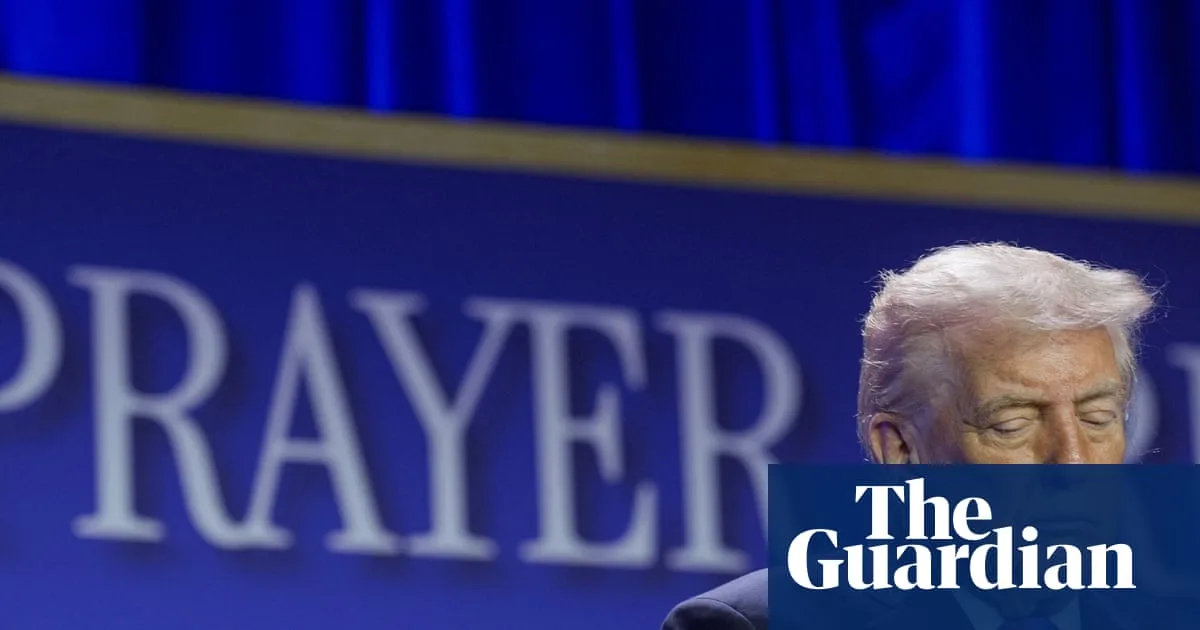
President Donald Trump delivered a meandering and controversial speech at the National Prayer Breakfast in Washington DC on Thursday, drawing criticism for its political tone and factual inaccuracies. The event, traditionally a bipartisan gathering focused on faith, saw Trump veer into campaign-style rhetoric, attacking political opponents and boasting about his election victory.
Trump, wearing a dark suit and purple tie, touched on a range of topics unrelated to prayer or breakfast, including what he called 'transgender insanity', criticism of wind farms, and a description of Greenland as 'the biggest piece of ice in the world'. He also repeated the false claim that the 2020 election was 'rigged' and mocked his predecessor Joe Biden, referring to him as 'Sleepy Joe' or 'Crooked Joe'.
The president also made personal insults, calling Republican Representative Thomas Massie of Kentucky a 'moron', and questioned how 'a person of faith can vote for a Democrat'. He praised El Salvador's President Nayib Bukele, despite documented human rights concerns, and struggled to recall the name of Congolese President Félix Tshisekedi, instead referring to him as 'the president'.

Trump's speech highlighted the ongoing alliance between the Republican Party and right-wing evangelicals, who view him as a modern-day Cyrus the Great—a flawed instrument chosen by God to achieve political goals. This 'devil's pact', as described by critics, prioritises policy victories over traditional Christian values, with Trump himself acknowledging a pastor's assessment that he 'may not have ever read the Bible' but would 'get things done'.