The White House's Columbus Statue: An Editorial Decision, Not a Historical One
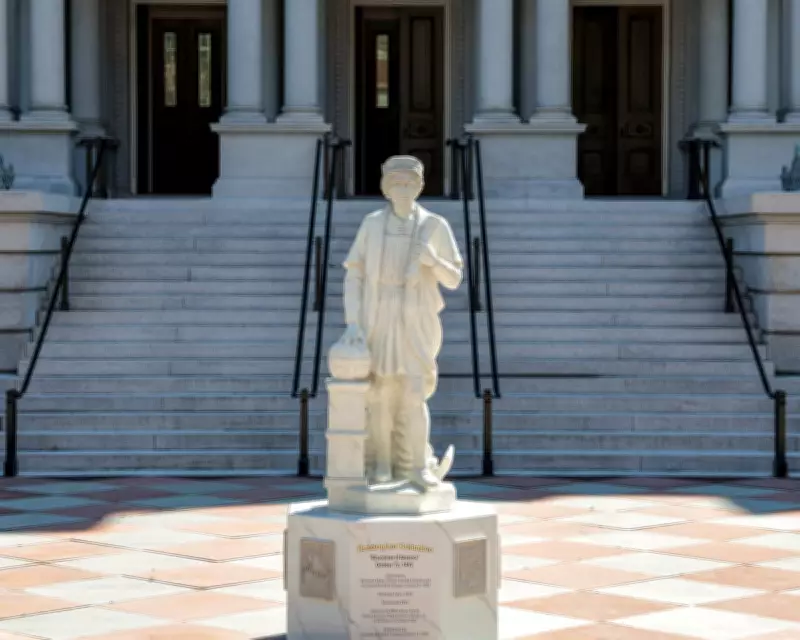
The Trump administration has recently taken a definitive stance on a figure with a well-documented record of genocide and enslavement. Following the installation of a statue on the grounds of the Eisenhower Executive Office Building, a White House spokesman declared, "In this White House, Christopher Columbus is a hero." This statement warrants careful examination, as it reveals a profound shift in how historical narratives are constructed and enforced at the highest levels of American power.
Heroism as a Narrative Choice
In the civic sense, a hero is not merely an admired individual but someone whose story a nation collectively agrees to tell in a specific manner. Heroism, therefore, represents a narrative decision. When the White House erects a statue and proclaims the depicted figure a hero, it is not making a historical claim based on evidence. Instead, it is making an editorial assertion, claiming the authority to determine which version of the past occupies the symbolic seat of American power or stands on its grounds.
The historical record surrounding Columbus is unambiguous and extensively documented. The Indigenous Taíno population collapsed catastrophically within decades of his arrival, devastated by forced labor, systematic starvation, and widespread violence. Columbus personally authorized the enslavement of Indigenous peoples and the trafficking of women and girls, facts recorded by his own contemporaries. These accounts have existed for centuries, yet powerful individuals and institutions have repeatedly and deliberately set them aside to propagate a more beneficent and self-serving narrative.

The Function of Monuments in Power Dynamics
Honoring Columbus at the White House does not necessitate the discovery of these uncomfortable facts. It requires a conscious decision that they do not matter. This approach is hardly without historical precedent. Monuments have never been neutral artifacts; leaders and their acolytes have consistently used them to simultaneously honor certain ideologies and terrorize dissenting voices. This explains why hundreds of Confederate statues were erected long after the Civil War, predominantly during the early and mid-1900s, to reinforce a specific racial and social order.
Columbus now serves a similar function. By choosing to honor a demonstrably dishonorable figure, the president is not engaging in a historical debate. He is undertaking something far more perilous. America now has a commander-in-chief who examines a documented record of genocide and enslavement, decides it changes nothing, and then insists that the public accept this conclusion.
A Replica as a Political Statement
The statue installed last week is a precise replica of one that protesters toppled and dumped into Baltimore's Inner Harbor during the summer of 2020. This period followed the murder of George Floyd by Minneapolis police officer Derek Chauvin, sparking a national reckoning with racial injustice and historical symbols. For generations, Columbus has occupied American civic space as a sanitized founding hero, laundered through myth into a figure children are taught to celebrate. Many learned the simplistic rhyme – "In 1492, Columbus sailed the ocean blue" – without ever confronting the brutal aftermath of his voyages.
Those protesters understood their actions perfectly. They were contesting a dominant narrative: rejecting the claim that conquest is inherently heroic, that the suffering underpinning American mythology is irrelevant, and that communities harmed by that mythology should continue to live in the shadow of its monuments. They were not rewriting history; they were refusing the version imposed upon them by more powerful forces. President Trump's response has been to install a replica of that very statue on the White House grounds, a deliberate and symbolic counter-statement.
Beyond the 'Culture War' Framing
When such events are framed as mere skirmishes in a "culture war," it mischaracterizes the conflict as a symmetrical dispute over the meaning of the past, with both sides possessing equal claim to the story. This framing entirely misses the critical power differential at play. Identity is not a distraction from power; it is a fundamental mechanism through which power operates and is maintained.

This governing logic, where history imposes no obligation, is evident in broader policy. At the United Nations, the United States recently voted against a resolution declaring the transatlantic slave trade a crime against humanity. In Florida, the state attorney general demanded the NFL abandon its Rooney Rule, a policy requiring teams to interview minority candidates for coaching and executive roles. Both actions reflect a worldview where power acknowledges a historical harm only to rewrite the narrative, making any obligation arising from that harm appear as the real injustice. Acknowledging the past becomes pointless if we excuse ourselves from addressing its enduring consequences.
A Worldview of Conquest and Overwriting
This administration has spoken openly about the United States "taking" Cuba, framing sovereign peoples as objects to be overwritten rather than agents of their own destiny. Columbus fits this worldview with unsettling precision: a figure who wrote over existing civilizations and labeled it "discovery," whose violence was folded into a founding national legend because the legend demanded it.
Installing this statue at the White House at this moment is no coincidence. It is a deliberate declaration of narrative intent. It seeks to render debate irrelevant and turn objection into mere background noise. President Trump does not feel compelled to defend conquest, whether in international contexts like Iran and Venezuela or within domestic history. He merely requires public acceptance of it.
The Enduring Power of Symbols
There is a superficial interpretation where the statue is mere provocation, political theater designed to generate temporary outrage before the news cycle moves on. However, symbols do more than reflect power; they instruct the public on which stories are authoritative, which forms of power are worthy of honor, and who possesses the authority to decide when a counter-narrative carries sufficient weight to matter.
This particular symbol communicates a clear message: the verdict delivered by protesters in the summer of 2020 – through the toppling of monuments and a national confrontation with what those monuments truly celebrated – did not bind anyone with sufficient power to simply ignore it. Why engage in the tedious work of denying history when you believe the presidency grants you the authority to edit it directly?
Contesting Stories and Carrying History Forward
The protesters who dumped Columbus into Baltimore's harbor were telling a story. So were the Indigenous scholars and journalists who have dedicated careers to documenting what Columbus actually did and the cost of perpetuating the myth. So were the communities that witnessed those statues fall.
A nation does not move beyond its history by refusing to reckon with it. It carries that history forward – not as passive memory, but as active permission for present actions. The core question is no longer what Christopher Columbus did. If pressed, most Americans possess enough knowledge. The pivotal question is whether that knowledge is permitted to matter in public life and civic memory, and, crucially, who gets to make that decision.
The protesters six years ago provided one answer. President Trump has now provided a starkly different one. The American story contains ample room for historical truth, but the current occupant of the Oval Office persistently chooses myth. The enduring question remains: who will step forward to correct this course?