Trump's AI Jesus Depiction Pushes Christian Alliance to Breaking Point
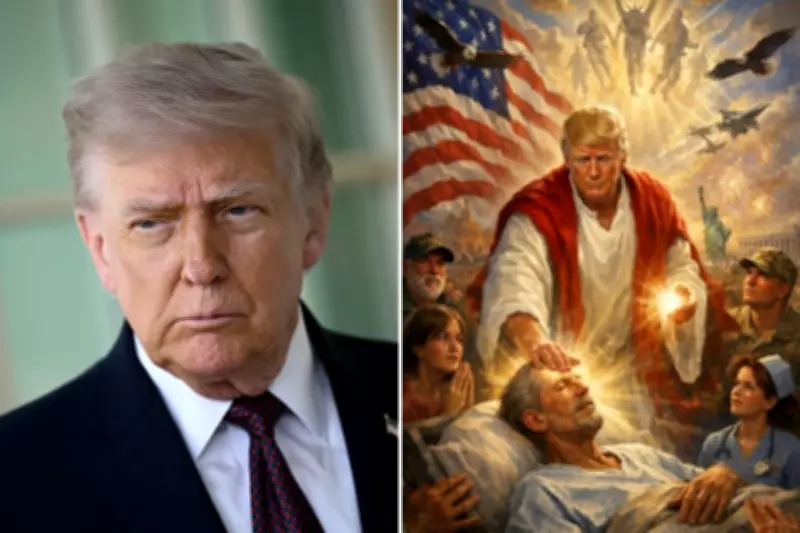
Donald Trump has pushed an already-fragile alliance of conservative Catholics and evangelicals to the breaking point with his latest controversial social media posts. The former president shared an AI-generated image depicting himself as Jesus Christ healing the sick, immediately sparking a wave of criticism from Christian allies who have thus far aligned with his volatile political agenda.
Blasphemy or Political Strategy?
Before posting the AI Jesus image, Trump had assailed Pope Leo XIV as "weak" and told him to "get his act together." Months earlier, the White House had posted another AI-generated image showing Trump as the head of the Catholic church, with the president declaring, "I'd like to be pope." These actions represent a pattern of behavior that is testing the limits of religious tolerance among his conservative Christian supporters.
The response to Trump's latest posts was swift and explicit from many Christian leaders. Descriptions ranged from "grotesquely wrong" and "dangerous" to "rank blasphemy." However, the reaction has revealed deep divisions within the right-wing Christian community about where to draw the line between political loyalty and religious conviction.

Fracturing Religious Alliances
"This moment tests more than just the Catholic-evangelical alliance," said Landon Schnabel, an associate professor of sociology at Cornell University who studies religion and social change. "For many religious Americans, faith leads and politics follows—their beliefs and values shape their political positions. But when a president posts himself as Christ, he asks believers to start with political loyalty and backfill the theology."
Schnabel emphasized that in the face of conflicting commitments to religious convictions and political loyalties, "something has to give." This tension has been building for months as Trump has shown increasing hostility toward Catholic leadership while his administration has characterized potential war with Iran as divinely ordained.
The Christian Nationalist Movement
Trump and his allies have successfully shaped a Christian nationalist movement into a critical voting bloc. This movement, driven by the belief that Christianity should be embedded in all aspects of law and society, has spent decades gaining influence in media and government at federal, state, and local levels. Evangelical groups have spent millions of dollars campaigning for Trump, while right-wing special interest groups have turned anti-abortion voters into a powerful GOP base that helped put Trump in the White House twice.
Trump administration officials and federal agencies are increasingly using official government social media accounts to share explicitly religious messages and declare Jesus the nation's savior. This has drawn warnings from First Amendment advocates who fear a critical breach of the church-and-state separation that has long been a cornerstone of American democracy.
Diverging Responses Among Christian Leaders
Despite the backlash to Trump's post, many influential evangelical figures have not publicly weighed in, declined to comment, or withdrawn their previous criticism after Trump claimed the AI-generated picture showed "me as a doctor." This response pattern reveals the complex calculations religious leaders are making between their theological principles and political allegiances.
Pastor Robert Jeffress, a longtime religious adviser to Trump who leads First Baptist Church in Dallas, declined to comment on the AI-generated image but defended Trump's criticism of Pope Leo, saying there was "no need" for Trump to apologize to the pontiff.
John Yep, president of the Trump-aligned group Catholics for Catholics, called the president's post "as dangerous as it is scandalous to all Christians." However, in the same statement, Yep also condemned what he characterized as a "well-organized attempt by the left to sever the Catholic base from the Republican Party" and criticized "left-leaning 'Catholics in name only'" who "are determined to swing the Catholic vote back in the other direction."

Polling Reveals Christian Nationalism's Hold
Recent nationwide polling from the Public Religion Research Institute reveals that a majority of Republicans—roughly 56 percent—qualify as Christian nationalist adherents or sympathizers. Overall, approximately one-third of Americans could be considered adherents or sympathizers of Christian nationalist ideology.
"For another year, our survey reveals the continued hold that Christian nationalism has on the Republican Party and its white evangelical base," according to PRRI president Robert P. Jones. "While Americans overall reject this worldview by a margin of two to one, its dominance among these groups amplifies it into an ongoing threat to our pluralistic democracy."
Theological Concerns Versus Political Calculations
Bonnie Kristian, a staff editor at the Billy Graham-founded evangelical Christian media magazine Christianity Today, wrote that Trump is "grotesquely wrong to elevate himself to the level of Christ and claim for himself authority over Christ's church." She emphasized that "the elevation in that image is not debatable" and rejected Trump's claim that it showed him "as a doctor, making people better."
Former Southern Baptist Convention president Bart Barber said he typically takes "every effort" to avoid criticizing the president but implored him "not to do things like this." Barber wrote, "Forget the politics. Forget the backlash or affirmations it generated. Someday you will stand before God and will have to defend this. It is a terrifying thing to fall into the hands of the living God."
Pastor Doug Wilson, a leading figure in the Christian nationalist movement, said he was "very grateful to see how many conservative Christians immediately denounced the blasphemous" image of Trump as a Christ-like figure. However, Wilson characterized it as "accidental blasphemy" and told The Washington Examiner that Trump "has to do better either way."
Political Consequences and Future Implications
The episode raises significant questions about the future of the conservative Christian political coalition. While conservative Catholics and evangelical Christians have largely agreed on a whole-of-government approach to ending abortion—a decades-in-the-making political project that radically reshaped the federal judiciary and overturned Roe v. Wade at the Supreme Court—Trump is now forcing his supporters to confront deeper religious questions framed as politics.
Vice President JD Vance, who is Catholic, told Fox News that the pope should "stick to matters of, you know, what's going on in the Catholic Church" and "let the president of the United States stick to dictating American public policy." Vance added, "When they are in conflict, they are in conflict. I don't worry about it too much."
Tennessee state Representative Jeremy Faison, chair of the state's House GOP, initially wrote that he "never imagined we'd reach a point where politicians would compare themselves to the Savior" and declared that "regardless of your opinion on the president, that post is wrong." However, after Trump claimed the image depicted him "as a doctor," Faison deleted his critical post, saying he found the president's explanation "plausible."
This pattern of initial criticism followed by retraction or qualification illustrates the difficult position in which many conservative Christian leaders find themselves as they navigate the competing demands of theological integrity and political loyalty in the Trump era.