Trump's AI Jesus Image Ignites Blasphemy Controversy Across Religious Communities
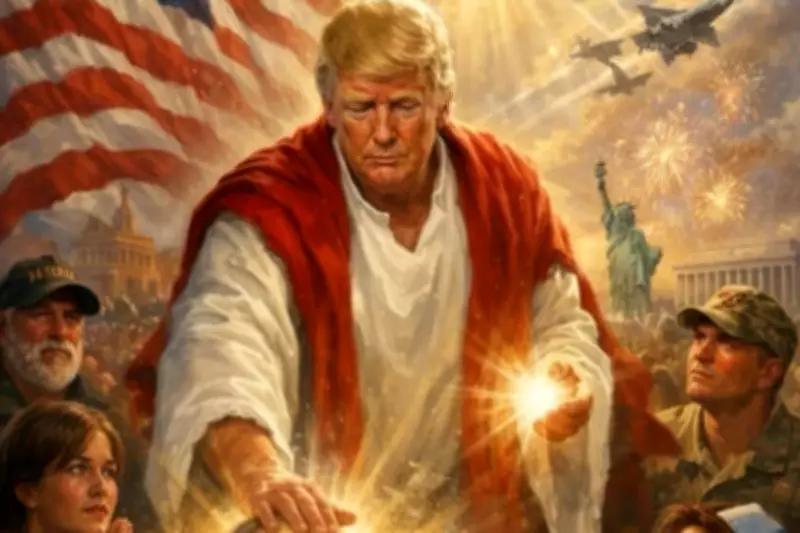
This week, former President Donald Trump posted an AI-generated image on his Truth Social platform that has sparked widespread controversy and accusations of blasphemy. The image depicted Trump dressed in white robes, placing a glowing hand over an ill or deceased man in a hospital bed, appearing to heal or resurrect him in a manner reminiscent of Jesus Christ.
Immediate Backlash and Deletion
The post was widely interpreted as Trump presenting himself as a Messianic Jesus figure, prompting immediate backlash from religious groups across the political spectrum. Conservative Catholic organization CatholicVote.org was among the first to denounce the image as blasphemous. Within hours, Trump deleted the post and offered an explanation to reporters, claiming he thought it showed him "as a doctor" and dismissing the Jesus interpretation as "fake news."
Prominent conservative Protestant writer Megan Basham declared on social media platform X: "I don't know if the President thought he was being funny or if he is under the influence of some substance or what possible explanation he could have for this OUTRAGEOUS blasphemy. But he needs to take this down immediately and ask for forgiveness from the American people and then from God."

Conservative Christian Reactions
Pastor Doug Wilson, who recently led a prayer service at the Pentagon and founded the network of churches that includes War Secretary Pete Hegseth, expressed gratitude for the swift condemnation from conservative Christians. "I was very grateful to see how many conservative Christians immediately denounced the blasphemous Jesus/Trump image," Wilson stated, highlighting the unusual consensus across theological lines regarding the post's problematic nature.
Understanding Blasphemy in Christian Tradition
Within Christian theology, blasphemy represents speech, thought, or action that shows contempt for or mockery of God and sacred matters. The concept originated from Old Testament injunctions against reviling God, where it was treated as a capital crime punishable by death. The New Testament expanded this to include rejection of Jesus, and medieval Christianity specifically considered posing as Jesus or asserting powers belonging only to him as blasphemous.
Professor Philip C. Almond, Emeritus Professor in the History of Religious Thought at the University of Queensland, explains: "More particularly, posing as Jesus or asserting powers that belong only to him was considered blasphemous in medieval times. The 'Christs' that emerged were treated harshly, as dangerous heretics. This is where Trump's presentation of himself as Jesus would undoubtedly be considered blasphemous."
Historical Evolution of Blasphemy Laws
From the 17th century onward, blasphemy evolved from being primarily an offense against God to one against society. In early modern Europe, blasphemy was viewed as socially and politically subversive. The concept traveled to the American colonies, where Virginia's first law code specified death for blaspheming the divine Trinity.
Despite the First Amendment's protection of free speech, blasphemy laws persisted in the United States until the Supreme Court ruled they infringed on free speech rights after World War II. Several states still technically have blasphemy laws on their books, though they are rarely enforced.
International Blasphemy Context
England's Blasphemy Act of 1697, which criminalized denial of the Holy Trinity, the truth of Christianity, or the divine authority of the Bible, carried over into Australian and New Zealand colonies. While blasphemy is no longer an offense under Australian federal law, state laws vary considerably. New Zealand's criminal code still addresses "blasphemous libel" as part of "crimes against religion, morality and public welfare."
Islamic Perspectives on Blasphemy
The controversy extends beyond Christianity. While Islam has no exact equivalent to "blasphemy," the concept of the "word of infidelity" serves a similar function, amounting to mockery of God, the prophet, or Islamic tradition generally. Trump's recent post mockingly declaring "Praise be to Allah" was viewed as blasphemous by Muslim communities.

The Islamic advocacy group Council on American-Islamic Relations called the post "disturbing" and "offensive to Muslims," while conservative commentator Dinesh D'Souza compared it to the Old Testament account of the prophet Elijah mocking the prophets of Baal.
Modern Implications and Secular Perspectives
In contemporary secular societies, the question of blasphemy often centers on intent rather than theological offense. Professor Almond notes: "It is not blasphemous to speak or publish opinions that are hostile to Christianity, Judaism or Islam – or, for that matter, any religion. What matters is not so much the substance of criticism as the manner in which it is made."
The key distinction lies in whether criticism crosses into "religious hate speech." From a secular perspective, Trump's post may represent "more self-indulgent foolishness than hate speech – but nonetheless, extremely inappropriate for a US president," according to religious experts analyzing the incident.
Broader Significance of the Controversy
This incident raises important questions about the intersection of technology, politics, and religion in the digital age. The use of AI-generated imagery to create potentially blasphemous content represents a new frontier in religious controversy. Additionally, the unified condemnation from typically divided religious groups highlights the seriousness with which many believers view representations that blur the lines between political figures and divine beings.
As society continues to navigate the complex relationship between free expression and religious sensitivity, incidents like Trump's AI Jesus image serve as important case studies in how ancient concepts of blasphemy adapt to modern technological and political realities.