Trump's $1.5 Trillion Defence Budget Sparks Clash with Congress Over Domestic Cuts
President Donald Trump has officially unveiled his 2027 budget, seeking a monumental $1.5 trillion in defence spending—the largest such request in decades—while proposing significant reductions to domestic programs. The budget arrives as the House and Senate remain deadlocked over current-year spending, particularly regarding Department of Homeland Security funding.
Historic Defence Increase and Domestic Reductions
The president's plan would boost Pentagon funding dramatically, a move telegraphed even before the U.S.-led war against Iran. Concurrently, it aims to cut non-defence spending by 10% by shifting some responsibilities to state and local governments. This reflects Trump's emphasis on military investments over domestic initiatives.
"President Trump promised to reinvest in America’s national security infrastructure, to make sure our nation is safe in a dangerous world," wrote Budget Director Russell Vought in a statement.

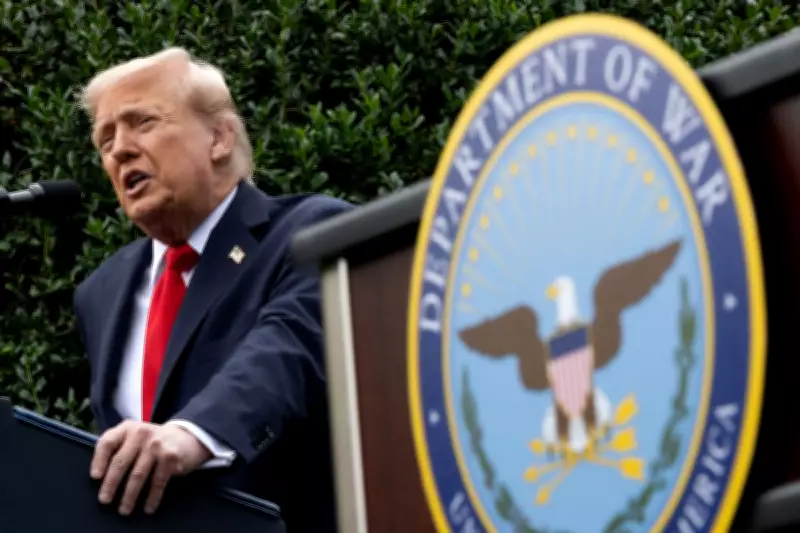
Trump himself underscored this priority ahead of a national address on the Iran conflict, stating at a private White House event, "We’re fighting wars. We can’t take care of day care... It’s not possible for us to take care of day care, Medicaid, Medicare—all these individual things. They can do it on a state basis. You can’t do it on a federal."
Key Budget Priorities and Cuts
The White House outlined several specific allocations and reductions:
- Support for immigration enforcement by eliminating refugee resettlement aid, maintaining ICE funds, and expanding detention facilities with 100,000 adult and 30,000 family beds.
- A 13% increase for the Department of Justice to target violent criminals and so-called "migrant crime."
- A $10 billion National Park Service fund for Washington, D.C. construction and beautification projects.
- A $481 million increase to enhance aviation safety and hire more air traffic controllers.
Conversely, the budget proposes substantial cuts:
- Cancellation of over $15 billion from bipartisan infrastructure law funds, including renewable energy projects and environmental justice programs.
- Reductions to NOAA climate change grants.
- A 19% cut to the Department of Agriculture, ending certain university grants.
- A 13% cut for Housing and Urban Development and about 12% for Health and Human Services, affecting low-income heating assistance.
- Elimination of $106 million from the Agency for Healthcare Research and Quality, which the administration claims has "pushed radical gender ideology onto children."
Political Reactions and Congressional Battle
Republican leaders praised the defence spending request. "America is facing the most dangerous global environment since World War II," said Sen. Roger Wicker and Rep. Mike Rogers, chairs of the Senate and House Armed Services committees.
Democrats, however, condemned the cuts. Rep. Brendan Boyle, top Democrat on the House Budget Committee, stated, "This budget represents ‘America Last.’" Sen. Patty Murray, leading Democrat on the Senate Appropriations Committee, called it morally bankrupt, contrasting Trump's focus with her own priorities: "Trump wants to build a ballroom—I want to build more affordable housing."
Budget Process and Fiscal Context
The president's annual budget, while reflecting administration values, lacks legal force and often faces rejection by Congress. This year's document serves as a roadmap amid ongoing disputes over 2026 spending and a 49-day partial government shutdown.
With annual deficits nearing $2 trillion and debt exceeding $39 trillion, fiscal pressures are acute. About two-thirds of the $7 trillion annual budget covers mandatory programs like Medicare, Medicaid, and Social Security. The remaining discretionary spending, typically split between defence and domestic accounts, is where congressional debates intensify.

The administration plans to secure $1.1 trillion for defence through regular appropriations requiring bipartisan support, while using budget reconciliation for $350 billion, allowing Republicans to pass it with majority votes alone. This strategy mirrors last year's success, when Trump signed a tax breaks bill providing $150 billion for the Pentagon and $170 billion for immigration operations.
As Congress remains tangled over current-year spending, Trump announced an executive order to pay DHS workers affected by the shutdown, highlighting the ongoing stalemate over immigration enforcement that Democrats seek to change.