Trump Transforms ICE into Personal Police Force to Tackle Political Challenges
Millions of Americans have witnessed firsthand Donald Trump's authoritarian tendency to deploy law enforcement and military personnel as instruments for resolving his political dilemmas. The president, following months of urban violence and disorder, is cynically exploiting the presence of armed Immigration and Customs Enforcement officers across more than a dozen major airports to coerce Democratic lawmakers into supporting his legislative agenda.
Performative Deployments and Political Posturing
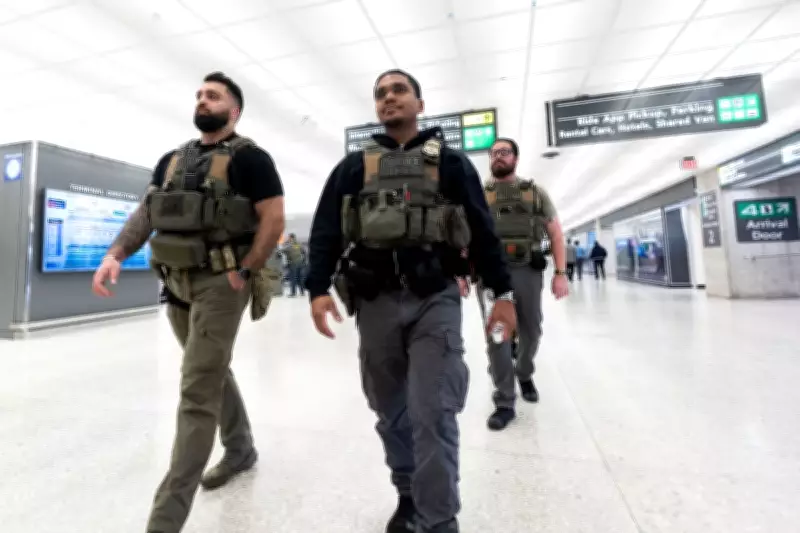
Instead of actively managing security operations, ICE officers have frequently been observed idling near barricades, engaging in phone conversations, and gazing at extensive security queues they cannot expedite. This represents the latest in a series of largely theatrical deployments and politically driven maneuvers designed to compel Democratic compliance while simultaneously unleashing violent, sometimes deadly, force against both citizens and immigrants.
Whether mobilising ICE and Border Patrol agents into Minneapolis or summoning National Guard troops to collect trash in Washington D.C., Trump consistently treats federal law enforcement and a federalised military as his private army. A federal judge previously described this approach as "a national police force with the president as its chief."

Manufactured Crises and Community Terror
Democratic officials and civil rights organisations have accused the president of fabricating successive crises to justify military and police presence in states and cities, only to claim "victory" when forces withdraw to new locations, leaving traumatised communities behind. In his second term, devoid of advisers willing to challenge his impulses, Trump is amplifying tactics attempted during his first administration, when he allegedly encouraged police to "crack skulls" and "beat the f*** out" of protesters.
During the Minnesota surge, thousands of immigrants were arrested under pretexts of widespread fraud, which local officials labelled an "invasion," yet none of those arrests connected to the initial fraud allegations. ICE and Border Patrol agents killed two individuals, with another dying in custody, contributing to an in-custody death toll that is on course to be the deadliest in decades.
Costly Deployments and Questionable Outcomes
Approximately 2,500 National Guard personnel were redeployed from their home states to patrol Washington D.C., addressing what Trump termed an "epidemic of crime." However, members of Congress "cannot point to tangible crime reduction successes specifically tied to their efforts." The Congressional Budget Office estimated that domestic troop deployments last year incurred costs nearing half a billion dollars.
Eager to conclude a partial government shutdown triggered by Democratic refusals to increase Homeland Security funding without safeguards against future violence and warrantless arrests, Trump stationed ICE officers at no fewer than fourteen airports where travellers endure hours-long security waits. Within a single week, he twice proposed sending National Guard troops into airports as well.
Conflicting Narratives and Operational Confusion
The White House maintains that ICE officers are providing assistance by distributing water, reserving spots in security lines, and, in one instance, aiding an unresponsive infant at John F. Kennedy International Airport. Press secretary Karoline Leavitt highlighted these efforts, while a Homeland Security spokesperson noted officers received "standard TSA training curriculum" to support operations.
Nevertheless, Transportation Security Administration agents, unpaid for over a month due to the DHS shutdown, argue ICE cannot perform their duties. One worker vented to New York magazine, stating, "They're the reason that we're not getting paid... They arrived on Monday, and now they're hanging out in the break room doing nothing."

Political Warnings and Legislative Stalemates
ICE's presence appears intended as a caution to Democrats and Republicans unwilling to break a filibuster to advance Trump's agenda: fund DHS and enact sweeping election legislation targeting transgender Americans, or confront continued disruptions. White House spokeswoman Abigail Jackson asserted, "President Trump's brilliant idea to send ICE to airports has helped make the travel process smoother for travellers and provided much-needed relief to TSA employees."
After repeatedly dismissing Democratic proposals to fund TSA separately while negotiating broader DHS plans, Republicans reportedly urged the White House to declare a state of emergency to circumvent legislative processes. Trump later announced he would sign an order to "immediately pay" TSA agents, and the Senate subsequently passed a measure funding DHS—excluding ICE and Border Patrol for now. Democratic Senate Minority Leader Chuck Schumer remarked, "This could have been done three weeks ago."
Expert Warnings and Constitutional Concerns
Former ICE lawyer turned whistleblower Ryan Schwank cautioned that ICE officers are operating "outside their experience," potentially forcing Americans to endure checkpoint systems reminiscent of Soviet and East German regimes. He warned, "At worst, it could result in a violent confrontation between a tired traveller and an inexperienced agent."
As House Republican leaders rejected the Senate deal and Congress entered a two-week Easter recess, the spectacle of ICE agents lingering in airports underscores Trump's strategy of leveraging federal force to achieve political objectives, blurring lines between law enforcement and partisan manoeuvring.