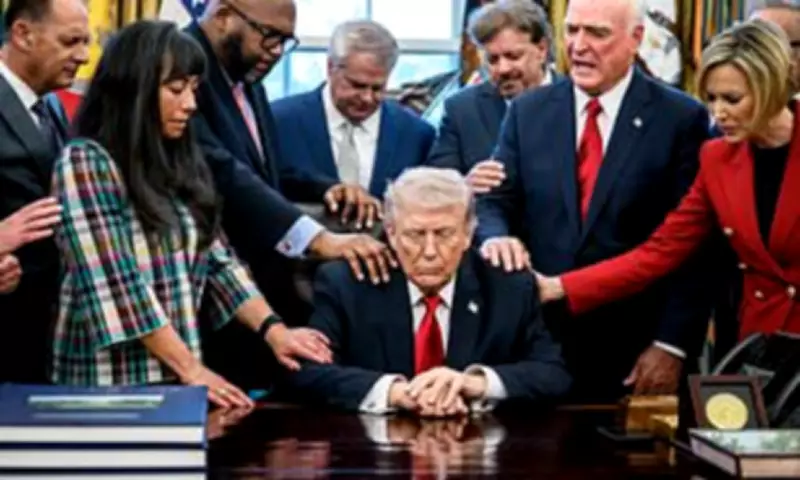
President Donald Trump convened a group of Christian leaders for a solemn prayer session in the White House, calling for divine protection over American troops as the United States intensifies military strikes against Iran. The gathering occurred on Thursday, with footage capturing the US President seated behind the historic Resolute Desk in the Oval Office, surrounded by several pastors who placed their hands on his shoulders.
A Moment of Spiritual Reflection Amid Conflict
The prayer was led by a pastor who asked for grace and safeguarding over President Trump and all members of the US armed forces. "I pray for your grace and protection over him," the pastor declared, while other clergy members bowed their heads in unison, echoing his words. The prayer continued with a plea for guidance and strength for Trump as he navigates the nation through the ongoing conflict, with the President remaining seated and eyes closed throughout the spiritual intercession.
Escalating Tensions in the Persian Gulf
This prayer session coincides with the seventh day of war between the US and Iran, a conflict ignited by the killing of Iranian Supreme Leader Ayatollah Ali Khamenei over the previous weekend. The Trump administration has vowed a surge in strikes on Tehran, but faces mounting discontent from Persian Gulf allies. Officials from two Gulf countries expressed disappointment in the US handling of the war, particularly the initial attack on Iran on February 28, complaining they received inadequate advance notice and that their warnings about devastating regional consequences were ignored.

White House spokeswoman Anna Kelly responded by stating, "Iran's retaliatory ballistic missile attacks have decreased by 90 per cent because Operation Epic Fury is crushing their ability to shoot these weapons or produce more. President Trump is in close contact with all of our regional partners, and the terrorist Iranian regime's attacks on its neighbours prove how imperative it was that President Trump eliminate this threat to our country and our allies."
Regional Impact and Military Casualties
The Gulf countries have become prime targets for Iran, well within range of its short-range missiles. These attacks have focused on American troops, high-profile business and tourist locations, and critical energy facilities, disrupting global oil supplies. Since the conflict began, Iran has launched at least 380 missiles and over 1,480 drones targeting five Arab Gulf nations, resulting in at least 13 civilian fatalities according to local officials.
In a tragic incident, six US soldiers were killed in Kuwait on Sunday when an Iranian drone strike hit an operations centre in a civilian port, located more than 10 miles from the main Army base. The husband of one slain soldier, who served in a supply and logistics unit based in Iowa, revealed the operations centre was a vulnerable shipping container-style building with no defences. Additional drone attacks this week caused limited fires at the US embassy in Riyadh, Saudi Arabia, and outside the US consulate in Dubai, UAE.
No Signs of De-escalation
As the conflict entered its seventh day, there were no indications of the war abating. President Trump appeared to rule out negotiations with Iran, demanding its "unconditional surrender." In a social media post on Friday, Trump stated that after Iran's surrender, "and the selection of a GREAT & ACCEPTABLE Leader(s), we, and many of our wonderful and very brave allies and partners, will work tirelessly to bring Iran back from the brink of destruction, making it economically bigger, better, and stronger than ever before."
Expanding Military Operations
Israeli warplanes conducted heavy strikes on Beirut and Tehran as Iran launched another wave of retaliatory attacks against Israel and Gulf countries. The strikes in Lebanon marked the most intense since a 2024 ceasefire ended the previous war between Israel and Iran-backed Hezbollah, prompting tens of thousands to flee Beirut's suburbs and southern Lebanon following Israeli evacuation warnings.

The US announced on Friday it had struck an Iranian drone carrier at sea, continuing an unrelenting campaign against Iran's navy that previously included torpedoing a warship in the Indian Ocean. Concurrently, Israel's military initiated "a broad-scale wave of strikes" on Tehran, with witnesses describing particularly intense airstrikes that shook homes in the area. Additional explosions were reported around Kermanshah, Iran, near multiple missile bases.
Human and Economic Toll
The war has resulted in significant casualties, with at least 1,230 people killed in Iran, more than 120 in Lebanon, and around a dozen in Israel according to officials. The conflict has already caused a spike in oil prices, with Qatar's energy minister warning it could "bring down the economies of the world" if widespread shutdowns of Gulf energy exports send oil to $150 a barrel.
As debris from Iranian drones struck iconic locations like Dubai's Palm Jumeirah hotel, and rocket trails from Israel's Iron Dome missile defence system illuminated skies over Jerusalem, the region remains embroiled in a conflict with shifting stated goals. The US has at times suggested seeking to topple Iran's government or elevate new leadership from within, while continuing coordinated strikes with Israel targeting Iran's military capabilities, leadership, and nuclear program.