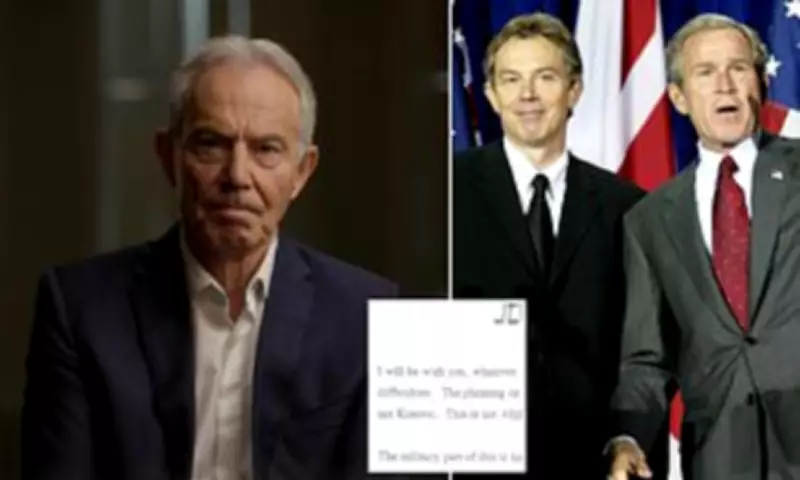
Tony Blair Stands By Controversial Iraq War Commitment in Channel 4 Documentary
Former Prime Minister Sir Tony Blair has defended his infamous 'I will be with you, whatever' note to then-US President George W. Bush in a revealing new Channel 4 documentary. The memo, first declassified in 2016, confirmed Sir Tony had committed himself in writing to backing the American president eight months before the 2003 invasion of Iraq.
Blair's Defense of the Controversial Note
In 'The Tony Blair Story', the former Labour leader was questioned about the letter by director Michael Waldman. Sir Tony insisted that people 'put far too much emphasis on the precise wording' of the note, which he wrote in July 2002 following a crucial meeting at President Bush's ranch in Crawford, Texas that April.
'I was actually trying to persuade the Americans to do something different,' Sir Tony explained. 'I wanted us to go through a UN process. I wanted to try and rally the world as far as possible. I thought it was possible that we might get Saddam to agree to the conditions that we wanted, and I knew it was important that President Bush felt I was with him on the essential issue.'

When pressed by Waldman about whether this commitment represented a 'slippery slope', Sir Tony responded firmly: 'No. Of course not. Was that a commitment that we were going to do whatever the Americans wanted? Of course not. But I was going to be with them in dealing with Saddam because I believed that was necessary, and I still do.'
Internal Criticism and Concerns
However, not everyone within Blair's government shared his perspective. Then-foreign secretary Jack Straw described the note as 'not his best moment', adding: 'I don't know quite to this day why he sent it.'
Mr Straw expressed concern that the ambiguous wording could be interpreted as 'a kind of blank cheque by the United States', potentially reducing Britain's leverage in diplomatic negotiations. He noted that while Sir Tony's ambiguous relationships could be 'brilliantly used to good effect', as demonstrated in the Good Friday Agreement, they could also lead people to 'drawing from what he was saying what they wanted to hear.'
Blair's Rationale for Supporting Military Action
Sir Tony set out his reasoning for supporting US action against Saddam Hussein, describing it as a necessary response to security threats. 'Only that regime had actually used weapons of mass destruction,' he explained, 'and the link for the US was, these terrorist groups, if they managed to get hold of weapons of mass destruction then, instead of 3,000 people dying, it'll be 30,000 or 300,000.'
He framed his decision around two key considerations: 'One, was it better to leave Saddam or remove him? For the security of the world. And number two, be with America or not?'
Intelligence and Dossier Controversy
The documentary also explores the controversial intelligence dossier that preceded the war. Sir Tony's communications director Alastair Campbell was asked to help intelligence services present their evidence about Iraq's supposed weapons of mass destruction.
When questioned about criticism that the intelligence was 'presented with a certainty that it didn't warrant', Mr Campbell responded: 'I understand lots of people made that criticism. What some people in the intelligence community will say is that you can never be certain. But I would argue there was an ultra-caution to the whole thing.'
However, broadcaster Andrew Neil offered a different perspective: 'To have the chief spin doctor of a government helping to edit and tinker with an intelligence dossier, I think it's just beyond the pale. The whole Blairite obsession with spin, of which Alastair Campbell was the prima donna, led to a dossier that was false, hyped up and inaccurate.'
Contemporary Context and Legacy
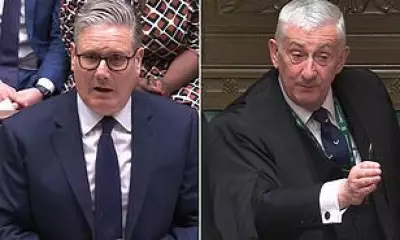
The documentary's release comes as current Labour leader Sir Keir Starmer referenced the Iraq War in a speech following the recent US-Israeli attack on Iran, stating: 'We all remember the mistakes of Iraq. And we have learned those lessons.'

The 'I will be with you, whatever' note was first revealed in the Chilcot inquiry in July 2016, which concluded that the case for war was presented with 'a certainty which was not justified'. The inquiry found the case was based on 'flawed' intelligence about Iraq's supposed WMDs that was not properly challenged.
In total, 179 British troops died in Iraq between 2003 and 2009, with approximately 4,500 US service members killed during the conflict. The documentary provides new insight into one of Britain's most controversial military engagements since the Second World War, revealing the complex diplomatic calculations and internal debates that preceded the invasion.