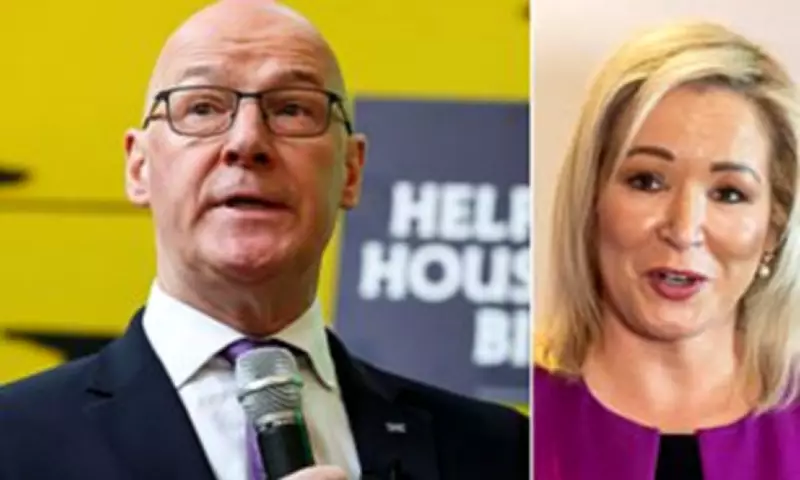
Scottish First Minister John Swinney has declared his intention to collaborate with Sinn Fein and Welsh nationalists Plaid Cymru in a concerted effort to dismantle the United Kingdom. Speaking at an election event in Edinburgh, Mr Swinney expressed his enthusiasm for working alongside these parties to advance the cause of Scottish independence, a move he believes would fundamentally and permanently alter the dynamics of the UK.
Historic Links and Political Ambitions
Mr Swinney's comments have ignited a fierce political debate, particularly given Sinn Fein's historical connections to IRA terrorism. The First Minister stated he would 'enjoy' cooperating with Sinn Fein, which currently holds the largest party position at Stormont with Michelle O'Neill as First Minister of Northern Ireland, and with Plaid Cymru, which is poised for a potential historic win in the Senedd as Labour's support wanes. This tripartite alliance of nationalist governments in Belfast, Edinburgh, and Cardiff represents a realistic scenario for the first time since devolution, raising alarms among Unionists.
Unionist Concerns and Electoral Stakes
The Scottish Conservatives have responded with stark warnings, asserting that 'the Union is on the line at this election.' Scottish Tory deputy leader Rachael Hamilton condemned Mr Swinney's remarks, stating that pro-UK voters would be 'appalled and terrified' at the prospect of such collaboration. She accused the SNP of being willing to 'team up with any party' to achieve its goal of breaking up the UK, highlighting the potential danger of an SNP majority in Holyrood, which Mr Swinney confidently predicts for May.

Former Tory cabinet minister Penny Mordaunt has previously cautioned about the risks to the Union if Sinn Fein, the SNP, and Plaid Cymru simultaneously hold power in their respective devolved administrations. She emphasized that Unionists cannot afford complacency in the face of this threat. Meanwhile, Scottish Liberal Democrat campaign chair Wendy Chamberlain suggested that only Vladimir Putin would be more excited by UK destabilization than Mr Swinney.
Strategic Implications and Psychological Impact
Mr Swinney elaborated that having three governments committed to 'fundamental change' in the UK would dramatically shift discussions between devolved administrations and the UK Government. A Plaid Cymru spokesman echoed this sentiment, noting that electing Plaid Cymru in Wales and the SNP in Scotland would create a 'powerful bloc' that should serve as a wake-up call to any future UK Labour Government.
Pollster Mark Diffley, founder of the Diffley Partnership research agency, acknowledged that Mr Swinney might be oversimplifying complexities, such as Sinn Fein's power-sharing arrangement with the Unionist DUP and Plaid Cymru's unlikely path to a majority. However, he conceded that a trio of separatist leaders could represent a significant psychological moment for England and Westminster, posing challenges for a Prime Minister focused on economic or international issues.
Criticism from Opponents
Reform UK Scotland candidate Thomas Kerr expressed outrage, describing Mr Swinney's comments as 'clumsy at best, and stoking hatred at worst,' and called for an apology. Scottish Labour deputy leader Dame Jackie Baillie criticized Mr Swinney for prioritizing 'grievance' over governance, suggesting Scotland would be better served by focusing on practical issues rather than independence campaigns.
As the political landscape evolves, with Sinn Fein aiming for a referendum on a united Ireland by 2030 and Plaid Cymru gaining ground in Wales, Mr Swinney's vision of a collaborative nationalist front underscores the escalating tensions over the future of the United Kingdom. The upcoming elections in Scotland and Wales, along with Sinn Fein's entrenched position in Northern Ireland, will likely determine whether this unprecedented alliance becomes a reality, potentially reshaping the UK in ways that many fear could be irreversible.