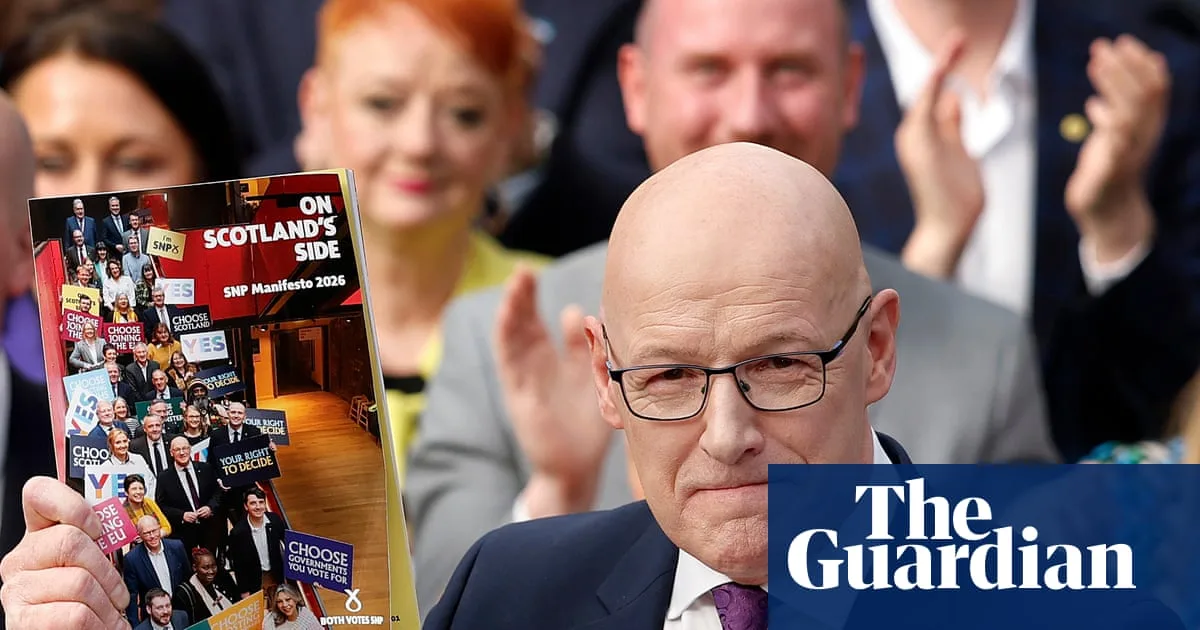
John Swinney has launched the Scottish National Party's manifesto for the Scottish Parliament election, pledging to cap supermarket prices on essential goods such as bread and milk if his party retains power. The SNP leader described the cost of living as 'the defining issue of this election' and said he would use devolved public health powers to fix prices on 20 to 50 items, including bread, milk, cheese, eggs, rice and chicken, because their rising cost was 'impacting our nation's nutrition'.
The eye-catching pledge was immediately dismissed as a 'potty gimmick' by retailers. Ewan MacDonald-Russell, deputy head of the Scottish Retail Consortium, said supermarkets already paid significantly higher rates in Scotland, £162m more over the next three years than in England. He added: 'Rather than recreating 1970s-style price controls and potty gimmicks, public policy should get serious and focus on cutting retailers' costs so that resources can be directed to keeping prices as low as possible for customers.' The Scottish Grocers' Federation predicted smaller shops could be put at a competitive disadvantage, while questions were also raised about whether discounting would force supermarkets to cut the prices they pay farmers.
At the manifesto launch in Glasgow, Swinney highlighted further cost of living measures including a £2 cap on bus fares for any journey in Scotland taken on one service. The party said that would cost £210m by 2032. The Scottish Greens, who pledged universal free bus travel in their manifesto, revealed that the SNP had rejected a similar proposal in budget negotiations last year.

Swinney claimed that an independent Scotland would be able to control energy prices, arguing that cutting them would 'be on the ballot' at this election. He was unable to name any specific policies to cut bills but said domestic electricity could be made cheaper by ending the system where the price was linked to the cost of gas used in backup power stations. Many energy experts said that would be very difficult to achieve when gas was still an essential part of the energy market. Labour says the best way to cut home energy bills is to shift as fast as possible to renewables and nuclear power.
Speaking to supporters and candidates at an arts venue in Glasgow, Swinney said: 'I want to be clear that a vote for the SNP on 7 May is a vote to put Scotland's future in Scotland's hands.' He later added there was a 'very realistic' possibility of a second independence referendum in 2028 but did not offer a mechanism for achieving this, given Westminster's consistent opposition. Swinney pitched himself as the serious candidate in a week dominated by a row between Scottish Labour and Reform over whether they could work together to keep the SNP out of power after May.
The manifesto, which the SNP forecast would cost an additional £1.4bn by 2032, also pledged a minimum income for artists, mirroring a scheme proposed by Scottish Labour last week, at an expected cost £30m over two years. Other plans include the building of 110,000 affordable homes by 2032, 10% of them in rural areas and islands, a national mobile phone ban in all classrooms, and the expansion of subsidised childcare based on family income. The Institute for Fiscal Studies, an economics thinktank, said the plans would require significant additional funding.