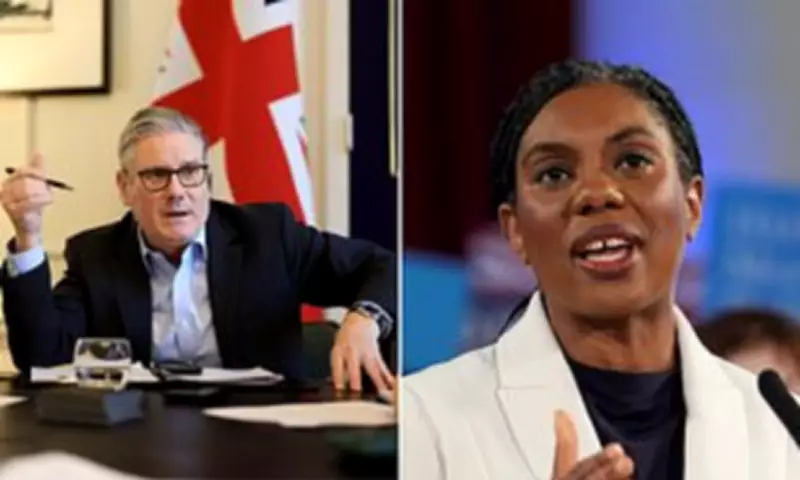
Prime Minister Keir Starmer has authorised the United States to employ British military bases for strikes against Iranian targets obstructing the vital Strait of Hormuz, a decision that Conservative leader Kemi Badenoch has labelled "the mother of all U-turns." This move significantly deepens the United Kingdom's involvement in the regional conflict, coming just hours after former US President Donald Trump lambasted NATO allies as "cowards" for their reluctance to assist in safeguarding the crucial shipping lane.
Expansion of Military Cooperation
Downing Street confirmed that RAF Fairford in Gloucestershire and the Diego Garcia base in the Indian Ocean can now be utilised by American forces for operations aimed at reopening the Strait of Hormuz. Previously, the UK government had only permitted the use of these installations for defensive actions against Iranian missile sites that posed a direct threat to British lives or interests. The Ministry of Defence also announced that the Royal Air Force is conducting defensive air patrols over Jordan, Qatar, the United Arab Emirates, and Bahrain to protect Middle Eastern allies.
Political Backlash and Accusations
Tory leader Kemi Badenoch sharply criticised Sir Keir's announcement, describing it as a dramatic reversal of policy. Shadow Defence Secretary James Cartlidge echoed this sentiment, stating, "After weeks of dither and finger-pointing, the Prime Minister has again changed his mind and performed another screeching U-turn." Members of Parliament expressed concerns that the Prime Minister is drawing the UK further into the war without allowing Parliament to have a say in the matter.

Former Labour leader Jeremy Corbyn condemned the decision, calling it "a reckless act of escalation that endangers us all. No discussion. No debate. What a disgrace. How on earth can the Prime Minister still pretend we are not involved?"
Strategic Implications and Intelligence Assessments
According to a US intelligence assessment reported by CNN, Iran possesses the capability to keep the Strait of Hormuz closed for up to six months. The new agreement enables the US to use UK bases for "defensive operations to degrade the missile sites and capabilities being used to attack ships in the Strait of Hormuz." A spokesperson for Number 10 explained, "Ministers agreed that Iran's reckless strikes, including on Red Ensign vessels and those of our close allies and Gulf partners, risked pushing the region further into crisis and worsening the economic impact being felt in the UK and around the world."
Downing Street emphasised that Britain will not be directly involved in the strikes and that "the principles behind the UK's approach to the conflict remain the same."
Trump's Criticism and NATO Dynamics
In a post on Truth Social, Donald Trump branded NATO a "paper tiger" without US support, vowing, "we will REMEMBER" how Western nations "didn't want to join the fight" and refused to assist in reopening the Strait of Hormuz. He added, "Now that fight is Militarily WON, with very little danger for them, they complain about the high oil prices they are forced to pay but don't want to help open the Strait of Hormuz, a simple military manoeuvre that is the single reason for the high oil prices."
Outside the White House, Trump remarked that the UK "should have acted a lot faster" in permitting America to use British bases to strike missile sites targeting the Strait. His comments coincided with NATO's withdrawal of its advisory mission in Iraq, which removed "all its personnel" from the Middle East.
Military Buildup and Potential Escalation
Approximately 2,500 US Marines are scheduled to arrive in the region in the coming days, with two additional units expected to follow. Reports indicate that the Trump administration is considering a high-stakes invasion of Kharg Island to force open the Strait. This tiny territory, twice the size of Heathrow and located 15 miles offshore, is strategically vital as it processes 90 percent of Tehran's crude oil exports.

A US source told Axios, "We need about a month to weaken the Iranians more with strikes, take the island and then get them by the balls and use it for negotiations." However, seizing Kharg Island could provoke Iran to ignite a full-scale war against energy infrastructure across the Gulf, potentially sending crude prices soaring even higher. It also risks angering China, which sources 13 percent of its oil from Iran.
Iranian Defiance and Regional Tensions
Tehran has defiantly insisted that it will continue to deny its enemies security in the Strait and will fight on. The Islamic Revolutionary Guard Corps (IRGC) stated, "The soldiers of Islam are eagerly awaiting the American marines. They are fully prepared to deliver a hard slap to the American warship deep in the theatre of war and to bring maritime surprises up close for the American marines to witness." IRGC spokesman General Ali Mohammad Naeini asserted, "These people expect the war to continue until the enemy is completely exhausted." Hours later, Naeini was reportedly killed in a strike.
Saudi Arabia has hinted at possible retaliation against Iran if the regime continues to strike critical infrastructure across the Gulf. Despite calls to halt attacks on energy facilities, Iranian drones targeted a Kuwaiti oil refinery today. Israeli Prime Minister Benjamin Netanyahu commented that a "ground component" would be necessary to topple the Iranian regime, as "revolutions from the air" were not feasible. The US has not ruled out deploying boots on the ground.
UK Military Planning and Parliamentary Concerns
UK military planners have joined US Central Command to evaluate options for facilitating the passage of tankers through the Strait of Hormuz. Defence sources have stressed that the situation is extremely dangerous, with few nations willing to position warships "in the middle of that threat right now." Shadow Defence Secretary James Cartlidge criticised the Prime Minister's handling of the crisis, noting, "The Prime Minister had the Navy's only active minesweeper taken out of the Gulf a week before the war began. He dithered about sending a warship to help defend our base in Cyprus."
Veteran Labour MP Jon Trickett argued, "It's impossible to reconcile the Government's stated objective to 'de-escalate the war' with the decision to allow US war planes to attack Iran from bases on UK territory." Plaid Cymru's Liz Saville Roberts called for a parliamentary vote on the matter, emphasising the need for democratic oversight.