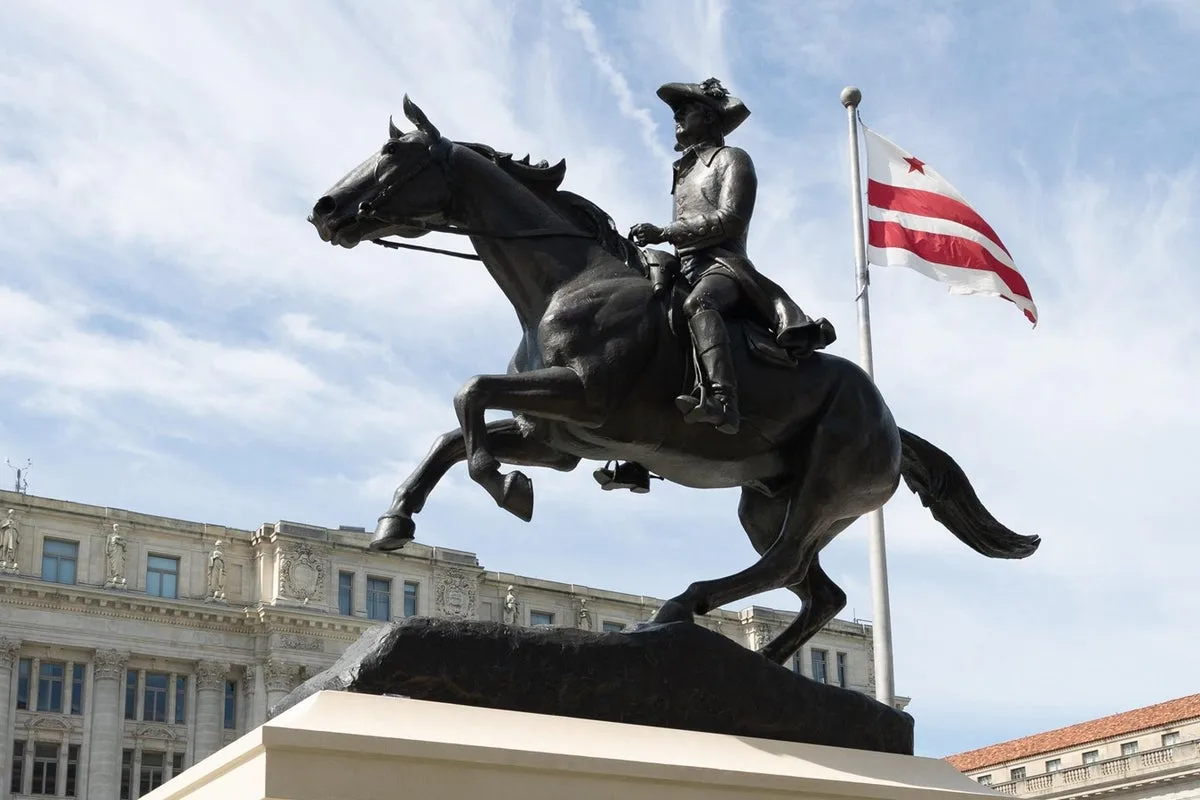
Controversial Slave-Owner Statue to be Reinstated in Washington DC
A bronze statue of Caesar Rodney, a founding father and slave owner, which was removed from public view in Delaware during the 2020 racial justice protests, is set for a high-profile return to the public eye. The Trump administration plans to temporarily install the statue in the heart of the nation's capital as part of the upcoming semiquincentennial celebrations marking America's 250th birthday, according to Interior Department documents reviewed by The New York Times.
Historical Context and Relocation Details
The statue, which depicts Rodney on his famous 1776 midnight ride to cast a tie-breaking vote for independence, has spent the last six years stored in a New Castle warehouse. Its new destination is Freedom Plaza on Pennsylvania Avenue, a federal park named in 1988 to honor Dr. Martin Luther King Jr. The relocation of the Rodney statue is the latest move by the current administration to restore monuments toppled or removed during the racial reckoning that followed the murder of George Floyd. The statue will stand in Washington for up to six months, starting in 2026, as confirmed by Interior Department documents reviewed by The Washington Post.
Administration's Monument Restoration Efforts
The move follows several similar reinstatements by the Trump administration. In August, Defense Secretary Pete Hegseth announced the reinstallation of a Confederate memorial at Arlington National Cemetery that had been removed by a previous congressional mandate. Hegseth claimed that naming military bases after confederates is 'important for morale'. In October, The National Park Service restored a statue of Confederate General Albert Pike to downtown D.C. after it was torn down by protesters in 2020. Additionally, a reconstruction of a Christopher Columbus statue, previously dumped into Baltimore's harbor, is slated for the White House grounds.
"As we approach America's 250th anniversary, the Trump administration has been committed to celebrating and acknowledging the full breadth of our nation's history," an Interior Department spokesperson told The Washington Post. The spokesperson highlighted Rodney's sacrifice, noting that despite suffering from a disfiguring facial cancer, he rode through a storm to secure the colonies' independence.
Rodney's Complex Legacy
Though Rodney was a pivotal revolutionary, historians have said that he also enslaved as many as 200 people on his family's plantation. Some evidence suggests Rodney grappled with the institution of slavery. As speaker of the colonial assembly in 1767, he introduced a bill to prohibit the importation of enslaved people into Delaware, though the measure failed. He also directed in his will that those he enslaved be freed upon his death.
Criticism and Divided Reactions
Critics, however, view the statue's placement in a plaza honoring a civil rights icon as a provocation. Adam Rothman, director of Georgetown University's Center for the Study of Slavery and Its Legacies, told The New York Times that the administration is "manipulating history to advance their own particular ideology."
In Rodney's home state, the reaction remains divided. Republican State Senator Eric Buckson, who initiated talks with the Park Service a year ago, argues that Rodney is the reason the country has a Fourth of July. "The purpose of locating him in D.C. for the country is to tell the story of the ride and the significance of that midnight ride," Buckson told The Washington Post. He expressed hope that the statue would eventually return to Delaware, where his story could be told "holistically," including his role as an enslaver.
Others are less eager for a homecoming. Shané N. Darby, a Wilmington councilwoman, told The New York Times that glorifying Rodney is "a slap in the face" to the city's Black and brown residents. "You can have him, D.C.," she said. The Caesar Rodney monument occupied Wilmington's Rodney Square for 97 years before being taken down in June 2020, and its potential return continues to spark debate over how to commemorate complex historical figures.






