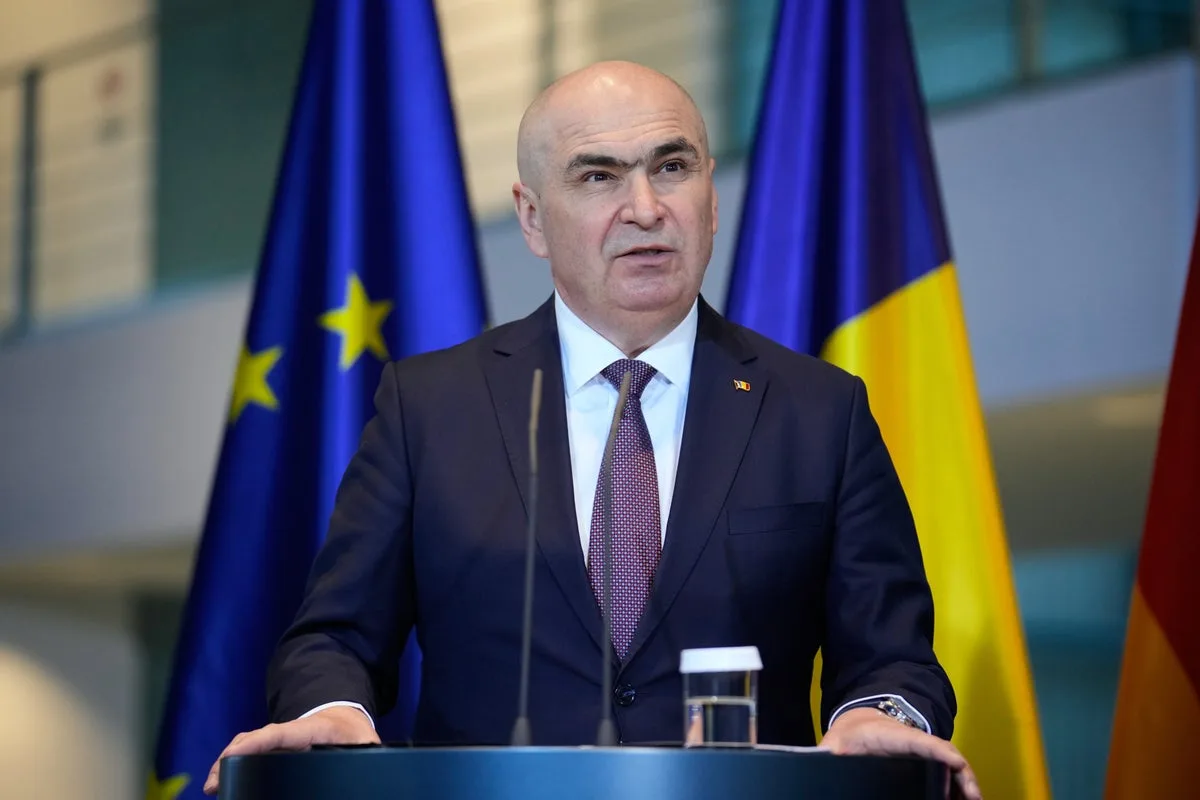
Romania's leftist Social Democratic Party (PSD) and the hard-right Alliance for the Unity of Romanians (AUR) jointly submitted a no-confidence motion on Tuesday, aiming to topple liberal Prime Minister Ilie Bolojan.
The motion was presented to Parliament a day after the two parties announced their collaboration. Bolojan, from the center-right National Liberal Party (PNL), has led a pro-European coalition for less than a year. The PSD, Romania's largest political party, was part of that coalition until last week.
The PSD stated it has secured sufficient support for the motion. AUR leader George Simion told a news conference that the motion has 251 signatures and predicted it will pass "without any problems." The vote is expected in parliament next week.
This development follows the PSD's withdrawal from the coalition, leaving Bolojan without a parliamentary majority and triggering a fresh political crisis. Romania has experienced prolonged instability since a presidential election was annulled in December 2024. The country is grappling with one of the highest budget deficits in the European Union, rampant inflation, and a technical recession.
Sorin Grindeanu, PSD president, stated that despite differences, there is a common goal to vote for the motion and topple the Bolojan government. He clarified that the motion has support beyond political colors, including from the far-right nationalist S.O.S. Romania party and other right-wing groups.
When the coalition was formed in June, it prioritized reducing the budget deficit. However, the PSD has often clashed with Bolojan over austerity measures, including tax hikes, wage and pension freezes, and cuts to public spending and administration jobs.
The PSD claimed Bolojan has "failed to implement any genuine reform" in his 10 months in office and argued that Romania needs a leader "capable of collaboration." The party emphasized that in the current geopolitical context, Romania requires coherent leadership without blockages or political arrogance to ensure good administration and economic recovery.
If Bolojan is ousted, the PSD would be needed to form a pro-European parliamentary majority. The party has previously ruled out entering a government with AUR. Siegfried Muresan, a Romanian MEP from Bolojan's PNL, defended the prime minister's fiscal reforms, stating they align with the coalition agreement. He criticized the PSD for suddenly withdrawing support for reforms they had previously agreed to.
Bucharest-based political analyst Cristian Andrei predicted a "long crisis" after the vote, which he said breaks the pro-European coalition and gives the populist AUR a place at the mainstream table. He described the PSD's move as a power play to reconnect with its former voter base that has shifted toward populist parties. According to Andrei, the PSD aims to regain its status as the party in charge, while AUR gains respectability and demonstrates a strong parliamentary position as the PSD moves toward populism.
The prime ministerial position was scheduled to rotate from Bolojan to a PSD premier in 2027 under a power-sharing agreement. A general election is set for 2028.






