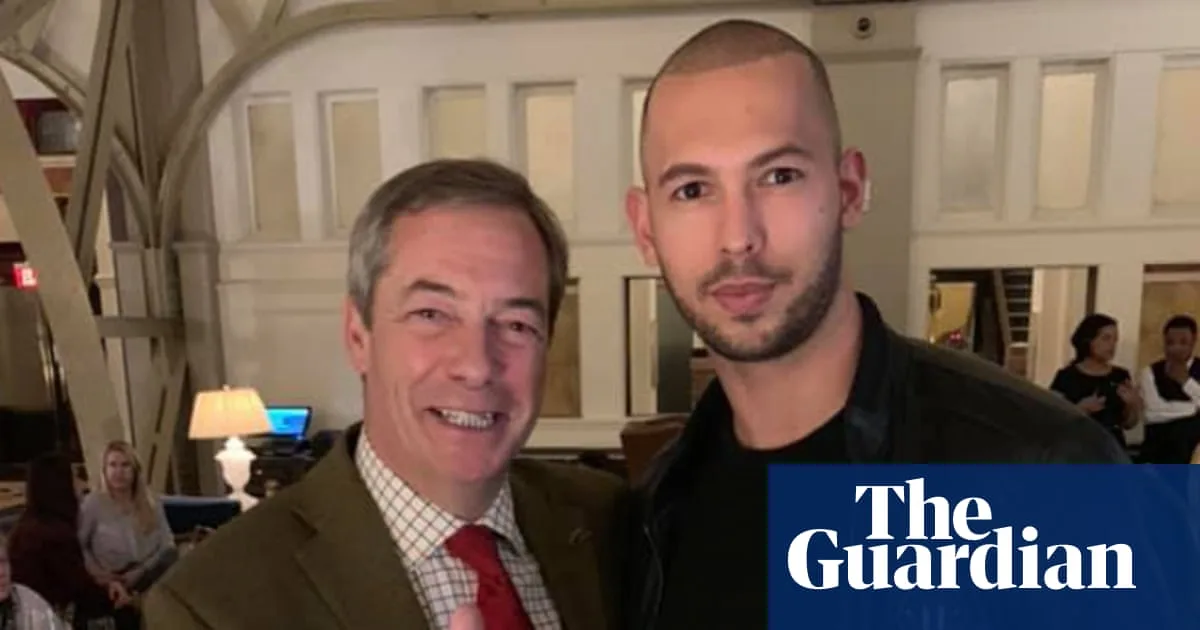
Reform UK Insiders Fear Andrew Tate Links Could Alienate Voters
Reform UK Insiders Fear Andrew Tate Links Alienate Voters

Reform UK Insiders Fear Andrew Tate Links Could Alienate Voters

Insiders within Reform UK are growing increasingly concerned that the party's associations with extreme online figures, such as Andrew Tate, could scare off mainstream voters. As the party prepares for a potential role in government, there is a concerted effort to distance itself from controversial personalities whose views are seen as too toxic for the broader electorate.

Farage's Reluctance to Criticise Tate

Nigel Farage, the leader of Reform UK, has previously described Andrew Tate as an "important voice" for young men, particularly those feeling "emasculated," and suggested he gives boys "perhaps a bit of confidence at school." However, Farage has held back from criticising Tate's misogynistic views, which have drawn widespread public revulsion. Tate is facing 21 charges, including human trafficking, should he return to the UK, and his conduct has been highlighted in media such as Louis Theroux's Netflix documentary Inside the Manosphere.

One Reform insider revealed, "Yes, I have advised Nigel and others to be more careful about who we associate with – if we are to win over a broader section of British society, we cannot be linked to unpopular characters or people who have made unsavoury comments about women." Another senior source emphasised, "He is nothing to do with Reform. We can’t help it if people that we don’t particularly want around us endorse us. There have been a few cases of that."

Wide Pickt banner — collaborative shopping lists app for Telegram, phone mockup with grocery list

Tommy Robinson and Voter Perceptions

Reform UK has also struggled to shake its association with Stephen Yaxley-Lennon, better known as Tommy Robinson, a right-wing agitator and convicted criminal. Although the party has stated he is not welcome as a member, Robinson recently endorsed Reform's candidate Matthew Goodwin for the Gorton and Denton byelection. Goodwin did not disavow Robinson, but a Reform UK spokesperson reiterated, "We have consistently been clear on this issue. He isn’t welcome in the party."

Polling data from Luke Tryl of More in Common supports the concern that these associations could deter new voters. Tryl's research shows a significant gap in approval ratings for figures like Robinson and Tate between hardcore 2024 Reform voters and newer supporters. For instance, Tommy Robinson has an approval rating of +15 among 2024 Reform voters, but this drops to -11 among new voters and -15 among women. Andrew Tate's approval rating is -34 among 2024 Reform voters, worsening to -46 among new voters and -51 among women.

Tryl explained, "The risk then to Reform is their association with online right figures alienates the wavering female voter who ultimately will decide whether Reform gets into government. The sort of voter who is tempted to roll the dice as the status quo feels so miserable, but is also worried Reform may be too extreme."

Other Controversial Figures and Celebrity Support

Beyond Tate and Robinson, Reform UK has attracted support from other controversial figures. Lady Victoria Hervey, a socialite, has been seen at Reform events, including a Veterans for Reform gathering where Suella Braverman defected from the Conservatives. Hervey, who has made controversial comments about Jeffrey Epstein's victims, was recently photographed with Farage at Donald Trump's Mar-a-Lago resort.

Holly Valance, a former soap actor and pop star, has also been a vocal supporter, making provocative remarks such as referring to climate campaigner Greta Thunberg as a "demonic little gremlin." Valance is an associate of Robinson and attended his Unite the Kingdom march in London. Few mainstream celebrities have backed Reform UK, but former model Caprice Bourret has shown enthusiastic support, including campaigning for Laila Cunningham as the party's candidate for London mayor.

As Reform UK navigates its path to broader electoral success, insiders warn that distancing from extreme figures is crucial to avoid alienating key voter demographics, particularly women and moderate voters seeking change without extremism.

Pickt after-article banner — collaborative shopping lists app with family illustration




