Political Discomfort with Muslim Prayer in Public Spaces
The recent remarks by Nick Timothy, who described Muslim prayer in Trafalgar Square as an "act of domination," have rightly drawn widespread criticism and condemnation. When prominent political figures imply that Muslim worship in public spaces is somehow at odds with national values, they send a damaging and divisive signal: that British Muslims are less entitled to visible participation in public life than other religious groups.
A Pattern of Suspicion and Unequal Treatment
Such claims, often presented as matters of legitimate public concern, echo a familiar and troubling pattern of suspicion directed specifically at Muslims in recent years. The support for these divisive sentiments from senior Conservative politician Kemi Badenoch, alongside toxic rhetoric from Nigel Farage suggesting restrictions on all mass public prayer, marks a particularly concerning political moment. This raises serious and fundamental questions about whether Britain's cherished freedoms of religion, expression, and peaceful assembly are being unevenly and unfairly applied across different faith communities.
With millions of British Muslims celebrating Eid al-Fitr this weekend, the notable absence of inclusive messages and gestures of solidarity from significant parts of the Conservative leadership has not gone unnoticed. When such national moments of community celebration and opportunity to acknowledge our nation's rich religious diversity are missed or ignored, it reinforces a growing perception that the Muslim community's sense of belonging and acceptance remains conditional and precarious.

The True Nature of Muslim Prayer
When Muslims gather to pray, whether in a mosque, a local park, or a major public square like Trafalgar Square, they are not asserting dominance or making political demands. The Adhan, the Islamic call to prayer, is not a declaration of power or conquest; it is simply an invitation to prayer directed at fellow Muslims that compels no one. The Qur'an is explicit on this matter: "There is no compulsion in religion" (2:256). Muslims offer their daily prayers at prescribed times wherever they happen to be. Had they been at home or in a mosque, they would have prayed there instead. Prayer is, at its very core, an act of personal devotion and humility before God, not an act of superiority or political statement.
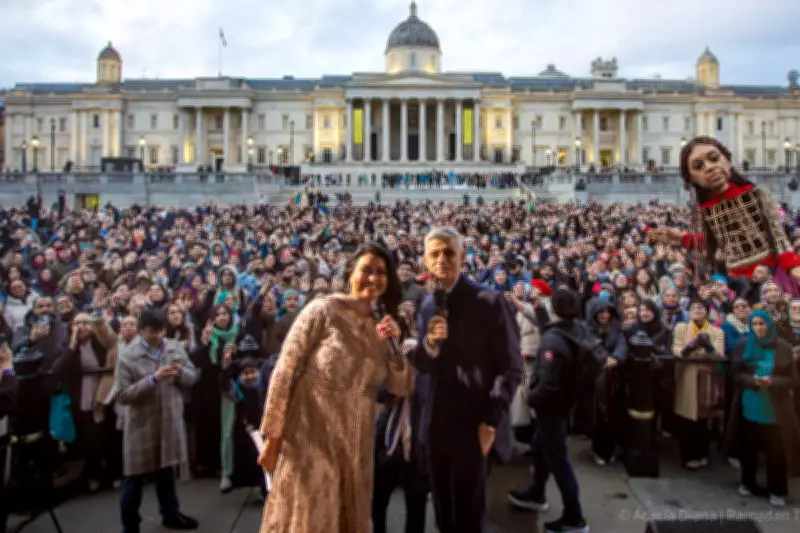
A lawful, well-organised gathering, peacefully marking a significant religious event, attended by people of many different backgrounds, should not be recast or misrepresented as something controversial or threatening. To single out Muslims for exclusion from public spaces would not strengthen social cohesion or effectively tackle extremism; rather, it would dangerously legitimise the notion that Muslims cannot fully and freely practice their faith in their own country.
Misplaced Claims About British Heritage
Equally misplaced and historically inaccurate are claims that visible Muslim prayer somehow undermines Britain's Christian heritage. Many prominent Christian leaders have firmly and publicly rejected this divisive framing, pointing instead to the core values of compassion, tolerance, and neighbourly love within their own tradition. Decades of sustained interfaith engagement and dialogue across Britain have demonstrated that mutual respect between different faiths actually strengthens the moral fabric of society and upholds universal human dignity.
As noted by the Acacia Diana Ramadan Tent Project: 'The strength of British society lies not in uniformity, but in its ability to hold together a diversity of voices, beliefs, and traditions without fear, and without favour.'
Churches, mosques, synagogues, and temples have consistently opened their doors to one another in moments of solidarity, shared prayers, and collective reflection. These gestures of goodwill are not seen as diluting individual belief, but as affirming a deeper, shared commitment to peaceful coexistence. Islam itself speaks directly to this ethic: the Qur'an describes Christians as among those "nearest in affection" to Muslims (5:82), underscoring significant shared moral ground and common humanity.

Trafalgar Square's History of Collective Expression
The profound irony is that Trafalgar Square has long been a celebrated public space for collective expression, both religious and secular. Christians, Jews, Sikhs, and Hindus have all historically marked significant religious moments and festivals there without controversy. Muslim participation in this shared civic life is not exceptional or new; it is part of the same long-standing British tradition of open, democratic expression in public forums.
What, then, makes Muslim prayer uniquely contentious for some politicians and commentators? Not the act of public prayer itself, but the identity of those performing it. This is precisely why such anti-Muslim rhetoric must be robustly challenged; not to silence legitimate debate, but to ensure public discourse remains grounded in facts, fairness, and equal treatment for all citizens.
The Government's Role and Responsibility
A society genuinely committed to social cohesion must recognise when a particular community is being subjected to disproportionate suspicion and demonisation. The Government's recent adoption of a working definition of anti-Muslim hostility is a welcome, if belated, acknowledgement of a real and persistent problem of prejudice and hostility towards Muslims. Although the precise wording may not have been universally accepted, it offers crucial guidance to public institutions on how to identify and tackle alarming levels of anti-Muslim sentiment.
Its practical value, however, will depend entirely on how it is applied in policy and public life. It should encourage necessary reflection among public figures and institutions about the tangible impact of their words and actions. Such a definition does not shield religious ideas from legitimate criticism, nor does it introduce blasphemy laws by stealth, as some critics disingenuously claim. It draws a necessary and important distinction between critique of religious doctrine and the targeting of people simply because of their faith.
Protecting Pluralism for the Future
At this critical juncture, Britain's hard-won pluralism must be actively protected from erosion by divisive rhetoric. When public discourse begins to cast one group's peaceful religious expression as inherently suspect, the damage extends far beyond that single community, undermining trust in society's fundamental fairness. A confident, mature democracy does not fear visible expressions of diverse belief; it accommodates and protects them as a sign of strength.
The enduring strength of British society lies not in enforced uniformity, but in its proven ability to hold together a rich diversity of voices, beliefs, and traditions without fear, and without favouritism. This principle must be defended now more than ever.