Meloni's High-Stakes Referendum on Italian Judiciary Overhaul Divides Nation
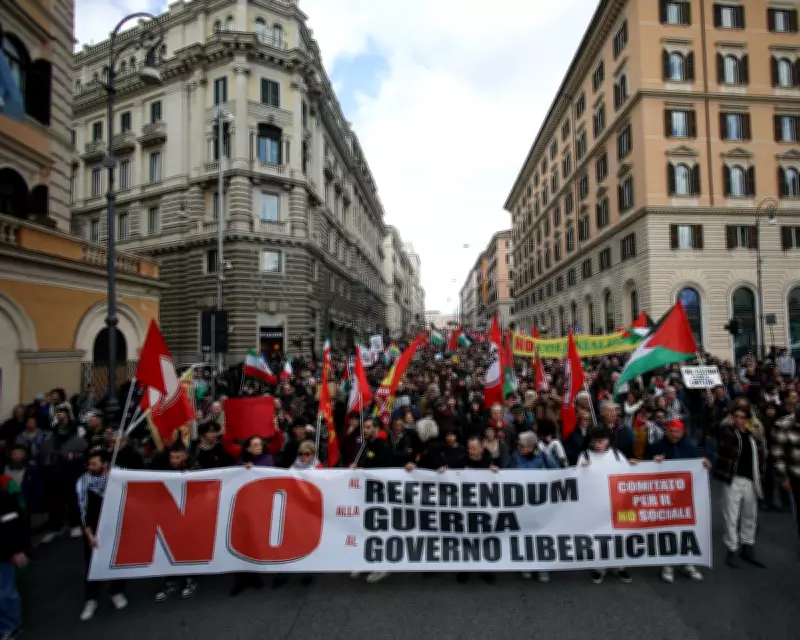
In the days leading up to Italy's national referendum on proposed changes to the organisation of the justice system, supporters of the no campaign took to the streets of Rome, marching in protest against what they see as a government power grab. The referendum, scheduled for Sunday and Monday, has escalated from a technical vote on constitutional amendments into a de facto confidence vote on Prime Minister Giorgia Meloni's government, with opinion polls indicating a tight race.
Inflammatory Campaign Rhetoric Dominates Debate
The campaign has been marked by heated rhetoric rather than substantive discussion. A flyer circulated online by Meloni's Brothers of Italy party, which has neofascist origins, quoted the prime minister targeting judges and feminists, stating, "Judges block the deportations of rapists. Where are the feminists? Vote yes – there will not be another opportunity." Although the flyer was later removed from the party's Facebook page, its confrontational tone has set the stage for a divisive national conversation.
At a demonstration against the proposals, Chiara Antonini, a resident of Rome, expressed outrage, saying, "It is shameful of Meloni to use such threatening language and to intervene on sensitive issues such as the protection of women, especially given the hypocrisy after the government backtracked on a law that would have defined sex without consent as rape. The government just seems to have it in for the judiciary."

Referendum Seen as Political Power Play
After more than three years in power, Meloni leads one of the most stable governments in Italian history and has been enhancing her international reputation. However, she is now risking that hard-earned credibility with this high-stakes referendum. The ballot asks voters to approve amendments to Italy's post-fascism constitution that would fundamentally restructure the justice system, including separating the career paths of judges and prosecutors, establishing two governing councils selected by lottery, and creating a court for disciplinary matters.
Mattia Diletti, a politics professor at Sapienza University in Rome, explained, "It has become a political referendum and is a power issue for her. It is essentially a choice between Giorgia Meloni or the judges." Meloni argues that the changes are necessary to ensure impartiality and eliminate what she describes as leftwing political factions within the judiciary. In contrast, critics warn that the reforms could weaken judicial independence, potentially leading to increased government control similar to Viktor Orbán's Hungary.
Justice Minister's Controversial Comments Fuel Tensions
As the campaign intensified, Meloni escalated her messaging, accusing judges of undermining her policies on crime and irregular immigration. She claimed that rejecting the changes would endanger public safety by allowing more immigrants, rapists, paedophiles, and drug dealers to be freed. Justice Minister Carlo Nordio added to the controversy by referring to the judiciary's supreme council as a "para-mafia system," while his chief of staff, Giusi Bartolozzi, likened the judiciary to a "firing squad" that needed elimination.
Justice has long been a contentious issue in Italy, with the legacy of former Prime Minister Silvio Berlusconi, who faced numerous criminal trials, casting a shadow. Berlusconi's Forza Italia party is part of Meloni's ruling coalition, and his daughter, Marina Berlusconi, remarked, "A win for yes wouldn't just be my father's victory."
Concerns Over Prosecutorial Independence and Future Reforms
Luigi Li Gotti, a criminal lawyer and former justice undersecretary, believes the reforms aim to target public prosecutors, whom Berlusconi once called "the cancer of our democracy." Li Gotti, who faced criticism from Meloni after filing a legal complaint against her, stated, "The government wants to change the constitution to weaken prosecutors and indirectly influence investigations." He dismissed Meloni's claims that the changes would improve efficiency, arguing that the real goal is political control.

Antonella Attardo, a civil judge in Milan, highlighted the lack of public understanding, saying, "The fear is very much about what will come afterwards." She cited proposed law changes that could make police forces more accountable to government ministries, potentially allowing the executive to dictate investigations and silence probes into corruption or powerful figures.
However, not all voices oppose the reforms. Micol Parati, a lawyer from Crema who attended a pro-referendum demonstration in Rome, argued, "Nowhere is it written that the judiciary would become slaves of the executive if the referendum wins."
Potential Electoral Implications and Meloni's Popularity
Meloni remains popular in surveys, an unusual feat for an Italian leader at this stage of their administration. If the referendum succeeds, she plans to prioritise an electoral law that could secure her coalition a comfortable victory in the next general election, due in 2025. Diletti warned, "If she loses, it will be upsetting because it will be much harder for her to prepare for the elections." Li Gotti also expressed concern that a win could embolden Meloni to pursue further controversial constitutional changes, such as introducing a directly elected prime minister.
In a bid to sway younger voters, Meloni recently appeared on an irreverent podcast hosted by a rapper, emphasising, "The vote is not about Meloni, it is about justice." Yet, many remain unconvinced. Matteo Bruno, a master's student in Rome, said, "I'm going home to Catania specifically to vote because this is a constitutional reform that might have important consequences for the future of our democracy."
As Italy heads to the polls, the outcome of this referendum will not only shape the future of its justice system but also determine the political trajectory of Meloni's government in the years to come.