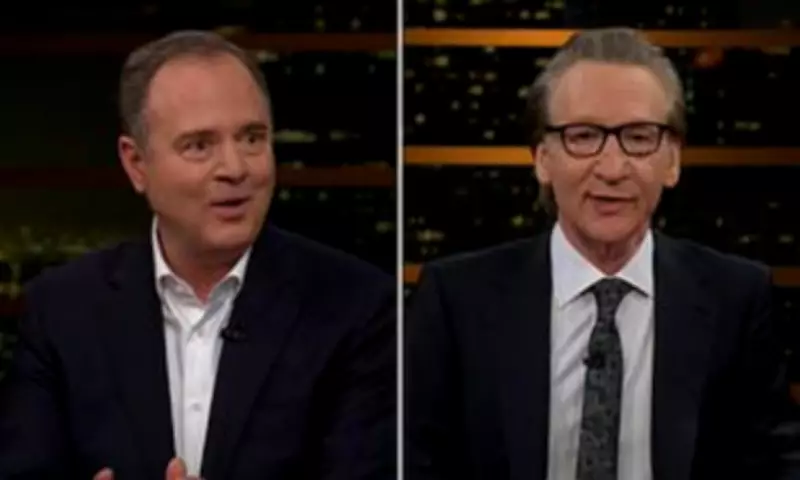
Bill Maher Exposes Adam Schiff's Confusion Over Obama Quote on Military Action
In a televised exchange that left a prominent California Democrat flustered, comedian and host Bill Maher cleverly tricked Representative Adam Schiff by presenting a presidential statement on military operations as originating from the Trump administration, only to reveal it was actually from former President Barack Obama. The incident occurred during a discussion focused on President Donald Trump's controversial decision to authorize strikes against Iran last month without seeking prior congressional approval.
Schiff's Stumbling Response to Maher's Revelation
Maher initiated the segment by reading a quote aloud: "The president had the constitutional authority to direct the use of military force because he could reasonably determine that such use of force was in the national interest." He then directly asked Schiff if this statement was "too vague" for his liking. Without hesitation, Schiff agreed, labeling the declaration as "totally vague" before Maher disclosed its true source—the Obama Administration in 2011, regarding military operations in Libya, not President Trump.
Visibly caught off guard, Schiff attempted to recover by noting that Obama had previously made similar arguments about entering Syria without authorization, a move he opposed. "I and many others pushed back on that argument," Schiff explained. "Ultimately, he did not go forward with going after [former Syrian President] Assad - even though Assad was gassing his own people - because he thought he might lose the vote in Congress." He added that he respected Obama for ultimately not proceeding without congressional support.

Context of Trump's Iran Strikes and Political Reactions
This exchange took place against the backdrop of heightened tensions following Trump's decision to strike Iran alongside Israel on February 28. Schiff has been a vocal critic of this action, publicly condemning it on social media platform X. "There was no imminent threat to justify starting a war with Iran," he wrote. "Instead, Donald Trump chose the path of more chaos - with American lives on the line." Schiff emphasized his commitment to joining colleagues in forcing a vote to curb presidential power abuses.
Surprisingly, Maher expressed support for the strikes, despite his ongoing feud with Trump. "This week, war. Did you hear about that thing? We bombed Iran and it's going on. Now, have you expected me to say I hate it? I don't, sorry," Maher stated. "When he puts boots on the ground, yeah, then I'll hate it." This stance contrasts with widespread criticism from both Democrats and Republicans, who have denounced the airstrikes that resulted in the deaths of Iran's Supreme Leader Ayatollah Ali Khamenei and other senior figures.
Broader Political and Military Implications
House Speaker Mike Johnson has denied that America is at war, describing the military operations as "limited in its scope." Meanwhile, Trump boasted on TruthSocial about Iran's perceived surrender, claiming the country apologized to its neighbors and thanked him. "Iran is no longer the 'Bully of the Middle East,' they are instead, 'THE LOSER OF THE MIDDLE EAST,'" Trump declared, hinting at further aggressive actions.
However, concerns persist over Trump's promise to avoid starting new wars, with fears of a "forever war" emerging. Schiff reiterated this point in an interview with ABC News, stating, "One thing is certainly true though, the president broke his promise to the American people of no more regime change wars. There's nothing in this action that's going to improve the lives of Americans."
Adding to the uncertainty, Trump suggested on Saturday that U.S. ground troops might be deployed to Iran in the future for a "very good reason," though he refused to elaborate. This comment followed White House Press Secretary Karoline Leavitt's denial of reports claiming Trump was seriously considering such a deployment, dismissing them as based on anonymous sources.
The episode underscores ongoing debates over executive power, military authorization, and the political fallout from recent actions in the Middle East, highlighting how historical precedents can resurface in contemporary discussions.