Supreme Court Strikes Down Trump Tariff Program in Landmark Ruling
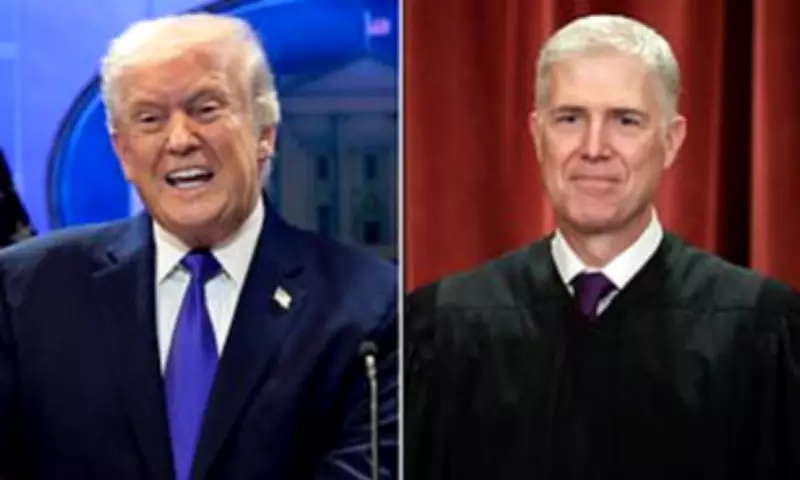
In a stunning rebuke to the president who appointed him, Conservative Supreme Court Justice Neil Gorsuch joined a 6-3 majority to declare Donald Trump's signature tariff program unconstitutional. The ruling delivered a fatal blow to one of Trump's most significant second-term economic policies while containing what appeared to be a direct lecture from Gorsuch to the former president about constitutional processes.
A Rare Conservative-Liberal Alliance
Gorsuch aligned with fellow Trump appointee Amy Coney Barrett, Chief Justice John Roberts, and the court's three liberal justices to form an unusual coalition that transcended traditional ideological divisions. This marked a rare moment of consensus among conservative justices to oppose the president, despite the court's overall rightward lean following Trump's three appointments during his first term.
The decision specifically rejected Trump's use of the International Emergency Economic Powers Act of 1977 as legal justification for imposing widespread tariffs. Chief Justice Roberts, writing for the majority, stated that if Congress had intended to grant the president such "distinct and extraordinary power to impose tariffs, it would have done so expressly - as it consistently has in other tariff statutes."

Gorsuch's Constitutional Lecture
Hidden within the ruling emerged what many interpreted as a direct message from Gorsuch to Trump. The conservative justice began his summation by addressing "those who think it important for the Nation to impose more tariffs," acknowledging that "today's decision will be disappointing" to supporters of the president's policy.
Gorsuch then delivered what legal observers described as a pointed lecture on constitutional governance. "Yes, legislating can be hard and take time. And, yes, it can be tempting to bypass Congress when some pressing problem arises," he wrote. "But the deliberative nature of the legislative process was the whole point of its design."
The justice continued with what appeared to be a direct critique of presidential overreach: "Through that process, the Nation can tap the combined wisdom of the people's elected representatives, not just that of one faction or man." He emphasized that America's system works because it "gives the highest percentage of its citizens a shot at dictating how the country is run."
Trump's Furious Response
The former president responded with characteristic fury, taking to Truth Social to criticize both Gorsuch and Barrett. "What happened today with the two United States Supreme Court Justices that I appointed against great opposition, Neil Gorsuch and Amy Coney Barrett, whether people like it or not, never seems to happen with Democrats," Trump wrote.
He added with bitter humor: "At least I didn't appoint" Chief Justice Roberts, whom he called "the ringleader" of the decision. Trump went further, suggesting the ruling represented "embarrassment to their families" specifically regarding his picks Gorsuch and Barrett.
Market Celebration and Legal Fallout
While Trump fumed, Wall Street celebrated the decision with a significant stock market spike. The ruling placed an estimated $175 billion in tariff revenue in jeopardy, according to the Penn-Wharton Budget Model analysis reported by Reuters.
Justice Brett Kavanaugh, Trump's third Supreme Court appointee, penned the dissent joined by fellow conservative Justices Samuel Alito and Clarence Thomas. Kavanaugh argued that "the Court today concludes that the President checked the wrong statutory box by relying on IEEPA rather than another statute to impose these tariffs."
Immediate Presidential Workaround
Undeterred by the Supreme Court's ruling, Trump moved quickly to implement alternative measures. Within hours of the decision, he announced on Truth Social: "It is my Great Honor to have just signed, from the Oval Office, a Global 10% Tariff on all Countries, which will be effective almost immediately."
The White House clarified that this new tariff would take effect on February 24 at 12:01am EST under Section 122 of the Trade Act of 1974. This obscure provision grants presidents temporary tariff authority for 150 days without congressional approval, marking the first time any president has invoked this particular statute.
Exemptions and Exceptions
The new temporary tariff includes significant exemptions designed to minimize consumer impact. Energy products, natural resources, fertilizers, pharmaceuticals, certain electronics, some vehicles, specific aerospace products, informational materials, and accompanied baggage will not face the 10% duty.
Food products including beef and tomatoes received exemptions, while Canada and Mexico were largely excluded due to the United States-Mexico-Canada Agreement. The countries will still face tariffs on steel, aluminum, and non-USMCA compliant goods. Certain textiles and apparel from countries covered by the Dominican Republic-Central America Free Trade Agreement also received exemptions.
Long-Term Constitutional Implications
The Supreme Court's decision establishes significant precedent regarding presidential authority in trade matters. While the ruling gave the administration avenues to seek congressional authorization for tariffs, it did not address how to handle potential tariff refunds, leaving that battle for lower courts.
Trump retains a Republican majority in both the House and Senate ahead of midterm elections, but would likely need to negotiate with Senate Democrats to pass any comprehensive tariff legislation. The ruling represents a major setback for Trump's economic agenda while reinforcing constitutional separation of powers principles that Gorsuch so pointedly emphasized in his concurring opinion.