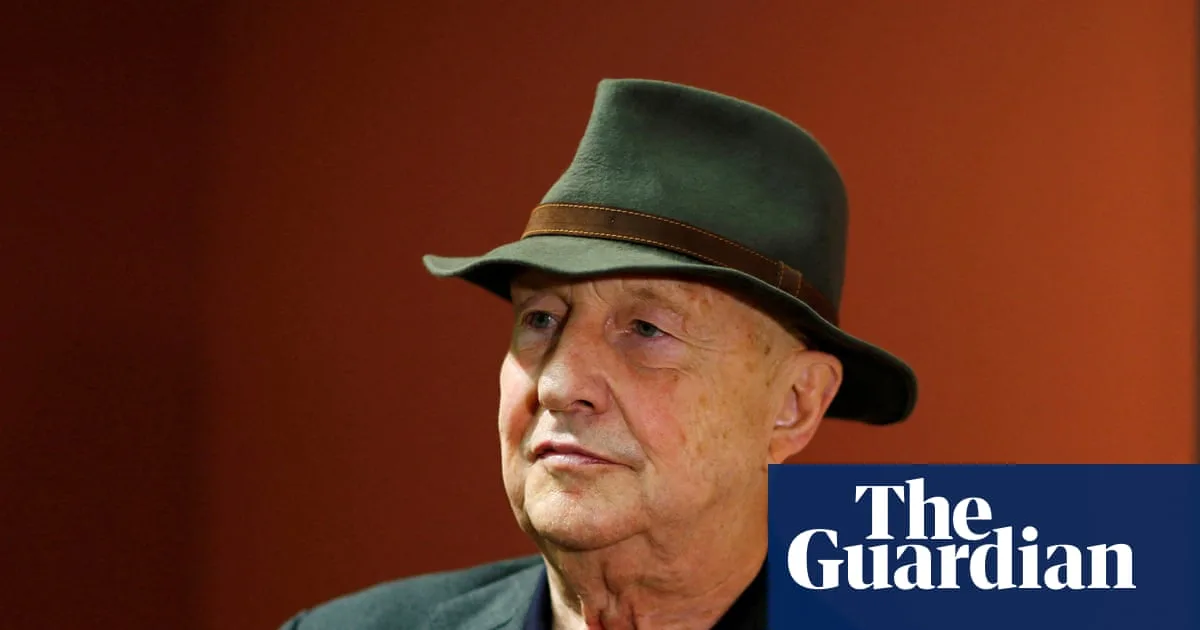
Georg Baselitz, the German painter and sculptor renowned for his provocative, inverted canvases and raw depictions of the human form, has died at the age of 88. The artist, who famously insisted he had 'no talent' and did not know how to paint, forged a career that positioned him as one of the defining figures of postwar German art. His death was confirmed by the Thaddaeus Ropac art gallery, which had represented Baselitz for over two decades, stating he died peacefully. No cause of death was given.
Early Life and Rebellion
Born Hans-Georg Bruno Kern in Deutschbaselitz in 1938, the artist later adopted his village's name. His formative years were marked by the stark realities of Nazi Germany and the subsequent ideological re-education under Soviet communism. Rejected by the Dresden Academy of Fine Arts at 17, he gained entry to an East Berlin academy only to be expelled two semesters later for 'sociopolitical immaturity.' Reflecting on this period, Baselitz recalled: 'I was stupid. I was uneducated, but I was a rebel.' This rebellious spirit, shaped by a 'destroyed order, a destroyed landscape, a destroyed people, a destroyed society,' as he later described it, became the bedrock of his artistic philosophy, compelling him to 'question everything, to be naive, to start again.'
Career and Controversy
Following his expulsion, Baselitz relocated to West Berlin, where he completed his studies and immersed himself in modernism, describing the experience as a 'sudden intake of oxygen.' While initially struck by the works of American abstract expressionists like Jackson Pollock, he consciously turned to German artistic traditions, embracing expressionism and folk imagery often dismissed as 'ugly' or 'degenerate.' His early career was punctuated by scandal; at a 1963 solo exhibition in Berlin, authorities seized two of his paintings, The Big Night Down the Drain and The Naked Man, on grounds of obscenity due to their 'crudely made works' featuring 'erections emerging from abject bodies.' This episode, as The Art Newspaper noted, propelled Baselitz to notoriety.
These early works, characterised by raw bodies and abrasive humour, were widely interpreted as both provocation and a stark commentary on postwar German life. This sensibility evolved into his mid-1960s 'Heroes' series, depicting hulking, battered figures that suggested survivors rather than victors. However, it was in 1969 that Baselitz introduced his most distinctive artistic innovation: painting motifs upside down. Rather than simply flipping finished images, he composed and painted them inverted from the outset. This technique, exemplified by works such as The Wood on Its Head and The Man by the Tree, deliberately disrupted conventional recognition, forcing viewers to engage with the painting's formal elements – its colour, balance, and composition. 'An object painted upside down is suitable for painting because it is unsuitable as an object,' he explained.
International Recognition and Later Years
The inversions cemented Baselitz's international reputation throughout the 1970s and 1980s, transforming him from a scandalous figure into a recognised pillar of European postwar art. Yet, his public persona remained defiantly controversial. He frequently ignited backlash with remarks, notably claiming that women 'don't paint very well.' Furthermore, a wooden sculpture displayed at the 1980 Venice Biennale was widely perceived as evoking a Nazi salute, an interpretation the artist vehemently denied, highlighting the enduring sensitivities surrounding Germany's history.
Baselitz was married to Johanna Elke Kretzschmar, known as Elke, and together they had two sons. In his later years, despite painting from a wheelchair, he continued to produce monumental canvases, moving his brushes and paints with a rolling cart. At 87, he told the Spanish newspaper El Pais: 'The sensible thing, in my situation, would naturally be to say: I stick to small formats. But of course I don't do what's sensible. What's right for me is the nonsensical.' This final statement encapsulates the lifelong defiance and unconventional spirit of an artist who consistently challenged norms, from his earliest rebellion to his last brushstrokes.






